
Your exam form is due next week. The notification says “EWS certificate required,” and you suddenly realise the one you have is from the wrong financial year—or worse, you applied for a plain income certificate thinking it would work. Every year, thousands of General Category candidates lose out on the 10% EWS reservation not because they were ineligible, but because of a format mismatch, an expired certificate, or an affidavit that didn’t match the state’s prescribed proforma. This guide walks you through the current eligibility rules for 2026, the exact documents that hold up during verification, and the state-wise online application process—along with the pitfalls that cause most rejections.
What Is an EWS Certificate and Who Is It For?
The Economically Weaker Section (EWS) certificate is officially called the Income and Asset Certificate. A state revenue officer—usually a Tehsildar or Sub-Divisional Magistrate—issues it after verifying that your family meets both an income test and an asset test set by the Department of Personnel and Training (DoPT). The category was created through the 103rd Constitutional Amendment in 2019 and provides 10% reservation in central government jobs and central educational institutions, excluding minority institutions.
Here is the part that trips up many applicants: EWS is not a caste certificate. It has nothing to do with SC, ST, or OBC status. In fact, if you are already covered under SC, ST, or OBC reservation, you cannot apply under EWS—even if your family income is low. The category exists exclusively for General Category citizens who fall below the prescribed economic thresholds.
It also differs from a plain income certificate. An income certificate only states what your household earns. The EWS certificate tests both income and assets, and confirms that you are outside the SC, ST, and OBC central lists. Submitting an income certificate in place of an EWS certificate is one of the most common reasons applications get rejected at the verification stage.
Discover More About:👇
Address Proof Documents List for Aadhaar: What Documents Are Accepted?
Aadhaar Status Check – How to Check Enrolment & Update Status Online
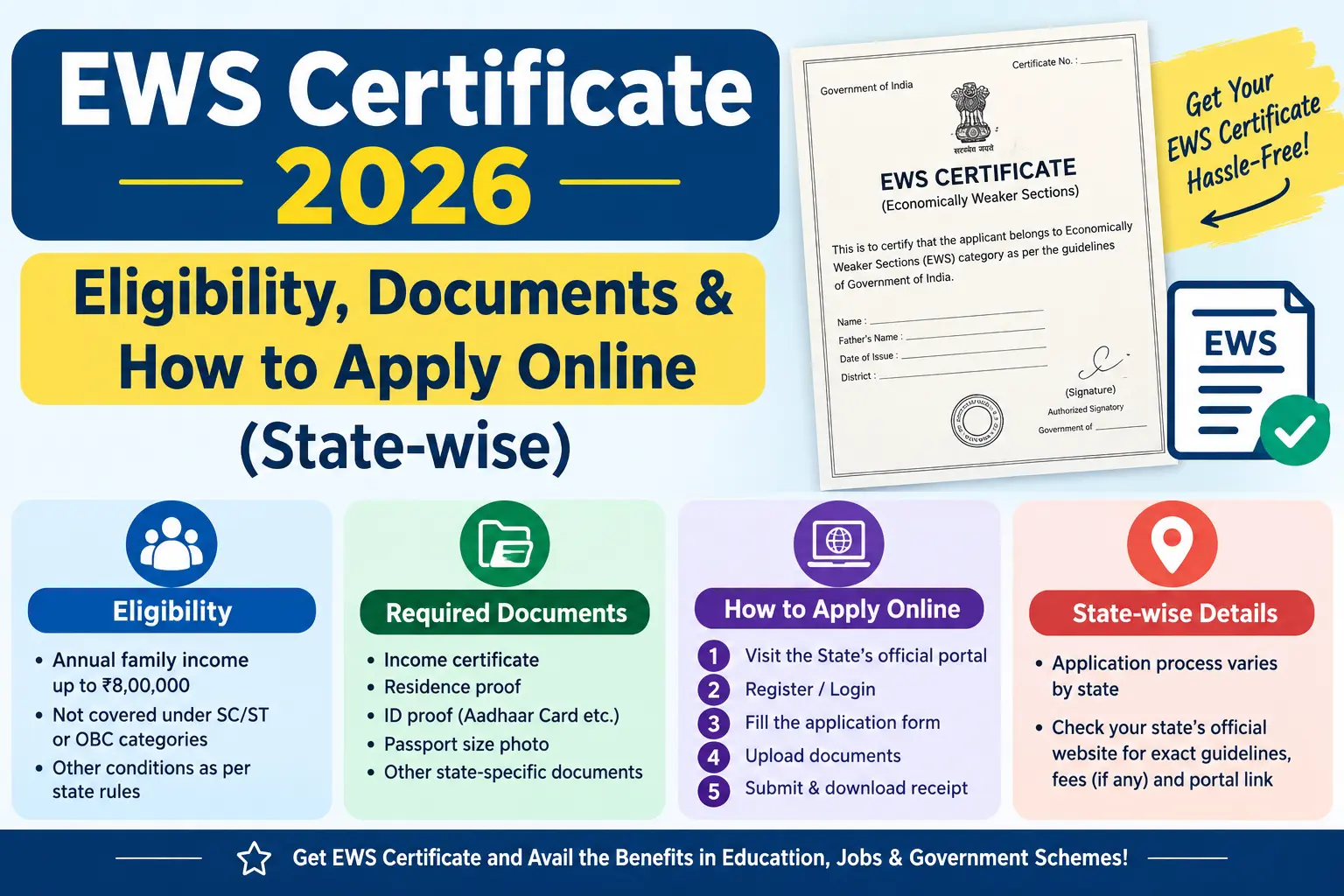
EWS Certificate 2026: Eligibility Criteria
To qualify, your family must pass two independent tests: an income test and an asset test. Failing either one disqualifies you.
Income test. The central government’s EWS income ceiling is ₹8 lakh per annum for the family. Your family’s gross annual income—from salary, agriculture, business, profession, rent, and all other sources—must fall below this limit for the financial year immediately preceding the year of application. If you are applying in 2026–27, the relevant income year is typically 2025–26. Some states set lower income limits for their own state-level EWS schemes, so check your state revenue department’s current notification if you are applying for a state benefit.
Asset test. Even if your income is below ₹8 lakh, you will be disqualified if your family owns any of the following:
- Agricultural land of 5 acres or more
- A residential flat of 1,000 square feet or more
- A residential plot of 100 square yards or more in a notified municipality
- A residential plot of 200 square yards or more in areas outside notified municipalities
Property held by the family in different locations is clubbed together. One important nuance: the “family” definition here is strictly limited to the applicant, their parents, siblings below 18 years, spouse, and children below 18 years. Including relatives outside this list—grandparents, married siblings, or adult children—can invalidate your application.
Documents Required for EWS Certificate
Having these ready before you open the portal saves multiple rounds of correction:
- Aadhaar card of the applicant and family members (identity and address verification)
- PAN card or Voter ID as additional identity proof
- Income proof — salary slips, latest income tax return, or Form 16. For self-employed or agricultural income, a declaration or certificate from a chartered accountant or village-level authority is commonly required.
- Land or property documents — Khasra/Khatauni or equivalent for agricultural land; registered sale deed or property tax receipt for residential property
- Self-declaration affidavit — a notarised affidavit confirming family income below ₹8 lakh and that asset limits are not exceeded. Some states provide a printed format for download from the portal; using that exact format avoids rejection.
- Recent passport-sized photograph
- Community certificate confirming you belong to the General (Unreserved) category
Some states also ask for bank statements covering the last 6–12 months, a Patwari report for rural applicants, or a disability certificate if you are claiming PwD reservation alongside EWS. Scanned PDFs for online applications commonly need to be under 1 MB each—portals often time out or reject uploads if files are larger. Keep originals and self-attested copies ready for physical verification, which some districts still conduct.
How to Apply for EWS Certificate Online: State-wise Process
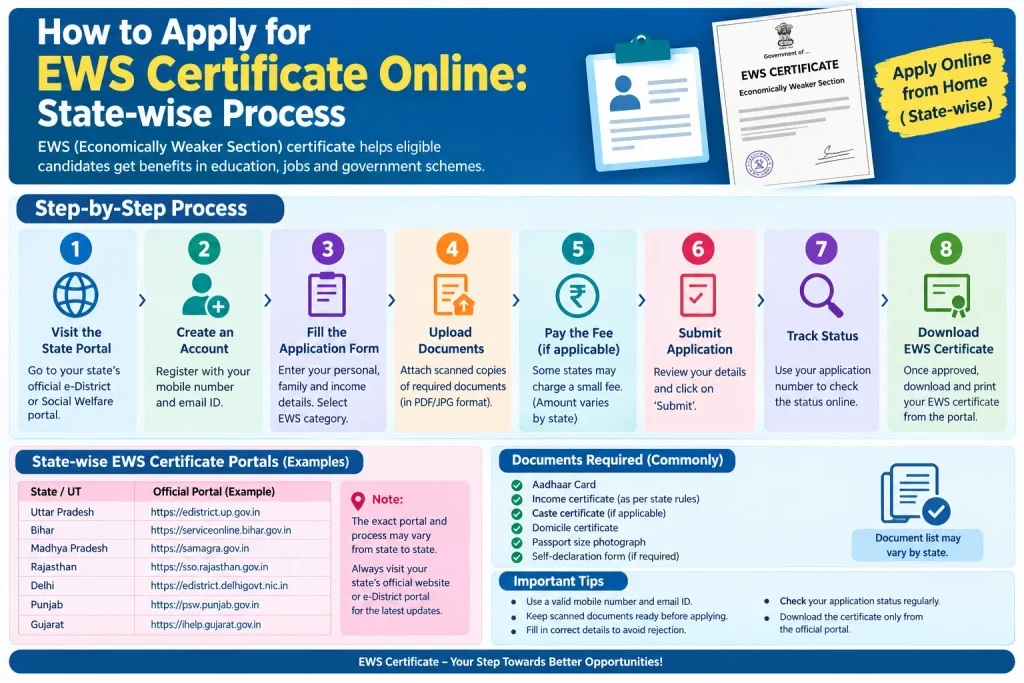
There is no single national portal for EWS certificates. Each state runs its own e-District, revenue, or citizen services portal. The service is usually listed as “Income and Asset Certificate for EWS” or a similar name. Below is the process for major states, along with the pitfall most applicants run into on each portal.
Uttar Pradesh
Apply through the e-District portal (edistrict.up.gov.in) or the e-Sathi portal (esathi.up.gov.in). Register with your mobile number, log in, fill the application form, upload documents, and submit. The application goes to the Lekhpal and Tehsildar for verification before the certificate is issued online. Common pitfall: if your name in the Aadhaar and the land records doesn’t match exactly—including spelling variations—the Lekhpal report can come back negative. Cross-check spellings before submitting.
Bihar
Bihar uses the RTPS portal (serviceonline.bihar.gov.in) . Register with your mobile number, verify via OTP, then select “Issuance of Income & Asset Certificate for Economically Weaker Section” and choose the appropriate RO level. Fill in personal details, upload documents, and submit.
Common pitfall: the RTPS portal allows you to apply for multiple certificates simultaneously, but each application needs separate document uploads. Reusing the same scanned file across applications sometimes causes upload errors—re-upload fresh copies for each.
Maharashtra
Applications go through the Aaple Sarkar portal (aaplesarkar.mahaonline.gov.in) . You can apply online or visit a Common Service Centre (CSC) or MahaOnline centre. The application is processed by the revenue department. Common pitfall: Maharashtra’s portal often asks for a self-declaration in a specific format. Downloading the format from the portal and filling it exactly as shown avoids back-and-forth with the verification officer.
Karnataka
Karnataka uses the Nadakacheri portal (nadakacheri.karnataka.gov.in) or Seva Sindhu (sevasindhu.karnataka.gov.in) . Click “Apply Online,” select “Economically Weaker Section,” enter personal and income details, upload supporting documents, and submit. The certificate is issued by the Tahsildar. Common pitfall: the portal may redirect you to a CSC for biometric verification in some districts. If your application status shows “pending at CSC,” visit the nearest centre with your original documents rather than waiting online.
Tamil Nadu
Apply through the e-District portal (tnedistrict.tn.gov.in) . New users register and log in, then navigate to “Revenue Department” and select “EWS Certificate.” Fill in family income details and upload documents in PDF or JPEG format. The certificate is issued by the Tahsildar.
Common pitfall: Tamil Nadu’s portal sometimes logs you out if the form is idle for too long. Keep all documents scanned and ready before you start filling the form, so you can complete it in one sitting.
West Bengal
Applications are accepted through the Backward Classes Welfare Department portal (castcertificatewb.gov.in/application_ews) . The application is completed online, and the digitally signed certificate is issued after verification. Offline applicants can visit their block or sub-division office. Common pitfall: the portal’s server can be slow during peak admission season (June–August). Applying early in the morning or on a weekday often works better than trying during evening hours.
Other States
Most other states follow a similar pattern. Start at your state’s e-District portal or the National ServicePlus portal (serviceonline.gov.in) and search for “EWS certificate” along with your state name. If you are unsure about the current process or fee, visiting your local Tehsildar or SDM office is the most reliable way to confirm details for your specific case. Do not rely on older blog posts or forwarded WhatsApp messages—formats and portals change, and what worked in 2023 may not work in 2026.
Common Mistakes to Avoid
Most EWS rejections trace back to four avoidable errors.
Confusing income certificate with EWS certificate. An income certificate does not run the asset tests and does not certify that you are outside SC, ST, and OBC categories. For central government recruitment and admission, the DoPT-prescribed format (often called Annexure-I) is mandatory. A state-issued certificate in a different format may not be accepted.
Using the wrong financial year. Your income must be calculated for the year immediately preceding the application year. A certificate issued in January or February for the current financial year may not cover the crucial date specified in an exam notification. Courts have clarified that the certificate must correspond to the financial year preceding the crucial date—so timing your application matters.
Misdefining “family.” The definition is narrow: applicant, parents, siblings below 18, spouse, and children below 18. Including anyone outside this list inflates your family income on paper and can push you over the ₹8 lakh limit.
Ignoring validity. EWS certificates are generally valid for the financial year in which they are issued, though some states allow longer validity or renewal. If you are applying for a job or admission, check the notification’s requirement—some demand a certificate issued after a specific date.
Frequently Asked Questions (FAQs)
Q1: Who can get an EWS certificate in 2026?
General Category citizens whose family gross annual income is below ₹8 lakh and who do not own assets exceeding the specified limits (5 acres of agricultural land, 1,000 sq ft residential flat, etc.) can apply. Individuals covered under SC, ST, or OBC reservation are not eligible.
Q2: Is an EWS certificate the same as an income certificate?
No. An income certificate only states what your household earns. The EWS certificate is an Income and Asset Certificate that also tests asset ownership and confirms you are not covered by SC, ST, or OBC reservation.
Q3: Can I apply for an EWS certificate if I already have an OBC non-creamy layer certificate?
No. The EWS category is for persons not covered under SC, ST, or OBC reservation. If you are on the Central List for OBC, you are not in EWS for Government of India posts, even if your income is low.
Q4: How long does it take to get an EWS certificate?
Processing times vary by state and can range from a few days to several weeks depending on verification workload. Check your state portal for the current expected timeline. Do not rely on unofficial estimates, as processing capacity changes with season and staffing.
Q5: Is there an age limit for applying for an EWS certificate?
There is generally no age limit for the applicant. The focus is on family income and assets, not the applicant’s age.
Q6: What should I do if my EWS certificate is rejected?
Check the rejection reason on the portal first—it is usually listed against your application. Common fixes include correcting name mismatches, re-uploading a clearer affidavit, or reapplying with the correct financial year’s income proof. If the reason is unclear, visit your Tehsildar or SDM office with your application number and original documents.
Before you apply, verify the current income limits, fees, and document requirements on your state’s official portal or by contacting your local revenue office. Rules and thresholds change, and the information here is a general guide, not a substitute for the official notification.
One last practical note: apply at least two to three months before your exam or admission deadline. Verification can stall if the Lekhpal or revenue officer is unavailable, and a pending application is no help when the form submission window closes. If your certificate is rejected despite meeting all criteria, do not reapply blindly—get the rejection reason in writing from the portal or the issuing office, fix that specific issue, and resubmit. That approach saves more time than starting from scratch.

2 Comments
Pingback: Non Creamy Layer Certificate 2026
Pingback: Category Certificate Means: Documents & Apply Online