
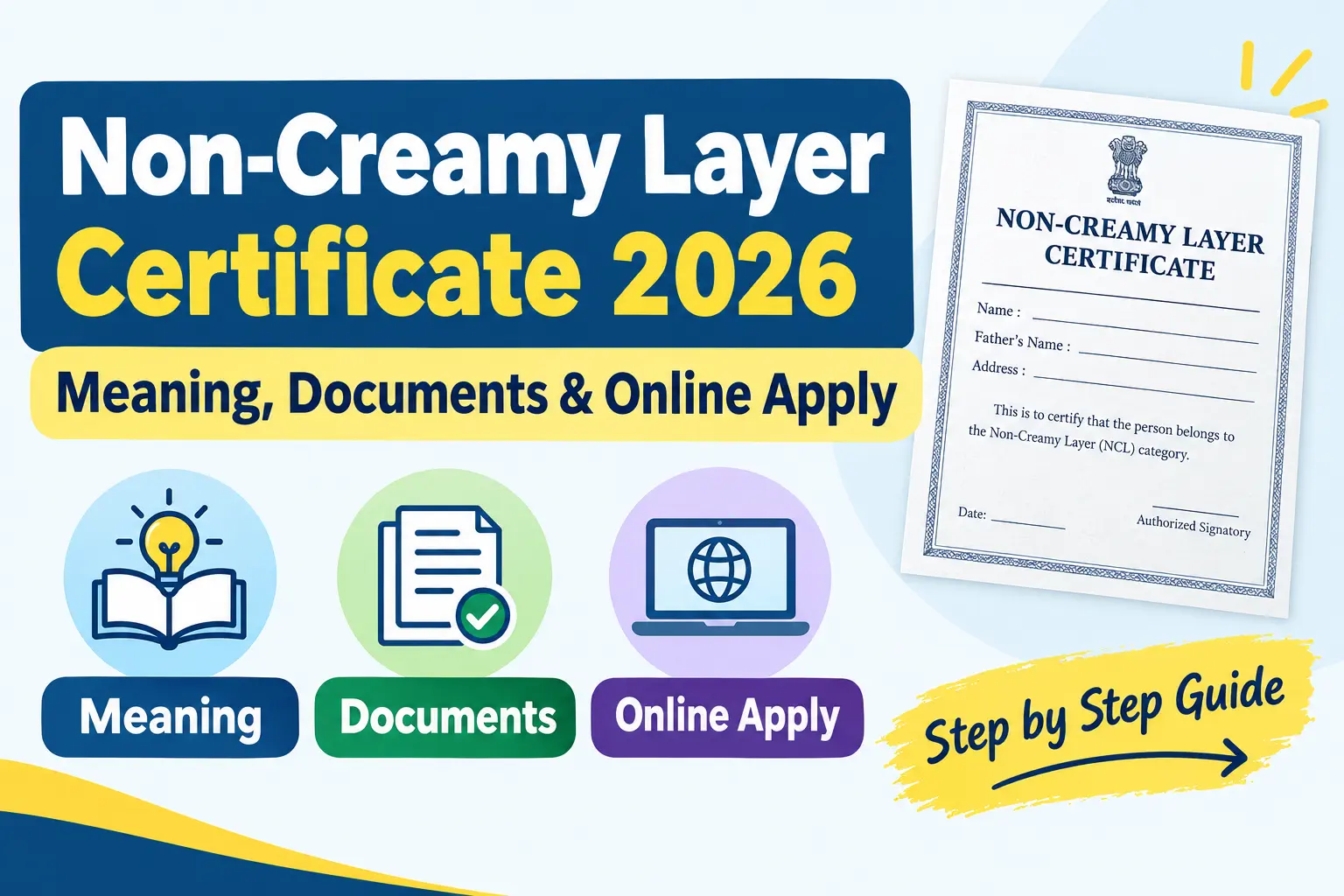
Your OBC caste certificate is ready. Your marks are competitive. Then the application window opens—and you discover that for central government jobs, UPSC exams, or an IIT/IIM seat, the caste certificate alone won’t do. What you actually need is a Non-Creamy Layer Certificate, and without it, your application gets treated as general category. Every year, thousands of OBC candidates lose out on reservation benefits simply because they didn’t know the difference, or because their NCL certificate had expired.
This guide covers what a non creamy layer certificate is, who qualifies for it, the documents you’ll need, and how to apply online—along with the small mistakes that cause big rejections.
Discover More About:👇
EWS Certificate 2026: Eligibility, Documents & How to Apply Online (State-wise)
What Is a Non-Creamy Layer Certificate?
The Government of India splits the OBC category into two groups. The creamy layer includes families that are economically and socially advanced enough to compete without reservation support. The non-creamy layer includes those who still need it. A Non-Creamy Layer (NCL) certificate is the document that proves your family falls in the second group.
In plain terms, it says: you are OBC, but your parents’ income and occupational status are below the threshold that would disqualify you from reservation benefits.
Readers searching for non creamy layer certificate meaning in marathi often find it explained as “नॉन क्रीमी लेयर प्रमाणपत्र हे सिद्ध करते की अर्जदार ओबीसी प्रवर्गात असून त्यांचे कुटुंब ‘क्रीमी लेयर’ मध्ये येत नाही.” The non creamy layer meaning in marathi carries the same idea—a certificate confirming your family is not part of the advanced or wealthier section of the OBC community.
This certificate is typically required for central government jobs (UPSC, SSC, and similar recruitments), admissions to central institutions like IITs, IIMs, NITs, and central universities, central scholarships, and central welfare schemes with OBC reservation components.
Who Needs a Non-Creamy Layer Certificate?
You need an NCL certificate if you are an OBC candidate claiming reservation benefits under the central government. That covers:
- Central government job applications through UPSC, SSC, or other central recruitment bodies
- Admission to central educational institutions—IITs, IIMs, NITs, central universities
- Central government scholarships and fellowships
- Central welfare schemes that include OBC reservation
A plain OBC caste certificate does not automatically entitle you to any of these. Without the NCL certificate, your application is usually treated as general category for central purposes.
Eligibility Criteria: Income and Parental Status
Two factors decide eligibility: your family income and your parents’ occupational status.
Income Limit
For central government purposes, the family income limit for the non-creamy layer is generally ₹8 lakh per annum. If your parents’ combined annual income from non-agricultural sources is below this limit, you are typically eligible. At ₹8 lakh or above, you fall into the creamy layer.
Two rules apply to how income is calculated:
- Parental income only. The calculation is based on your parents’ income, not your own salary or business income.
- Agricultural income excluded. Income from agricultural land or farming is not counted toward the ₹8 lakh limit.
Parental Government Service Position
Even with family income below ₹8 lakh, your parents’ job position can affect eligibility. Children of Group A officers (IAS, IPS, and other high-ranking central or state government officers) are generally placed in the creamy layer. Children of Group B officers may be conditionally eligible depending on promotion details. Children of Group C and Group D employees are typically eligible for the non-creamy layer.
Documents Required for Non-Creamy Layer Certificate
The exact list varies by state. The following are commonly required. If you are looking for non creamy layer certificate documents in marathi, the list usually includes जात प्रमाणपत्र, उत्पन्न प्रमाणपत्र, रहिवासी पुरावा, and आधार कार्ड.
| Document | Details |
|---|---|
| Caste certificate | OBC caste certificate issued by a competent authority |
| Income certificate | For the last financial year, typically from the Tehsildar |
| Identity proof | Aadhaar card, Voter ID, or PAN card |
| Address proof | Ration card, electricity bill, or residence certificate |
| Age proof | Birth certificate or school leaving certificate |
| Photographs | Passport-size photographs |
| Self-declaration | Affidavit or self-declaration in some states |
Some states also ask for parents’ salary slips or IT returns, plus a self-declaration of income. Check your state’s e-district portal or local revenue office for the exact list applicable to you.
How to Apply for Non-Creamy Layer Certificate Online
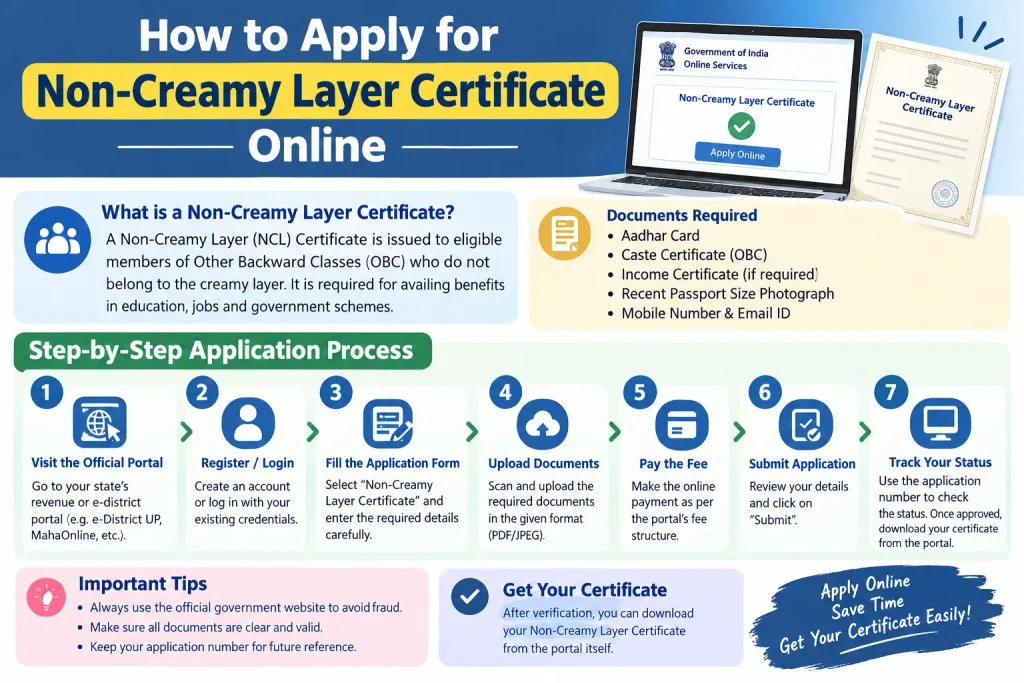
The process is state-specific, but most states follow a similar sequence through their e-district or revenue department portals. Here is the step-by-step process, along with the pitfalls that trip people up.
1. Check eligibility first. Confirm your caste is in the OBC list and your parents’ income is below the prescribed limit. Ensure your parents don’t hold disqualifying positions. Skipping this step means you may pay the fee and wait weeks only to be rejected.
2. Collect the required documents. Gather your caste certificate, income certificate, identity proof, address proof, photographs, and any state-specific documents. Scan them clearly—blurry uploads are a common reason for rejection.
3. Visit the official state portal. Most states have a dedicated e-district portal or services portal (Maharashtra’s Aaple Sarkar, Bihar’s RTPS, Kerala’s e-district, and so on). Register or log in.
4. Select the service. Choose “Non-Creamy Layer Certificate” or “OBC NCL Certificate” from the list of available certificates.
5. Fill the application form. Enter your personal details, parents’ occupation and income, caste details, and the purpose. Upload scanned documents. Watch for name mismatches—your name on the application should match your caste certificate and Aadhaar exactly, or the application may be returned.
6. Submit and save your reference number. Review the form and submit it. Save the application number or reference ID. Without it, tracking becomes difficult.
7. Track your application. Check status on the same portal using your application number. If the office needs clarification, they may contact you. Portal timeouts during peak hours are common—if the site logs you out mid-form, your data may not save. Keep your documents ready before you start filling.
8. Collect the certificate. Once approved, download the digitally signed certificate from the portal or collect a physical copy from the designated office, depending on your state.
If online application isn’t practical, visit your local Tehsildar or SDM office and submit a physical application with the required documents.
Validity and Processing Time
NCL certificate validity varies by state. In many states, it is valid for one year from the date of issue and may need renewal for each academic year or job application. Some states allow longer validity, and central guidelines have been revised from time to time. Check your state’s current rules rather than assuming.
Processing time also varies. Some states issue the certificate within days; others take weeks depending on workload. For a specific timeline, check the state portal or contact the local revenue office.
Common Mistakes to Avoid
- Assuming the OBC caste certificate is enough. For central benefits, the NCL certificate is usually mandatory.
- Including your own income. The calculation is based on your parents’ income, not yours.
- Forgetting to exclude agricultural income. This can incorrectly push you into the creamy layer.
- Submitting an expired certificate. Many institutions require the NCL certificate to be issued within a certain period, often the current financial year.
- Using the wrong format. Some central institutions require the certificate in a specific format, such as the one prescribed by the Department of Personnel and Training (DoPT). Check the institution’s requirements before applying.
FAQs
Q: What is the income limit for the Non-Creamy Layer Certificate?
A: For central government purposes, the family income limit is generally ₹8 lakh per annum from non-agricultural sources. Agricultural income is excluded. Verify the current limit on the concerned department portal, as limits can be revised.
Q: Is the Non-Creamy Layer Certificate valid for how many days?
A: In many states, it is valid for one year. Validity rules differ, and some states issue certificates valid for longer. Check your state’s current rules.
Q: Can I apply for an NCL certificate online?
A: Yes, most states offer online application through their e-district or revenue department portals. The process involves registration, form filling, document upload, and submission.
Q: What is the difference between creamy layer and non-creamy layer?
A: The creamy layer refers to the relatively wealthier and socially advanced section of the OBC community, which is not eligible for reservation benefits. The non-creamy layer refers to the economically weaker section that is eligible.
Q: Does my own salary count for NCL eligibility?
A: No. The income calculation is based on your parents’ income, not your own earnings.
Q: Is the NCL certificate required for state government jobs?
A: State government jobs may have their own reservation rules and certificate requirements. The NCL certificate is primarily required for central government jobs, central educational institutions, and central schemes. Check the specific requirements of the state or institution.
If any detail is unclear, verify current rules, fees, and timelines on the relevant state revenue department portal. For Aadhaar-related queries—since Aadhaar is commonly used as identity proof in these applications—you can check the official UIDAI website (uidai.gov.in) or call the UIDAI toll-free helpline. For certificate-specific questions, your local Tehsildar office or the state e-district portal is the right place to ask.
One last thing worth remembering: if your NCL certificate is about to expire and you have an active application, don’t wait for the deadline. Apply for renewal at least a few weeks in advance—processing delays are common during admission and recruitment season, and an expired certificate at the wrong moment can cost you an entire opportunity.
