

You have probably seen the boards outside small shops—”Bank Mitra” or “CSP Point”—and wondered how those operators actually got started. Or maybe you are a CSC VLE who has been trying to activate banking services for months, stuck somewhere between document upload and physical verification, unsure what happens next. The csc bank mitra route is one of the few genuine self-employment options that lets you earn from banking transactions without setting up a full branch. But the information scattered across portals, YouTube videos, and agent WhatsApp groups is often outdated, exaggerated, or outright misleading. This guide walks through what a Bank Mitra actually does, who qualifies, how the CSC Cloud onboarding works step by step, what commission rates look like in practice, and where to log in once you are approved.
Discover More About:👇
Aadhaar Seva Kendra Near Me: How to Find Your Nearest Aadhaar Enrollment/Update Centre
Aadhaar Correction/Enrollment Form: Download, Fill & Submit Guide
What a Bank Mitra Actually Does (And Why Banks Need Them)
A Bank Mitra is a local agent—technically a Business Correspondent (BC) or Customer Service Point (CSP) operator—authorised to deliver basic banking services on behalf of a bank. The CSC (Common Service Centre) network, which already runs government service delivery through Village Level Entrepreneurs (VLEs), provides one of the main channels for this.
In practice, a Bank Mitra sits in a shop or small office with a micro-ATM, a biometric fingerprint scanner, and an internet connection. Customers walk in to withdraw cash using Aadhaar-enabled payment system (AEPS), deposit money, check balances, open accounts, transfer funds, or enrol for welfare scheme payments. Banks use this model because opening a full branch in every village is not financially viable. For the operator, it is a business—transaction volume directly determines income.
Eligibility: Who Can Apply
Requirements shift depending on the bank and its corporate BC partner, but the baseline is consistent. You need to be an Indian citizen, at least 18 years old, with a minimum of 10th pass education—12th pass is commonly preferred, and some banks in urban areas ask for graduates. Computer literacy is non-negotiable; you will be operating a tablet or micro-ATM daily.
Most banks require IIBF (Indian Institute of Banking and Finance) certification, either before appointment or within six months of joining. Police verification is standard. If you already hold a valid CSC ID as a VLE, you have a head start because the CSC network has a structured banking activation channel. Without a CSC ID, you can still approach a bank’s BC department directly, though the process is less streamlined.
Documents You Will Need
Gather these before starting the application. The exact list varies by bank, but most ask for:
- Aadhaar card (mandatory for identity and e-KYC)
- PAN card
- Proof of address for the proposed centre—electricity bill, rent agreement, or shop ownership document
- Passport-size photographs
- Bank account details (passbook or cancelled cheque)
- Highest educational qualification certificate
- Police verification certificate (often during activation)
- CSC ID, if you are already a registered VLE
If the premises are rented, some banks also ask for an NOC from the property owner. Confirm the final list with your CSC district manager or the bank’s BC coordinator—missing one document can delay verification by weeks.
Step-by-Step Registration on the CSC Banking Portal
The onboarding happens through the CSC banking portal, commonly at bconboarding.csccloud.in or through the Digital Seva dashboard. Here is how it typically flows.
Step 1: Open the CSC banking onboarding portal and select the VLE registration option.
Step 2: Log in with your CSC ID and password. No CSC ID yet? Complete VLE registration on csc.gov.in first. The genuine CSC route does not charge heavy fees—if a third-party website demands ₹10,000 or more for “guaranteed approval”, walk away.
Step 3: Choose “New User” and proceed. Some of your CSC details will auto-populate.
Step 4: Fill in personal details—name, gender, marital status, contact information.
Step 5: Enter your proposed BC centre details: state, district, sub-district, village, pincode, and approximate latitude/longitude.
Step 6: Provide the nearest bank branch details, including IFSC code.
Step 7: Upload scanned documents—ID proof, address proof, educational certificate, PAN card.
Step 8: Enter hardware details: computer type, internet connection, network provider, fingerprint device.
Step 9: Review everything carefully and submit. You will receive an 11-digit registration number—save it.
Common pitfalls: The portal sometimes times out during document upload if your connection is slow; keep files under the size limit and use a stable connection. Also, if your CSC ID password is not working, use the “forgot password” option on the CSC portal rather than creating a new ID—duplicate IDs cause verification failures.
After submission, a district manager or bank representative visits your centre for physical verification. Once the bank partner approves, you receive your BC ID and login credentials.
Commission Structure: What You Actually Earn
There is no single national rate card. Commission is transaction-based and varies by bank and BC partner. Broadly, here is what the ranges look like:
- AEPS cash deposit/withdrawal: roughly 0.25%–0.40% of transaction value
- Account opening: approximately ₹15–₹100 per account
- Money transfer (NEFT/IMPS/DMT): about 0.20%–0.50%
- Bill payments and recharges: around 1%–2%
- Insurance and loan products: 5%–15% of premium, or 0.5%–2% of loan amount
Some banks offer a fixed monthly support amount during initial months, but this is not universal. Your real income depends on footfall and transaction volume. For exact rates, refer to your bank agreement—these figures shift with policy changes.
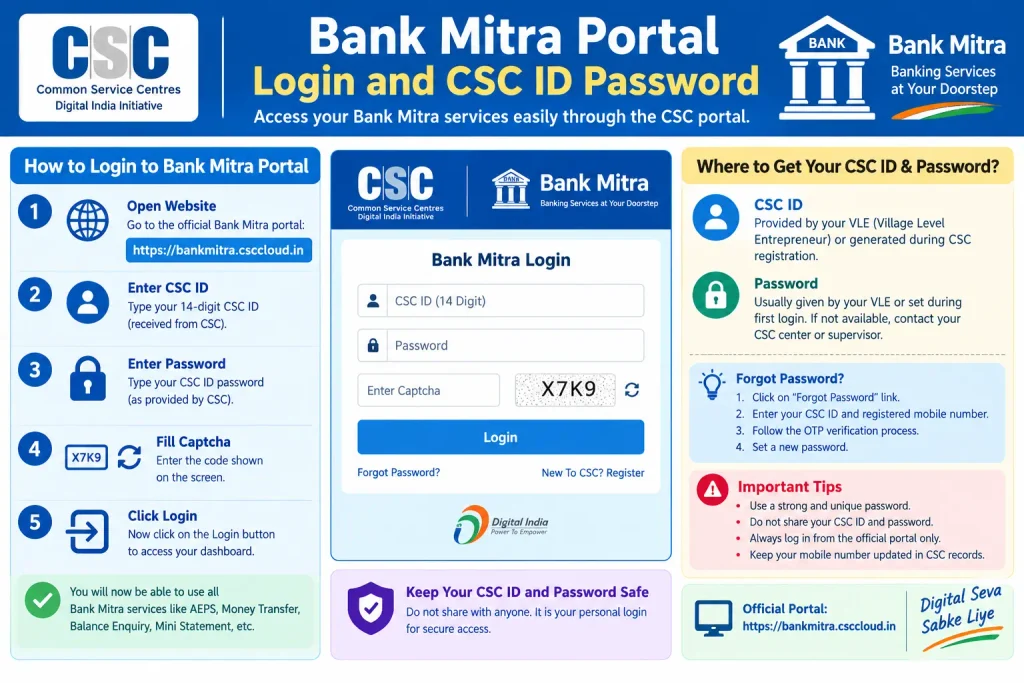
Bank Mitra Portal Login and CSC ID Password
Once approved, your login is through the CSC banking portal—typically bankingmitra.csccloud.in or a similar CSC Cloud domain—using your CSC ID and password. If you forget the password, the reset link goes to your registered mobile number. The Digital Seva portal (digitalseva.csc.gov.in) and CSC Connect (apna.csc.gov.in) are the standard entry points for VLEs.
For AEPS transactions, you use UIDAI-compliant authentication devices. The UIDAI portal (uidai.gov.in) and mAadhaar app are official resources for Aadhaar queries, but daily Bank Mitra operations run through the CSC banking portal and your bank’s BC system.
Common Mistakes to Avoid
Paying large upfront fees to unofficial agents promising guaranteed CSP approval is the biggest trap. The genuine CSC and bank BC routes involve minimal or no registration fees. Any demand for ₹5,000–₹25,000 should be treated as a red flag.
Mismatched documents are the second most common problem. The name and address on your Aadhaar, PAN, and CSC registration must match. Blurry scans or expired address proofs get rejected quickly.
Do not assume that having a CSC ID automatically activates banking services. You still need to apply for the BC channel, complete verification, and obtain a BC ID. And remember: at the customer interface point, a Bank Mitra represents only one bank—even if the BC entity behind the scenes works with multiple banks.
Frequently Asked Questions
Can I become a Bank Mitra without a CSC ID?
Yes, by approaching a bank’s official BC channel directly. But having a CSC ID simplifies onboarding because the CSC network has a structured banking activation system. Many applicants register as VLEs first.
Is there any fee for CSC Bank Mitra registration?
The genuine CSC route generally involves minimal or no registration fees. Some banks charge for training or IIBF certification. Verify all fees through official CSC or bank channels—not through agents.
What is the minimum educational qualification?
Most banks ask for at least 10th pass, with 12th pass preferred. Urban locations may ask for graduates. Computer literacy matters regardless of formal qualification.
How long does approval take?
It varies by bank, document verification, and physical inspection. Some applicants hear back within weeks; others wait longer. Check with your CSC district manager or bank BC coordinator for a realistic timeline in your area.
Can I operate as a Bank Mitra for more than one bank?
At the customer-facing outlet, you typically represent one bank. The BC entity behind the scenes may work with multiple banks, but visible services at your centre are for a single bank.
What is IIBF certification, and is it mandatory?
The Indian Institute of Banking and Finance certification is a banking qualification many banks require for BC agents. Some banks allow you to join first and complete it within six months. Confirm with your bank partner.
Closing Thoughts
The Bank Mitra model works best for people who already have a shop, an internet connection, and patience for paperwork. If you are approved, do not expect heavy earnings in the first two or three months—transaction volume builds slowly as villagers discover your centre and trust it. Keep your AEPS device firmware updated, reconcile your daily cash position carefully, and maintain a clean transaction record. If your application gets stuck at verification for more than a month, follow up directly with the CSC district manager rather than waiting on portal status updates.
