
You’ve seen the plaque. A stretch of village road, a school boundary wall, a community borewell—and on it, the name of your local MP. You’ve also probably heard the number: ₹5 crore per MP, per year. But where does that money actually sit? Who signs the cheques? And why does a project recommended two years ago still look untouched?
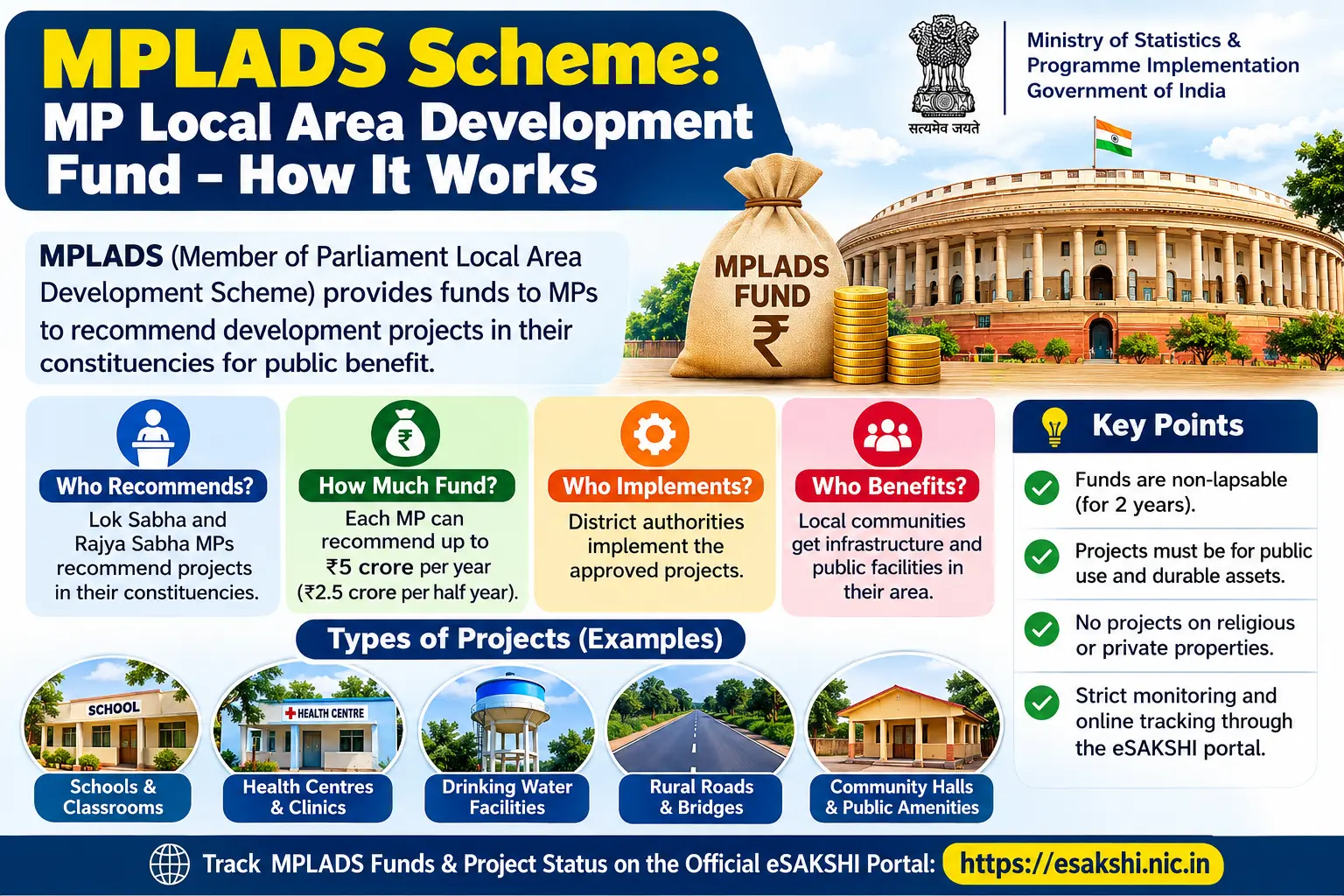
The answer usually comes down to one misunderstanding: that the MP controls the money. Under the MPLADS scheme—the Members of Parliament Local Area Development Scheme—the MP recommends, but the district administration sanctions and spends. This article walks through how that pipeline works, from recommendation to completion, and how you can track it yourself.
What Is the MPLADS Scheme?
MPLADS is a Central Sector Scheme, fully funded by the Union government and administered by the Ministry of Statistics and Programme Implementation (MoSPI). It began on 23 December 1993 with an annual entitlement of ₹5 lakh per MP. That figure was raised to ₹1 crore, then ₹2 crore, and has stood at ₹5 crore per MP since 2011-12. Every MP gets the same amount—rural or urban, large constituency or small.
The scheme’s purpose is to let MPs recommend developmental works based on locally felt needs, with an emphasis on durable community assets: drinking water, education, public health, sanitation, roads.
Here’s the part that trips people up. The MP does not receive, hold, or spend MPLADS funds. Not a rupee passes through their hands. The money moves from the central government to the District Authority, which sanctions the work, picks an implementing agency, and gets it built. The MP proposes; the district administration disposes. Think of the MP as holding a gift voucher, not a wallet—they can point at what they want built, but a government official redeems the voucher, checks the rules, and does the buying.
Discover More About:👇
Check Your Aadhaar Update Status with an Official Guide
How MPLADS Funds Are Allocated, Released, and Recommended
Each MP is entitled to ₹5 crore a year. Until April 2023, this arrived in two equal instalments of ₹2.5 crore to the District Authority of the MP’s nodal district. From 1 April 2023, with the launch of the eSAKSHI portal, the full ₹5 crore is authorised in a single instalment at the start of each financial year or at the beginning of the MP’s term.
These funds are non-lapsable. Money not spent in one financial year does not expire; it carries forward. The idea is to prevent wasteful year-end spending. In practice, it has also allowed large unspent balances to pile up in district accounts—something government auditors have flagged more than once.
Two equity earmarks are built into the scheme. Every MP is expected to recommend works costing at least 15% of the annual entitlement for areas inhabited by Scheduled Caste populations, and 7.5% for areas inhabited by Scheduled Tribe populations.
Who can recommend where depends on the type of MP:
- Lok Sabha Members can recommend works within their own parliamentary constituency.
- Elected Rajya Sabha Members can recommend works within the state from which they were elected, with certain exceptions.
- Nominated Members of both Houses can recommend works anywhere in the country.
There is one major exception to these geographic limits. MPs can contribute MPLADS funds outside their constituency or state for rehabilitation works after a natural calamity of rare severity, subject to prescribed limits. Under revised guidelines, the cap for spending outside the parliamentary constituency was raised from ₹25 lakh to ₹50 lakh.
Step-by-Step: How a Work Moves from Recommendation to Completion
Step 1: The MP recommends a work. The MP identifies a locally felt need and recommends it to the District Authority of their nodal district. The recommendation is made on the MP’s letterhead, duly signed—and since April 2023, digitally through eSAKSHI, where the MP earmarks funds from the annual entitlement.
Pitfall to watch: an unsigned or improperly formatted recommendation gets returned, not processed. The clock doesn’t start until the District Authority receives a valid proposal.
Step 2: The District Authority examines the proposal. The District Authority runs feasibility checks. If the work is eligible under the scheme guidelines, it sanctions the work. Eligible recommendations should generally be sanctioned within 75 days of receipt. If a work is rejected, the MP is informed within 45 days, with reasons.
Pitfall to watch: most rejections happen here, and the usual cause is ineligibility—the proposed work simply isn’t on the permissible list. A rejected proposal doesn’t silently disappear; it comes back with a reason.
Step 3: An implementing agency is designated. The District Authority identifies an agency capable of executing the work qualitatively, on time, and satisfactorily. This could be a government department, a local body, or another designated agency.
Step 4: The work is executed. The implementing agency carries out the work. Under the guidelines, sanctioned works are generally required to be completed within one year from the date of sanction.
Pitfall to watch: this is where timelines slip most often. A work sanctioned in March may sit through monsoon, then through a tender cycle, and cross the one-year mark before anyone notices.
Step 5: Payments are released and the work is marked complete. Implementing agencies raise vendor payment requests on eSAKSHI at various stages of execution, against sanction orders issued by the District Authority. After the final payment is released, the agency marks the work as “complete” on the portal.
Step 6: The asset is put to public use. For every work executed under MPLADS, a plaque—stone or metal—must be permanently erected. It carries the inscription “Member of Parliament Local Area Development Scheme Work” and records the cost, commencement and completion dates, and the name of the MP who recommended it.
Pitfall to watch: a missing plaque is one of the easiest compliance failures to spot. If a completed asset has no plaque, the paperwork may not match what’s on the ground.
The eSAKSHI Portal: How to Track MPLADS Funds Yourself
Before 1 April 2023, MPLADS ran in physical mode. District Authorities maintained records of recommended and sanctioned works, and expenditure moved through physical bank accounts at the district level.
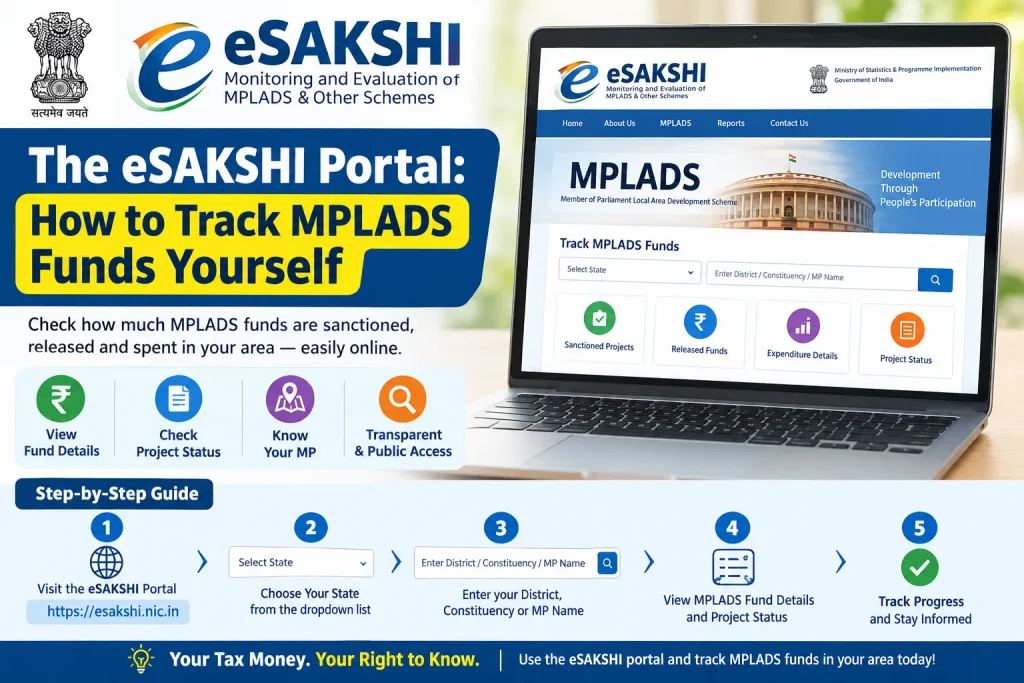
Since April 2023, the scheme runs on a fully digital end-to-end platform called eSAKSHI (www.mplads.mospi.gov.in), with a mobile app as well. The portal issues dedicated login credentials to every stakeholder—MPs, MoSPI as the Central Nodal Agency, State Nodal Authorities, District Authorities, and Implementing Agencies.
For citizens, the public dashboard is the useful part. It shows works recommended, works sanctioned, works completed, and expenditure on both completed and ongoing works, with drill-down tabs for detail. Data updates in real time from stakeholder inputs, and implementing agencies upload photographs of assets at different stages along with relevant documents.
The practical effect: you no longer need to file an RTI to find out what your MP recommended. You can look it up.
What Kinds of Works Are Permitted Under MPLADS?
MPLADS funds go toward a wide range of developmental works, with an emphasis on durable assets. Permissible works generally include:
- Drinking water facilities
- Education-related infrastructure (school buildings, boundary walls)
- Public health facilities
- Sanitation and drainage works
- Roads and pathways
- Community centres and public halls
- Sports facilities
The scheme also permits expenditure on certain specified non-durable items, as listed in the guidelines. MPLADS funds can be converged with individual or stand-alone projects of other Central and State schemes, provided the works are eligible under MPLADS. Local body funds can similarly be pooled with MPLADS works.
There are ceilings on certain categories. For works meant for a trust or society, the limit is ₹50 lakh over that organisation’s lifetime. For repair and renovation of immovable assets, an MP can recommend up to ₹50 lakh per year.
Common Mistakes and Misconceptions About MPLADS
Misconception 1: The MP receives ₹5 crore in cash or personal funds. The most persistent one. The MP does not receive, hold, or spend the money. The funds go from the central government to the District Authority. The MP’s role is recommendation only.
Misconception 2: The MP can spend the money on anything. No. There is a defined list of permissible works, and the District Authority verifies eligibility before sanctioning.
Misconception 3: MPLADS funds can be used in any area. The geographic rules are specific: Lok Sabha MPs within their constituency, Rajya Sabha MPs within their state of election, with calamity relief as the main exception.
Misconception 4: There’s no way to track MPLADS spending. True before April 2023; no longer true. The eSAKSHI public dashboard lets anyone see works recommended, sanctioned, and completed, along with expenditure figures.
Frequently Asked Questions About MPLADS
Q1: Can an ordinary citizen suggest a work under the MPLADS scheme?
Yes. The eSAKSHI portal has a functionality for citizens to suggest work. The formal recommendation still has to come from the MP, so you can also approach your MP’s office directly with a suggestion.
Q2: What happens to MPLADS funds that are not spent in a year?
They carry forward. MPLADS funds are non-lapsable—unspent money does not expire at the end of the financial year.
Q3: Can MPLADS funds be used for works outside the MP’s constituency?
Generally, no. The main exception is rehabilitation works after a natural calamity of rare severity, where MPs can contribute outside their constituency or state within prescribed limits. The cap for spending outside the constituency was raised from ₹25 lakh to ₹50 lakh under revised guidelines.
Q4: Who sanctions MPLADS works—the MP or the District Authority?
The District Authority. The MP only recommends. The District Authority runs feasibility checks, sanctions eligible works, and designates implementing agencies.
Q5: How can I check what MPLADS works have been done in my area?
Visit the eSAKSHI public dashboard at www.mplads.mospi.gov.in. It shows works recommended, sanctioned, and completed, with expenditure details and drill-down tabs.
Q6: Is there a limit on MPLADS funds given to a trust or society?
Yes—₹50 lakh over the lifetime of that trust or society.
The design is sound: the MP recommends, the District Authority sanctions and pays. That separation is what keeps the scheme constitutionally clean and prevents the fund from becoming a personal purse. Where it slips is execution—unspent balances accumulate, sanctioned works cross the one-year mark, plaques go missing. None of these are hidden anymore. They show up on the eSAKSHI dashboard, which means the next time you see a plaque with your MP’s name on it, you can check the portal and see exactly when the work was recommended, sanctioned, completed, and paid for. That’s a more useful civic habit than reading the plaque itself.
