
If you have ever been passed from one office to another—Anganwadi to police station to hospital—while trying to get help as a woman in distress, or applied for a maternity benefit only to watch the payment stall because your bank account wasn’t linked correctly, you have felt the exact gap that Mission Shakti was created to close. This umbrella programme, run by the Ministry of Women and Child Development, bundles India’s key women-focused interventions into two clear verticals—Sambal for safety and Samarthya for empowerment—so that support is easier to find and actually reaches the people who need it. Below is a plain-language guide to what the mission covers, who qualifies, how to apply, and the mistakes that most often delay benefits.
What Exactly Is Mission Shakti?
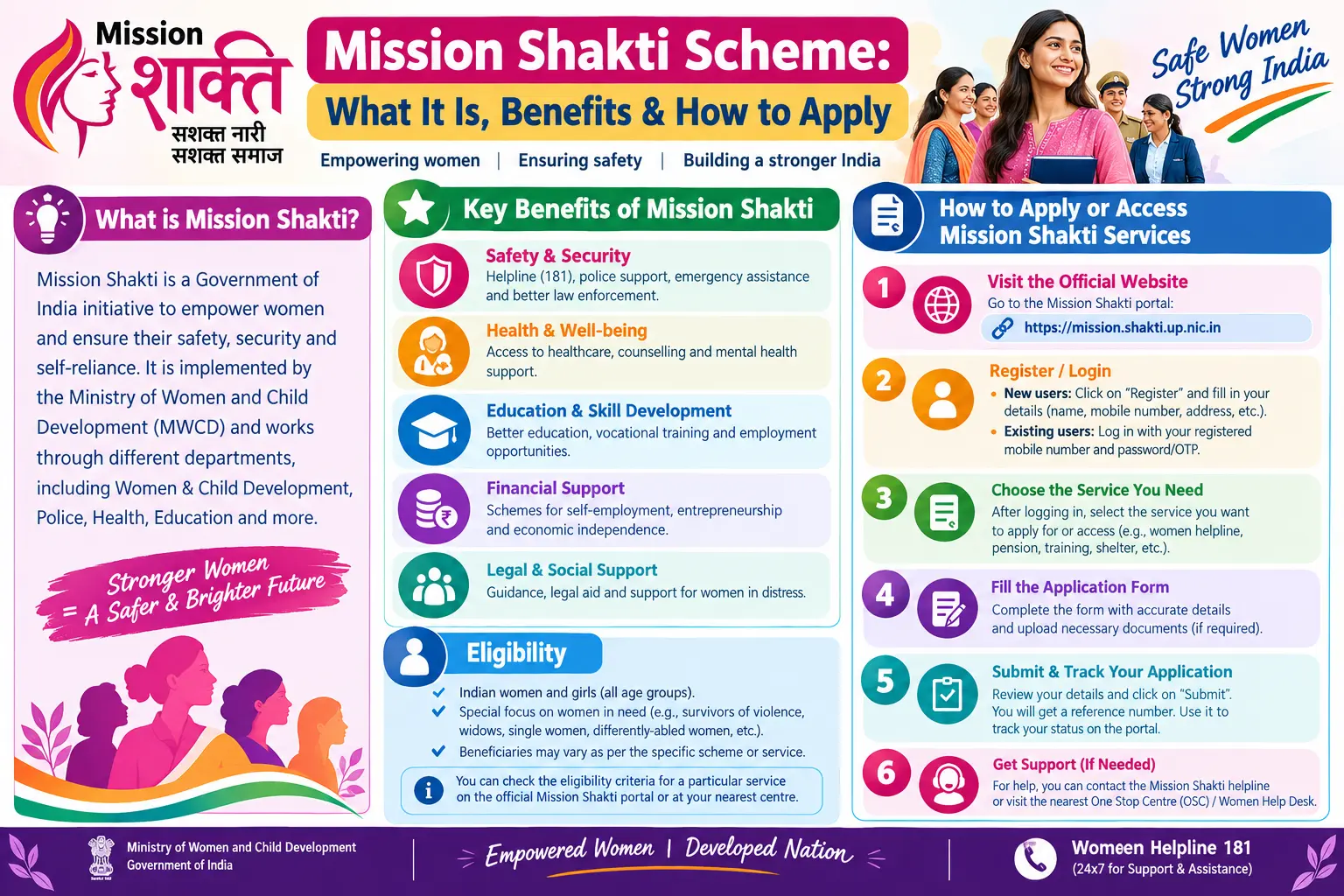
Mission Shakti is not a single scheme with one form and one office. It is an umbrella programme that consolidates several existing and new interventions for women under a shared framework, implemented during the 15th Finance Commission period (2021–22 to 2025–26). The logic is simple: a woman facing violence, looking for maternity support, or seeking safe accommodation should not have to figure out which ministry runs which scheme.
The mission runs through two verticals. Sambal handles safety and security. Samarthya handles empowerment—economic independence, maternity support, shelter, and childcare. Each vertical contains multiple components, and knowing which one your need falls under is the first step to finding the right office.
A less visible but important feature is convergence: ministries, state departments, and local bodies are expected to coordinate rather than operate in silos, with Panchayati Raj institutions involved in last-mile delivery and digital tracking used to monitor whether services actually reach women.
Discover More About:👇
Aadhaar Status Check – How to Check Enrolment & Update Status Online
Sambal: Safety and Security Services for Women
Sambal is built for women facing violence, distress, or threats to their safety. Its main components:
One Stop Centres (OSCs). District-level facilities that bundle temporary shelter, medical assistance, police facilitation, counselling, and legal support under one roof. As of mid-2025, 843 OSCs were operational across states and union territories, having assisted roughly 11.94 lakh women. You can visit your nearest OSC directly, or book an appointment through the Mission Shakti portal or mobile app.
Women Helpline (181). A toll-free, 24-hour service for support, information, or immediate assistance. It has handled over 2.30 crore calls—one of the most heavily used parts of the mission.
Beti Bachao Beti Padhao (BBBP). Focused on improving the sex ratio at birth, promoting girls’ education, and running awareness campaigns to shift mindsets around valuing the girl child.
Nari Adalat. A newer, pilot-stage component offering an alternative grievance redressal platform for petty disputes at the grassroots level, aimed at resolving conflicts within communities rather than through formal courts.
Samarthya: Empowerment Services for Women
Samarthya covers economic independence, maternity support, shelter, and childcare. Its components:
Pradhan Mantri Matru Vandana Yojana (PMMVY). A maternity benefit scheme paying cash incentives directly into the bank or post office accounts of pregnant women and lactating mothers through Direct Benefit Transfer (DBT). Under the current framework, ₹5,000 is paid in two instalments for the first child, and ₹6,000 in one instalment for a second child if that child is a girl. The account must be Aadhaar-seeded to receive the transfer.
Shakti Sadan. Integrated relief and rehabilitation homes for women in distress, including those who have been trafficked or lack family support. They provide shelter, health services, nutritious food, and legal and counselling support.
Sakhi Niwas (Working Women Hostel). Safe, conveniently located accommodation for working women in urban, semi-urban, and rural areas where employment opportunities exist.
Palna. Day-care creche facilities for children of working mothers, delivered through Anganwadi infrastructure to reach the last mile.
SANKALP: Hub for Empowerment of Women. National, state, and district-level hubs that bridge the information gap about schemes and facilities available to women—useful if you are unsure what exists in your district.
How to Apply or Access Mission Shakti Services
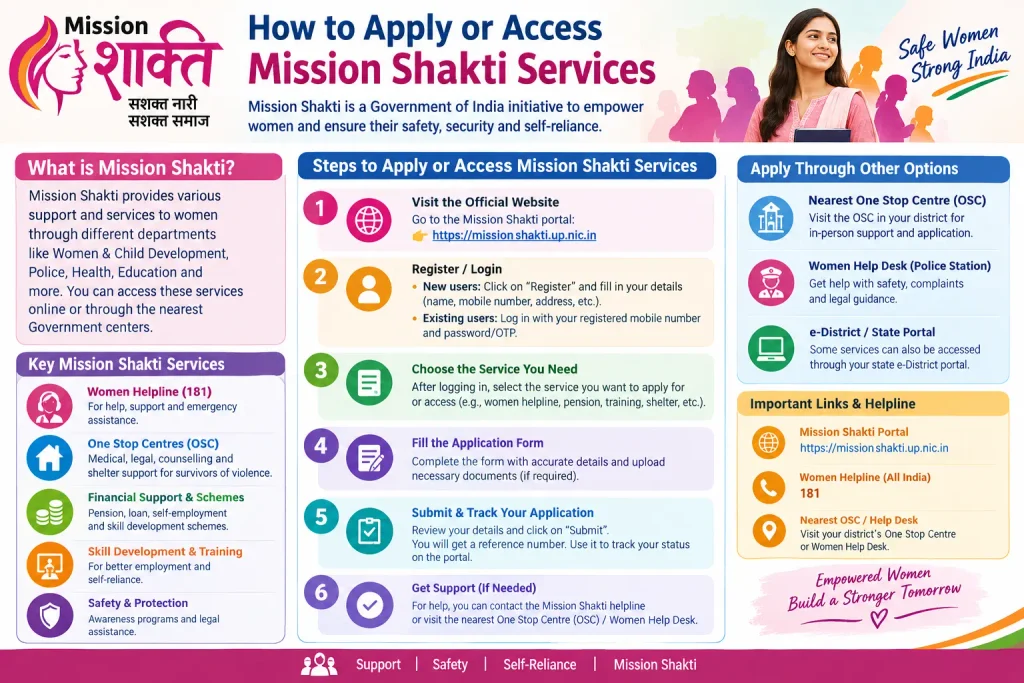
There is no single Mission Shakti application form. The route depends entirely on which component you need.
For One Stop Centre services: Walk into your nearest OSC—no prior appointment is required to seek help. If you would prefer to plan ahead, use the Mission Shakti portal (missionshakti.wcd.gov.in) or the mobile app to find your district’s OSC and book an appointment. In an emergency, call 181. A common pitfall here is assuming you need to “apply” online first; you do not. OSCs are designed to assist first and sort out paperwork later.
For PMMVY maternity benefits:
- Go to pmmvy.wcd.gov.in and register with your mobile number.
- Verify the number using the OTP sent to your phone.
- Fill in beneficiary details—your name, Aadhaar number, bank account details, and pregnancy or delivery information.
- Upload the required documents (identity proof, address proof, Aadhaar-seeded bank passbook, and the pregnancy or delivery documents specified in the form).
- Submit and note the application reference number for tracking.
If the portal feels cumbersome, your local Anganwadi worker or ASHA worker can register you through the field functionary application—free of cost. Two pitfalls worth watching: an OTP that never arrives because the mobile number is inactive, and a bank account that is not Aadhaar-seeded, which can stall the DBT payment even after approval.
For Sakhi Niwas and Shakti Sadan admissions: Log in to the Mission Shakti portal and navigate to the relevant scheme section to fill in admission details. State-level Women and Child Development departments implement these components, so procedures can vary—check your state WCD website for specifics.
For Samarthya components generally: Because states implement these schemes, the exact procedure can differ. The official Mission Shakti portal or your state WCD department is the reliable source.
Documents Required
Requirements differ by component. For PMMVY, you will typically need:
- Identity proof (Aadhaar or voter ID)
- Address proof
- A bank or post office account passbook linked to Aadhaar
- Pregnancy or delivery documents as specified in the application form
For Sakhi Niwas admission, identity and employment-related documents are generally required. For Shakti Sadan, minimal documentation is typically sought at admission, with detailed paperwork handled afterwards. For One Stop Centre services, no documents are mandatory to seek immediate help—the priority is assistance first, paperwork later.
Eligibility criteria were revised with the Mission Shakti guidelines effective April 2022, so verify current requirements on missionshakti.wcd.gov.in or with your district WCD office before submitting anything.
Common Mistakes to Avoid
Treating Mission Shakti as a single scheme with one application form is the most common misunderstanding. It is an umbrella programme, and each component has its own process. Applying for PMMVY through the wrong portal, or waiting for an “online application” before approaching an OSC, wastes time.
Not linking the bank account to Aadhaar is another frequent cause of delay. PMMVY payments go through DBT to an Aadhaar-seeded account; without the seed, the transfer can fail or bounce back.
Assuming services are urban-only is a third mistake. OSCs are district-level institutions, and Palna uses Anganwadi infrastructure to reach rural areas. SANKALP hubs exist precisely to tell you what is available in your district.
Finally, avoid third-party websites or agents charging fees to “register” you under Mission Shakti. Official portals are the reliable route, and Anganwadi and ASHA workers help with registration at no cost.
Frequently Asked Questions
Is Mission Shakti only for women in distress?
No. Sambal covers safety and support for women facing violence or distress, but Samarthya covers broader empowerment services—maternity benefits, working women’s hostels, and childcare support. Any woman meeting the eligibility criteria for a specific component can apply.
Can I apply for Mission Shakti online?
There is no single online application for the whole mission. PMMVY has an online portal (pmmvy.wcd.gov.in). One Stop Centre appointments can be booked through the Mission Shakti portal or app. Other components may require visiting a local office or contacting your district WCD department.
Is Aadhaar mandatory for Mission Shakti benefits?
For PMMVY, the bank or post office account must be Aadhaar-seeded to receive the cash transfer. For other components, Aadhaar is commonly accepted as identity proof, but the specific requirement depends on the service. Check the official guidelines for your component.
What is the Women Helpline number under Mission Shakti?
It is toll-free, available 24 hours, and meant for women seeking support and information.
What is the difference between Sambal and Samarthya?
Sambal covers safety and security—One Stop Centres, the 181 helpline, Beti Bachao Beti Padhao, and Nari Adalat. Samarthya covers empowerment—PMMVY, Shakti Sadan, Sakhi Niwas, Palna, and SANKALP hubs. Both sit under the Mission Shakti umbrella.
Are there any fees to access Mission Shakti services?
Government-run services like OSC assistance and the 181 helpline are free. PMMVY has no application fee. If any portal or office asks for payment for a service that should be free, treat it with caution and verify through the official Mission Shakti portal.
A Final Note
If you have submitted a PMMVY application and the payment has not arrived, check two things before following up: whether your bank account is Aadhaar-seeded, and whether the mobile number registered on the portal is still active. Most delays trace back to one of those two. If the issue persists, your district WCD office can check the application status on the backend—something the portal itself does not always show you. And if eligibility rules have changed since you last checked, the current guidelines on missionshakti.wcd.gov.in are the version that matters.
