

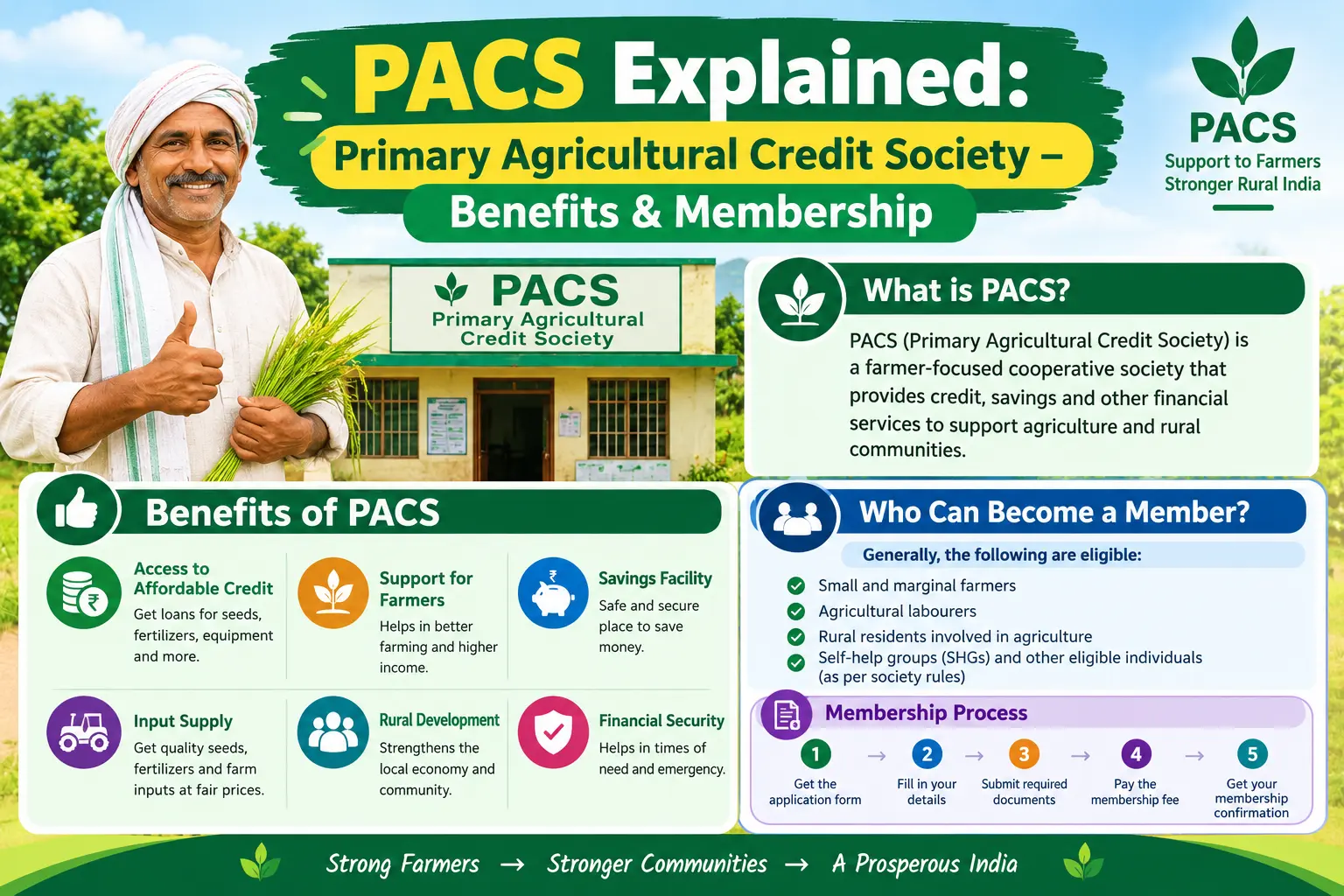
If you need a crop loan before sowing and the nearest bank branch is a bus ride away, the phrase “join the PACS” can sound like either a solution or a puzzle. A Primary Agricultural Credit Society (PACS) is the village-level cooperative that most farmers encounter first when they need short-term credit, seeds, fertiliser, or a government service closer to home. This guide explains what a PACS does, who can become a member, what documents are usually asked for, and how the application process works in states that offer online registration. It also flags the small errors that delay membership — so you can avoid them.
What a PACS Actually Does for a Village
A PACS sits at the base of India’s short-term cooperative credit structure. It is owned by its members, run by an elected management committee, and focused on the everyday needs of the village it serves. Its main job is to provide short-term and medium-term credit to farmer members, but many societies now do much more.
Credit services
Short-term loans are typically given for crop production — seeds, fertiliser, pesticides, and other seasonal costs. Medium-term loans may support minor irrigation, farm equipment, or other productive assets. These loans are generally refinanced through District Central Cooperative Banks (DCCBs), State Cooperative Banks (StCBs), and NABARD. For small and marginal farmers, a PACS is often the most accessible credit option because it operates locally and understands the crop cycle.
Agricultural inputs and daily services
A PACS also distributes essential inputs such as seeds, fertilisers, and pesticides. Many societies have been upgraded as Pradhan Mantri Kisan Samriddhi Kendras (PMKSK), which bring fertiliser and related services under one roof. That saves farmers a trip to the nearest town for basic supplies.
Discover More About:👇
Farmer ID (FID) Status Check by Aadhaar Number – PM Kisan
Digital and government services
Under the PACS computerisation project, societies are being equipped with ERP-based software, biometric devices, and secure connectivity for digital record-keeping and faster loan processing. A Memorandum of Understanding between the Ministry of Cooperation and CSC e-Governance Services India Limited has enabled many PACS to function as Common Service Centres (CSCs). Where authorised, they can deliver a range of e-services — banking, insurance, PAN-related services, welfare scheme registrations, and in some cases Aadhaar enrolment or updation. For Aadhaar-specific work, always confirm current services and procedures on the official UIDAI portal (uidai.gov.in) or through the UIDAI helpline.
Why PACS Membership Is Worth Considering
Joining a cooperative PACS is not just about taking a loan. Membership gives you a stake in a local institution that is accountable to its members.
- Access to affordable credit. PACS typically charge lower interest than commercial lenders for short-term agricultural loans, and repayment is structured around the crop cycle.
- Priority access to inputs. Members usually get preferential access to seeds, fertilisers, and pesticides distributed through the society, often at cooperative prices.
- Government scheme benefits. PACS integration with schemes such as PM-KISAN, PM Fasal Bima Yojana, and various state welfare programmes can make enrolment and benefit delivery simpler.
- Democratic participation. Each member generally has a vote in electing the management committee, which gives you a say in how the society is run.
- New income avenues. As PACS diversify into dairy, fisheries, warehousing, or custom hiring centres, members gain access to new livelihood opportunities and market linkages.
Who Can Join a PACS?
Eligibility is governed by the respective State Cooperative Societies Acts and each society’s bye-laws. The broad framework is fairly similar across states, but the details can differ.
- Age: You must generally be at least 18 years old and competent to contract as per law.
- Residence: You must belong to, or reside within, the village or area of operation of the PACS.
- Occupation: Agriculturists, agricultural labourers, artisans, and small traders living in the village can usually become members.
- Land holding: Some states require a minimum land holding. In Maharashtra, for example, rules have been proposed around a minimum of 10 R (0.10 hectare) of agricultural land. Other states allow landless agricultural labourers and artisans to join. Check your state’s rules before applying.
- No duplicate membership: A person who is already a member of another PACS operating in the same area may not be eligible to join a second one there.
The minimum number of members needed to form a new PACS is typically ten. Membership fees are usually kept low so that even the poorest agriculturist can join.

How to Become a PACS Member: Online and Offline Steps
The process varies by state. Some states have introduced online registration through dedicated portals, while others still accept offline applications through the local PACS office or DCCB branch. Below is a general outline. For state-specific details, check your State Cooperation Department’s website or visit your nearest PACS office.
Online registration, where available
- Visit your state’s PACS membership portal. States such as Uttar Pradesh have a dedicated portal commonly known as pacs member.in. Do not assume one portal covers all of India — each state may have its own system.
- Select “Become a PACS Member” and choose your district, block, and the specific PACS you want to join. Check the society’s area of operation first.
- Enter your mobile number and verify it with the OTP. If the OTP does not arrive, check your signal, wait for the timer to expire, and request it again. If possible, try an alternate mobile number.
- Fill in the registration form carefully. Enter your name, date of birth, and address exactly as they appear on your Aadhaar, voter ID, and land records. A mismatch is one of the most common reasons for rejection.
- Upload supporting documents. This usually includes identity proof, address proof, land records, and a passport-size photograph. Keep file size and format within the portal’s limits.
- Pay the membership fee and share capital contribution. The amount varies by state and society. Use the portal’s payment mode and save the receipt. If money is debited but no receipt is generated, do not pay again immediately — check the application status first.
- Download and print the acknowledgment. Note the application number. You will need it for follow-up.
Pitfalls to watch for: portal sessions can time out if you leave the form idle; do not refresh the page during payment; and double-check that you selected the correct PACS. Applying to a society whose area does not cover your village will only delay your membership.
Offline registration
- Visit the PACS office or the DCCB branch in your area and ask for the membership application form.
- Fill in the form and attach copies of the required documents. Carry originals for verification.
- Submit the form along with the prescribed membership fee and share capital contribution.
- Obtain a receipt and note the application number or reference. Follow up with the PACS office for status updates.
Exact fees, forms, and processing timelines differ from state to state. Always confirm current details with the local PACS office or the official state cooperation department.
Documents Commonly Required and Mistakes to Avoid
While the list varies by state and society, the following documents are commonly required:
- Identity proof: Aadhaar card, voter ID (EPIC), or ration card
- Address proof: Aadhaar card, utility bill, or bank statement
- Land records: Parcha, deed, 7/12 extract, or other proof of agricultural land holding, where applicable
- Passport-size photographs
- PAN card in some states
- Membership fee and share capital receipt
If you are applying as a tenant farmer or landless agricultural labourer, the society may ask for proof of residence or occupation instead of land ownership.
Common mistakes:
- Applying to the wrong PACS. Each society has a defined area of operation. Confirm the correct one before submitting.
- Ignoring name and address mismatches. If your Aadhaar says one spelling and your land record says another, correct the mismatch at the source first.
- Assuming membership guarantees a loan. Membership makes you eligible to apply for credit, but approval depends on the society’s assessment of repayment capacity and other factors.
- Paying without a receipt. Always collect a receipt for the membership fee and share capital.
- Relying on old fee amounts. Fees and share capital requirements change periodically. Verify current amounts from the PACS office or state portal.
FAQs About PACS Membership
Q1: Can I become a member of a PACS online?
In several states, yes. Uttar Pradesh, for example, has an online system commonly known as pacs member.in. Other states may offer offline registration only. Check your State Cooperation Department’s website for the current process.
Q2: Is Aadhaar required for PACS membership?
Aadhaar is commonly accepted as identity and address proof. In computerised PACS, Aadhaar-based authentication and e-KYC are increasingly used for loan processing and other services, as per the applicable state guidelines. Alternative documents may be accepted in some cases.
Q3: Can I be a member of more than one PACS?
Generally, a person cannot be a member of more than one PACS operating in the same area. Rules may differ across states, so verify with your local society.
Q4: What is the minimum land requirement for PACS membership?
It varies by state. Some states require a small minimum land holding, while others allow landless agricultural labourers and artisans to join. Check your state’s cooperative society rules for the exact requirement.
Q5: How long does PACS membership take?
There is no fixed timeline. Offline applications may be processed after the next management committee meeting; online applications may move faster once documents are verified. Follow up with your application number.
Q6: Can a PACS help with Aadhaar services?
Some PACS that function as Common Service Centres may offer Aadhaar enrolment or updation where authorised. For current services, fees, and procedures, refer to the official UIDAI portal (uidai.gov.in) or call the UIDAI toll-free helpline.
If Your PACS Application Gets Stuck
Online forms time out. OTPs fail. A land record spelling does not match the Aadhaar card. These are ordinary problems, not dead ends. If your online application stalls, try again during off-peak hours and keep the acknowledgment safe. If an OTP never arrives, visit the PACS office with your mobile number and ID. If documents are rejected, fix the mismatch at the source — Aadhaar, land record, or bank details — before reapplying. And if the application stays pending beyond the local office’s usual timeline, ask for a written status update or escalate to the DCCB or State Cooperation Department. A PACS membership is a long-term relationship, so it is worth getting the paperwork right the first time.
