
Bank fixed deposit rates have slipped for several quarters now, and if you are hunting for a safer, higher-yielding place to park your savings, the post office counter is worth a serious look. The post office rate of interest for 2026 has stayed put across most small savings schemes even as bank rates drifted downward — a gap that has widened to nearly 1–1.5 percentage points on some tenures. This article gives you the full rate table, shows how each scheme stacks up against bank FDs, walks through the Aadhaar e-KYC process that now makes post office accounts easier to operate, and covers the girl child savings scheme that families in Tamil Nadu keep asking about.
Note on rates: The Ministry of Finance notifies small savings rates every quarter. The figures below reflect the most recently notified rates available at the time of writing. Rates can change, so confirm the latest numbers on the official India Post website (indiapost.gov.in) or at your nearest post office before investing.
Discover More About:👇
Aadhaar Bank Seeding Status: How to Check Aadhaar Card Link With Bank Account
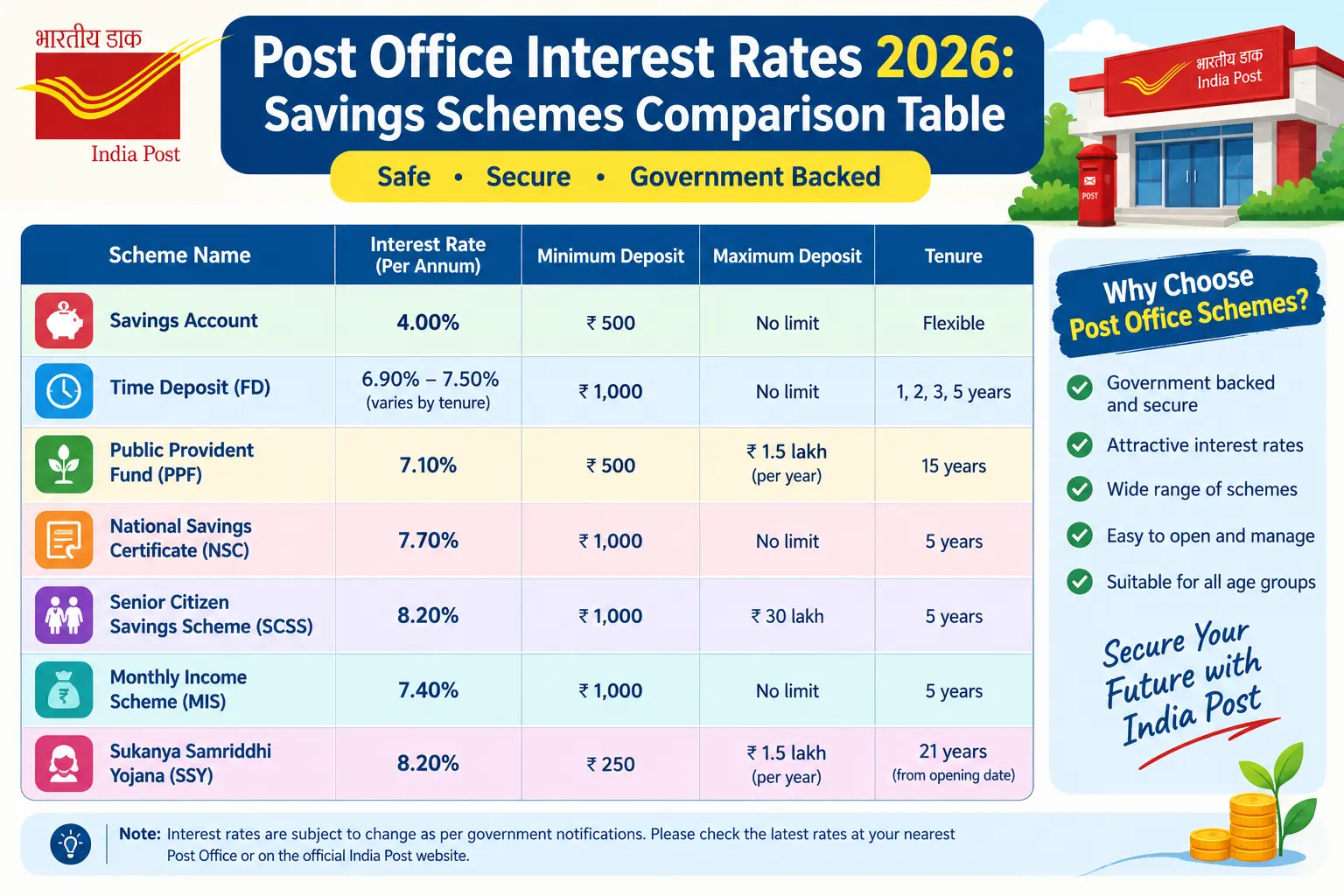
Current Post Office Interest Rates 2026: Full Comparison Table
Rates have been held steady for the October–December 2026 quarter — the eleventh consecutive quarter without a change. That stability is unusual, and it means the schemes below have not needed to be re-priced since mid-2024.
| Scheme | Interest Rate (2026) | Compounding / Payout | Minimum Investment | Tax Note |
|---|---|---|---|---|
| Post Office Savings Account | 4.0% | Annually | ₹500 | Interest up to ₹10,000 exempt under Section 80TTA |
| 1-Year Time Deposit | 6.9% | Quarterly | ₹1,000 | Fully taxable |
| 2-Year Time Deposit | 7.0% | Quarterly | ₹1,000 | Fully taxable |
| 3-Year Time Deposit | 7.1% | Quarterly | ₹1,000 | Fully taxable |
| 5-Year Time Deposit | 7.5% | Quarterly | ₹1,000 | Eligible for Section 80C deduction |
| 5-Year Recurring Deposit | 6.7% | Quarterly | ₹100/month | Interest fully taxable |
| Monthly Income Scheme (POMIS) | 7.4% | Monthly payout | ₹1,000 | Interest fully taxable |
| Senior Citizens Savings Scheme (SCSS) | 8.2% | Quarterly payout | ₹1,000 | Section 80C benefit; interest taxable above ₹50,000 |
| National Savings Certificate (NSC) | 7.7% | Annually (paid at maturity) | ₹1,000 | Section 80C benefit; interest deemed reinvested |
| Kisan Vikas Patra (KVP) | 7.5% | Annually | ₹1,000 | Fully taxable; investment doubles in about 115 months |
| Public Provident Fund (PPF) | 7.1% | Annually | ₹500/year | EEE status — fully tax-free |
| Sukanya Samriddhi Account (SSA) | 8.2% | Annually | ₹250 | EEE status — fully tax-free |
| Mahila Samman Savings Certificate | 7.5% (closed to new deposits) | Quarterly | — | Accounts opened before 31 March 2025 continue until maturity |
SCSS and Sukanya Samriddhi sit at the top with 8.2% each. The Post Office Savings Account, at 4%, is a transaction account — not a growth product.
How Post Office Rates Compare With Bank Fixed Deposits
The gap between post office and bank rates is the main reason these schemes are drawing fresh attention. A 5-year Post Office Time Deposit pays 7.5%, while SBI was offering roughly 6.05–6.25% on comparable tenures and private banks ranged between 6.15% and 6.75% for one-to-two-year deposits. The RBI has itself noted that small savings rates have remained unchanged for 11 straight quarters, which is why the differential has grown.
What you give up in return is flexibility. Bank FDs come with more tenure options, online management, premature withdrawal (with a penalty), and loan facilities against the deposit. Post office Time Deposits offer only four tenures — 1, 2, 3, and 5 years — and the process has traditionally been branch-oriented. Aadhaar e-KYC is slowly changing that second part.
Girl Child Savings Through Post Office in Tamil Nadu
When people search for a post office scheme for girl child in Tamil Nadu, the scheme they mean is almost always Sukanya Samriddhi Yojana (SSY) — Selvamagal Semippu Thittam in Tamil. The Department of Posts runs it nationwide, and the Chennai City Postal Region alone has opened over 10.44 lakh SSY accounts since inception, with deposits exceeding ₹9,234 crore up to March 2025.
Key features
- Eligibility: A parent or legal guardian can open an account for a girl child below 10 years of age.
- Deposit range: Minimum ₹250 per financial year; maximum ₹1.5 lakh per financial year.
- Interest rate: 8.2% per annum, compounded annually.
- Tax benefit: Contributions qualify under Section 80C; interest and maturity proceeds are fully exempt (EEE status).
- Withdrawal: Up to 50% of the balance can be withdrawn when the girl turns 18 or passes Class 10, for higher education.
- Maturity: 21 years from the date of opening. It can also be closed for marriage after the girl turns 18, subject to conditions.
For families in Tamil Nadu, the appeal is simple: a government-backed account at one of the highest small savings rates, opened at any post office, with the option to start small and scale up contributions as income allows.
Opening and Managing Post Office Accounts With Aadhaar e-KYC
The Department of Posts has extended Aadhaar-based e-KYC to several small savings schemes, which means you can open and operate accounts without paper forms in many cases. When you consent to e-KYC, your name, date of birth, gender, and address are pulled directly from UIDAI records instead of being manually entered. e-KYC here stands for electronic Know Your Customer — an Aadhaar-authenticated way of completing the same identity verification that paper forms used to require.
Which schemes support it
Post Office Savings Account (https://www.indiapost.gov.in/) (POSA), Recurring Deposit (RD), Public Provident Fund (PPF), Monthly Income Scheme (MIS), Time Deposit (TD), Kisan Vikas Patra (KVP), National Savings Certificate (NSC), and Sukanya Samriddhi Account (SSA).
What changes once your CIF is converted
Your Customer Information File (CIF) is the post office’s internal record of your KYC details. Once it is converted to an e-KYC CIF, you can:
- Deposit up to ₹50,000 in POSA, RD, and SSA accounts using Aadhaar biometric authentication — no pay-in slip needed.
- Withdraw up to ₹20,000 from a savings account without a withdrawal form.
- Operate your account at any post office branch, not just the one where it was opened.
Aadhaar seeding — linking your Aadhaar number to your Post Office Savings Bank (POSB) account through the NPCI mapper — is a separate step, and it is required if you want Direct Benefit Transfer (DBT) payments credited to your post office account.
How the process actually works
- Visit your post office with your Aadhaar number and consent to biometric authentication at the counter. If you are opening a new account, the post office creates an e-KYC CIF as part of account opening itself.
- If your account already exists, request conversion of your current CIF to an e-KYC CIF. Carry your existing passbook and Aadhaar.
- For deposits or withdrawals, authenticate with your fingerprint or iris at the counter. The system pulls your details from UIDAI and completes the transaction.
Two pitfalls worth knowing: First, biometric authentication fails more often than people expect — dry or worn fingertips, especially for manual labourers and older applicants, are a common cause. If it fails repeatedly, ask the counter staff whether iris authentication is available at that branch, or whether you can complete the transaction through an alternate verification method. Second, if your Aadhaar has a mobile number linked but the post office system shows a mismatch, the e-KYC will not go through. Check that your Aadhaar details are current before you visit, and update them at an Aadhaar Seva Kendra if needed.
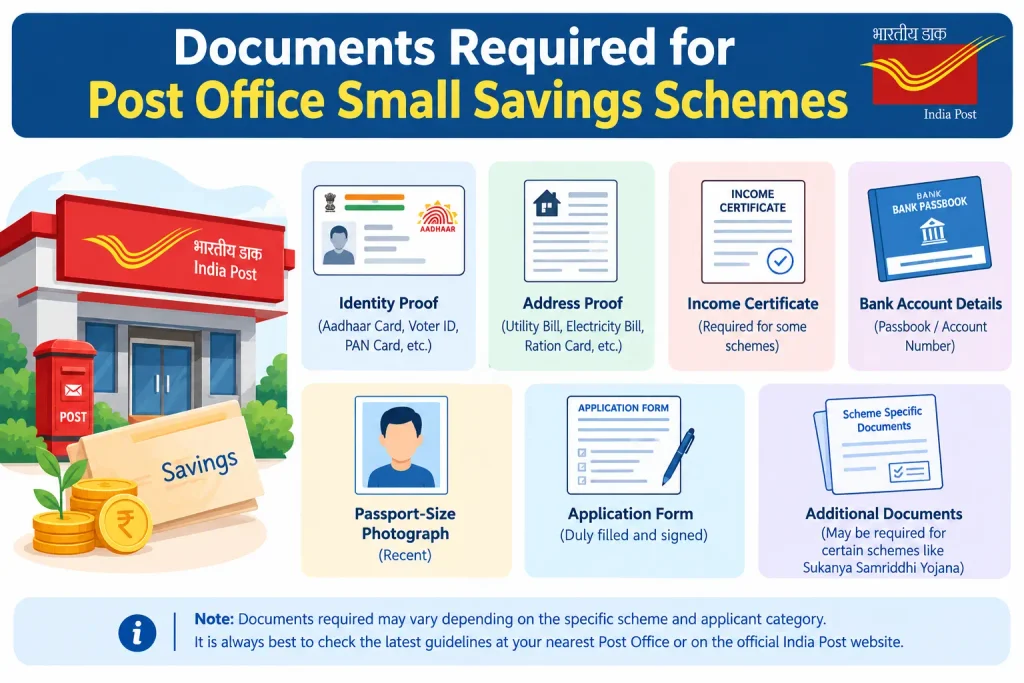
Documents Required for Post Office Small Savings Schemes
The list varies slightly by scheme and whether you are opening a new account or converting an existing one. As a general guide, keep the following ready:
- Aadhaar card — mandatory for all small savings schemes and for e-KYC authentication. A masked Aadhaar (showing only the last four digits) is generally accepted for KYC purposes.
- PAN card — required for investments above ₹50,000 in some schemes; mandatory for PPF and SSY under current rules.
- Passport-size photographs — for joint accounts, photographs of all holders may be needed.
- Proof of address — if your Aadhaar address is not current, a utility bill, ration card, or passport may be requested.
- Bank account details — for schemes where interest or maturity proceeds are credited electronically.
- For SSY specifically: birth certificate of the girl child and proof of relationship (such as a birth certificate showing the parent’s name).
For scheme-specific requirements, check the India Post website or ask at your local post office, since rules are updated periodically.
Common Mistakes to Avoid
- Treating the savings account as an investment. At 4%, it barely keeps pace with inflation. Use it for transactions and emergency parking.
- Ignoring the 5-year Time Deposit’s tax benefit. Only the 5-year option qualifies for Section 80C. The 1-, 2-, and 3-year deposits do not.
- Assuming SCSS is open to everyone. It is for individuals aged 60 and above, with limited exceptions for retirees aged 55–60 under specific conditions.
- Forgetting the SSY deposit cap. The maximum is ₹1.5 lakh per financial year. Anything above that is not permitted.
- Not converting to e-KYC. If you opened your account years ago with paper KYC, you may still be limited to your home branch and paper-based transactions.
- Overlooking the quarterly rate review. A rate that looks attractive today could be revised in three months for new deposits — though existing Time Deposits and NSC generally continue at the rate locked in at the time of investment.
Frequently Asked Questions
Q1. What is the highest interest rate available in a post office scheme in 2026?
8.2%, offered by both the Senior Citizens Savings Scheme and Sukanya Samriddhi Account. SCSS is for seniors aged 60 and above; SSY is for girl children below 10.
Q2. Can I open a Sukanya Samriddhi account for my daughter in Tamil Nadu at any post office?
Yes. It is available at post offices across Tamil Nadu, including branch post offices in smaller towns. You will need the girl’s birth certificate, your Aadhaar, and PAN.
Q3. Is Aadhaar mandatory for post office savings schemes?
Aadhaar is mandatory for investments in small savings schemes including PPF, NSC, KVP, and post office deposits, as per Finance Ministry notifications. For e-KYC transactions, a masked Aadhaar is generally sufficient.
Q4. How does Aadhaar e-KYC help with my post office account?
With your consent, your KYC details are fetched directly from UIDAI. Once converted, you can deposit up to ₹50,000 and withdraw up to ₹20,000 without slips, and operate your account from any post office branch.
Q5. Can I withdraw from Sukanya Samriddhi before maturity?
Yes — up to 50% of the balance when the girl turns 18 or passes Class 10, for higher education. The account matures after 21 years, or can be closed for marriage after age 18 under specified conditions.
Q6. Are post office interest rates revised every quarter?
Yes. The Ministry of Finance reviews and notifies small savings rates every quarter. Rates have been unchanged for multiple consecutive quarters as of late 2026, but that can change. Always verify the current rate on the India Post website or at your post office.
If you are comparing options right now, the practical move is to check the latest rate notification before you commit — a new quarter starts in January, and that is when the next revision (or hold) will be announced. For long-tenure goals like a daughter’s education or retirement, the 5-year Time Deposit, NSC, PPF, and SSY remain the schemes where the rate is locked in for the full term, so a rate change next quarter will not affect what you have already invested. For short-term parking, the savings account and 1-year deposit are better treated as liquidity tools than as return generators.
