

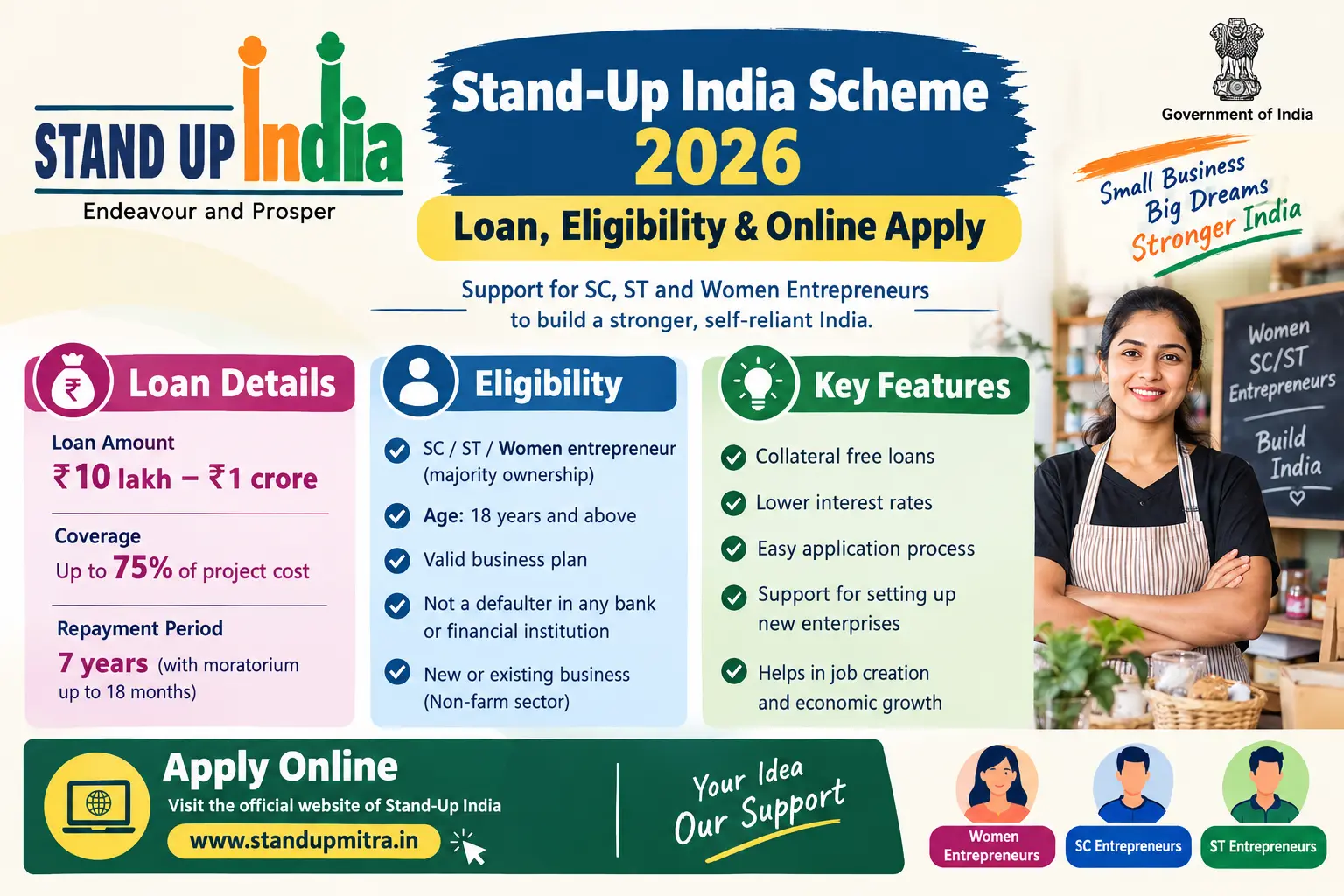
You have the business idea. You have the location, the supplier, maybe even a first customer lined up. What you don’t have is ₹15 lakh — and every bank you visit wants collateral you cannot produce. That is exactly the gap the Stand-Up India scheme was created to close. It offers bank loans of ₹10 lakh to ₹1 crore to Scheduled Caste (SC), Scheduled Tribe (ST), and women entrepreneurs starting their first business. This guide covers who qualifies, how the loan is structured, what documents the bank will ask for, and how to apply online — including the points where applications usually stall.
What the Stand-Up India Scheme Actually Offers
Announced in the Union Budget 2016–17 and launched on 5 April 2016, the scheme is administered by the Small Industries Development Bank of India (SIDBI) and delivered through Scheduled Commercial Banks. Its mandate is unusually concrete: every bank branch is expected to facilitate at least one loan to an SC or ST borrower and at least one to a woman borrower. The point is to move institutional credit toward first-time entrepreneurs who have traditionally been turned away from it.
One restriction catches more applicants than any other. The scheme funds only greenfield enterprises — a business you are starting from scratch in that sector. If you already run a shop and want a second one, or you want to expand an existing unit, this is not the scheme for you. Takeover of a running business is also excluded.
Discover More About:👇
Udyog Aadhaar (Udyam) Registration: How to Register & Download Certificate
Who Qualifies for a Stand-Up India Loan
- Category: SC, ST, or woman entrepreneur. For partnerships, LLPs, and private limited companies, at least 51% of the shareholding and controlling stake must rest with an SC/ST individual or a woman.
- Age: 18 or above.
- Repayment record: No existing default with any bank or financial institution.
- Business stage: A greenfield project — your first enterprise in the chosen sector.
- Entity type: Sole proprietorship, partnership, LLP, or private limited company.
- Sector: Manufacturing, services, trading, and activities allied to agriculture such as dairy, poultry, fishery, and agro-processing. Core agricultural lending — crop loans, land improvement — falls outside the scheme.
If you are unsure whether your activity counts as “allied to agriculture,” ask your bank branch or the Lead District Manager (LDM) for your district before you spend time on an application.
How the Loan Is Structured
The Stand-Up India loan is a composite loan: term loan for fixed capital such as machinery and equipment, plus working capital for day-to-day operations, bundled into one facility. You repay through a single EMI instead of managing two accounts.
- Amount: ₹10 lakh to ₹1 crore per borrower.
- Coverage: Typically up to 85% of the project cost, combining term loan and working capital. The borrower contributes at least 10% as own contribution, and the remaining margin can be converged with eligible central or state schemes where available.
- Interest rate: Capped at base rate plus 3% plus any tenor premium, and linked to the bank’s Marginal Cost of Funds Based Lending Rate (MCLR) — the benchmark banks use to price loans. Because it moves with the market, the exact rate varies by bank. Confirm the current rate with your branch.
- Repayment: Up to 7 years, with a moratorium of up to 18 months from first disbursement. A moratorium is the gap before your first EMI begins, giving the business time to start earning.
- Collateral: The primary security is the assets the loan creates. Coverage under the Credit Guarantee Fund for Stand-Up India Loans (CGFSIL) protects the bank’s exposure, which is why branches are more willing to lend without heavy collateral. A bank may still seek additional security based on its own assessment.
- Working capital: Up to ₹10 lakh can be sanctioned as an overdraft with a RuPay debit card; above that, as a cash credit limit.
How to Apply Online: Step by Step
You can apply at a bank branch, through your district’s Lead District Manager, or online at standupmitra.in, the SIDBI-run portal. The online route is the most structured, and it also gives you access to handholding support if your project report is not ready.
- Register on standupmitra.in. You will need your name, email ID, and mobile number, plus an OTP to log in. Keep the mobile number active for the entire process — bank and portal updates come to it.
- Answer the classification questions. Based on your responses, the portal tags you as a “Trainee Borrower” (you need help with a project report or training) or a “Ready Borrower” (your business plan is already prepared).
- Open your dashboard. It lists the Lead District Managers and Stand-Up India connect centres mapped to your district. This is where district selection matters — pick your actual district, or your file routes to the wrong LDM and sits idle.
- Use handholding support if you are a Trainee Borrower. Help centres assist with project report preparation and training. Once your requirements are met, a loan application gets generated through the portal.
- Submit to a bank branch if you are a Ready Borrower. You fill in personal, business, and financial details and upload documents in the prescribed format, then select a branch for processing.
- Bank evaluation and sanction. The branch assesses your project report and eligibility. On sanction, the loan is disbursed and repayment begins after the moratorium.
Where the Process Usually Gets Stuck
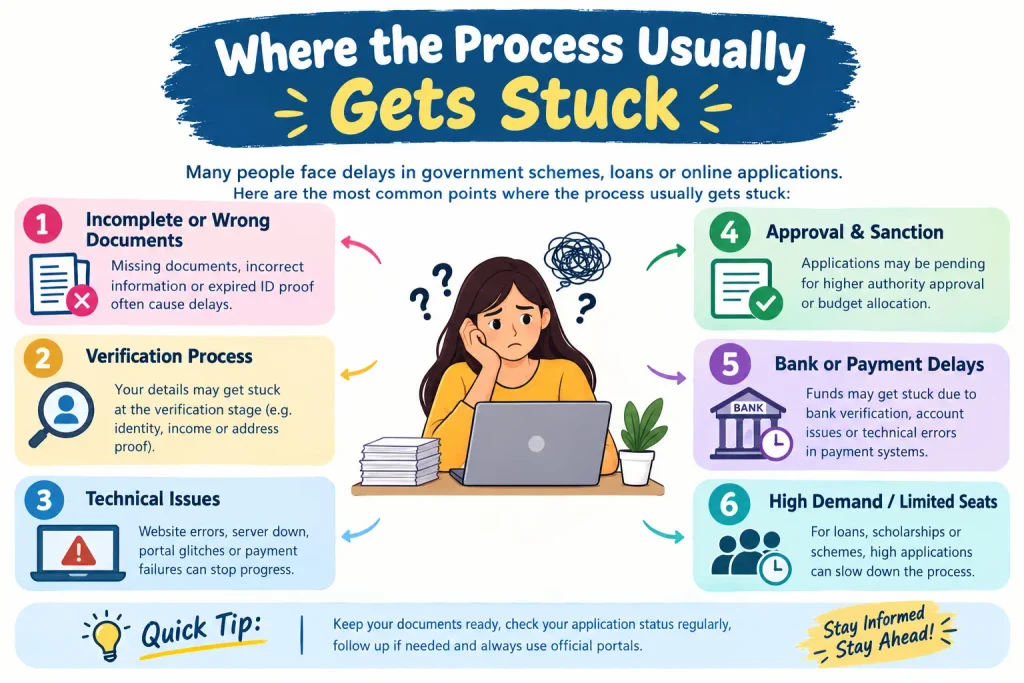
The OTP is the first hurdle — it often fails to arrive if the mobile number was typed incorrectly at registration or if the network is patchy. Wait for the timer before requesting a resend, and do not create a fresh account each time. Duplicate registrations confuse the system and delay verification.
The second is session timeout. The portal logs you out after a period of inactivity, and a half-filled form can be lost. Gather your documents — scanned ID proof, category certificate, bank statements, project report — into one folder before you start, and keep files within the portal’s stated size and format limits.
Third, applicants frequently upload a project report written for a different purpose. Banks assess viability, so the report needs to state what you will make or sell, who will buy it, your cost structure, and your projected revenue. A two-page generic template rarely clears scrutiny.
Registering on the portal itself does not involve an application fee. Treat any intermediary demanding money to “get your file approved” as a red flag.
Documents Required
Requirements vary by bank and by the nature of the business, but applications commonly require:
- Identity proof: Aadhaar card, PAN card, passport, or voter ID
- Address proof: Utility bill, Aadhaar card, or voter ID
- Category proof: SC/ST certificate from a competent authority, for SC/ST applicants
- Project report: Financial projections for the proposed enterprise, often in the bank’s preferred format
- Premises proof: Rent agreement or property documents, where applicable
- Bank statements: Recent statements for your existing account
- Business registration: Partnership deed, LLP agreement, or certificate of incorporation, if applicable
- Financial statements: Audited or projected balance sheet and ITR, as applicable
Confirm the exact list with your branch before submitting, since banks do add their own requirements.
Common Mistakes That Delay Applications
Choosing a branch far from where you intend to operate creates avoidable friction. Any Scheduled Commercial Bank branch can process the loan, but a nearby branch is easier to follow up with, and your LDM can intervene if the file stalls.
Assuming the scheme covers expansion is the other recurring error. It does not — greenfield only.
And do not work off second-hand figures for interest rates, processing timelines, or charges. These are set by individual banks and change periodically. Verify with your branch or the official portal on the day you apply.
FAQs
Can an existing business apply for a Stand-Up India loan?
No. The scheme funds only greenfield enterprises — a new business being started for the first time in that sector.
How is Stand-Up India different from Start-Up India?
Stand-Up India provides bank credit to SC, ST, and women entrepreneurs for greenfield ventures in manufacturing, services, trading, and allied agriculture. Start-Up India is a wider programme supporting innovation-driven startups through tax benefits, funding routes, and regulatory relaxations.
Is collateral compulsory?
The assets created by the loan serve as primary security, and CGFSIL cover reduces the bank’s risk. A branch may still ask for additional security depending on its assessment of your proposal.
What is handholding support?
It is assistance available through the portal — help with preparing a project report, skill training, and connecting you to the right branch. Trainee Borrowers can access it before a loan application is generated.
Can I apply online?
Yes. standupmitra.in allows registration, handholding access, and online submission. You can also apply at a bank branch or through your district’s Lead District Manager.
What interest rate applies?
The rate is capped at base rate plus 3% plus tenor premium and linked to the bank’s MCLR, so it differs across banks and changes with market conditions. Ask your branch for the current applicable rate.
If a bank rejects your application, ask for the reason in writing — vague rejections are common, and a specific reason tells you whether the project report needs rework or whether you should approach a different branch. A “no” from one branch is not a verdict on your business idea, and the LDM for your district exists precisely to help route such cases. Keep your document set ready and your expectations realistic: sanction takes time, and the paperwork is the part you control.
