
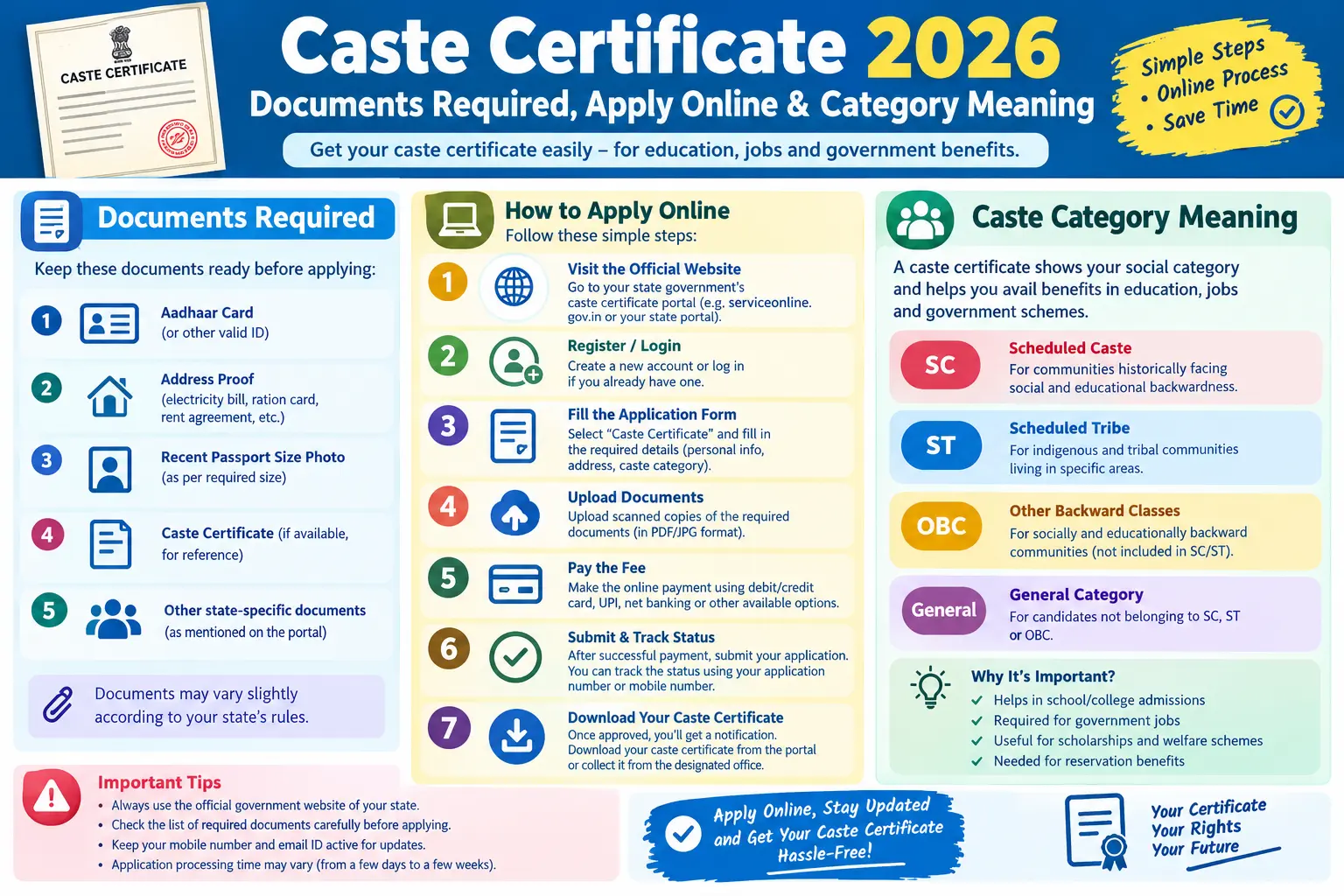
Your admission form is due tomorrow, the portal is asking for a caste certificate number, and you have never applied for one. Or worse — you applied three weeks ago and the status is still stuck at “under verification.” Either way, the certificate you need is not the problem; the paperwork around it is. A category certificate means a state-issued document confirming that you belong to a reserved community — Scheduled Caste (SC), Scheduled Tribe (ST), Other Backward Class (OBC), or another backward class notified by your state. Most people call it a caste certificate (जाति प्रमाण पत्र, जातीचा दाखला). This guide walks through what it actually certifies, the documents that trip people up, how the online application works in practice, and what to do when something goes wrong.
What Does Category Certificate Mean?
In admission forms and recruitment notifications, “category certificate” is the catch-all term. It covers SC, ST, OBC, and EWS (Economically Weaker Section) documents. A caste certificate is the specific proof of community — so when a form asks for a category certificate, it is usually asking for your caste certificate.
The important nuance: each state maintains its own list of communities. A caste recognised as OBC in Maharashtra may hold no reserved status in Karnataka. SC and ST lists are similarly state-specific, even though they derive from constitutional schedules. So a certificate issued in one state does not automatically travel with you.
The issuing officer also varies. Uttar Pradesh and Bihar route applications through the Tehsildar or SDM; Maharashtra through the Sub-Divisional Magistrate; Tamil Nadu through the Tahsildar. In recent years the power to designate issuing authorities has been delegated to state governments, so check your state’s current rule rather than assuming.
One more distinction worth knowing early: a caste validity certificate is not the same as a caste certificate. In Maharashtra especially, the caste certificate is the first-stage document, while the validity certificate comes after a separate scrutiny committee verifies your claim. Professional course admissions and government service often demand the validity certificate specifically — and it can take considerably longer.
Discover More About:👇
EWS Certificate 2026: Eligibility, Documents & How to Apply Online (State-wise)
Non-Creamy Layer Certificate 2026: Meaning, Documents & Online Apply
Documents Required for Caste Certificate
The documents required for caste certificate applications are broadly consistent across states, but the lineage proof is where most applications fail. Keep originals and clear scans of everything before you start.
Core documents
- Father’s caste certificate — the primary lineage proof. If your father has passed away, a grandfather’s certificate is generally accepted.
- Identity proof — Aadhaar, Voter ID, or ration card, for yourself and your family members.
- Residence proof — Aadhaar, electricity bill, voter ID, or property tax receipt showing your current address.
- Birth certificate — establishes date of birth and parent linkage.
- Notarised affidavit — a self-declaration of caste and lineage on stamp paper. The denomination is fixed by your state; ask at the notary or check the portal’s checklist.
- Photographs — usually two recent passport-size with a plain background.
Situational documents
- Migration certificate — needed if your family moved from another state and you are applying for a fresh certificate.
- School Leaving Certificate and Class 10 marksheet — useful where caste is recorded in school records. Often accepted as a substitute when a father’s certificate is unavailable.
- Mother’s caste certificate — required in some states, or where the claim runs through the maternal line.
- Old land records — a 7/12 extract in Maharashtra, for instance, can help establish ancestral lineage.
For Maratha caste certificate documents in Marathi-speaking districts, applicants pursuing a Kunbi certificate typically need school leaving certificates for the applicant and blood relatives, identity and address proof, and historical land or genealogy records linking the family to the community.
How to Apply for a Caste Certificate Online
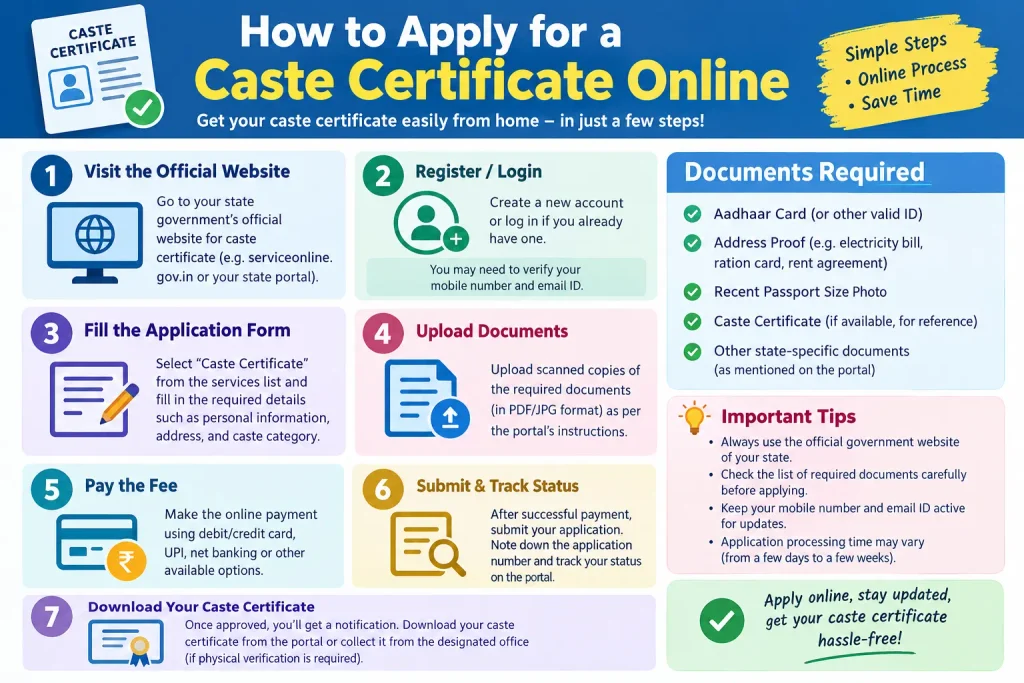
Applications are now handled online in most states. The sequence below reflects how the portals generally work — but treat each step as a checkpoint, because mistakes made in step 4 are the hardest to undo later.
- Locate your state portal. Maharashtra uses Aaple Sarkar, Uttar Pradesh uses edistrict.up.gov.in, Bihar uses serviceonline.bihar.gov.in, Karnataka uses Seva Sindhu. Unsure where to start? Search “Caste Certificate” on the National Government Services Portal (services.india.gov.in) and follow the link to your state.
- Register and verify your mobile number. The OTP arrives within seconds on a working number. If it does not, check that your number is not on DND (Do Not Disturb) — this is the single most common reason applicants get stuck at registration.
- Select the certificate type and category. OBC lists are state-specific; SC and ST lists follow constitutional schedules. Choosing the wrong category here means starting over.
- Fill in family and lineage details. Father’s and grandfather’s caste, village, occupation. This is what the field officer will verify. Spellings matter enormously — the caste name must match your state’s official list exactly, including suffixes. A missing “a” or “u” can trigger a rejection notice weeks later.
- Upload documents. Most portals accept PDF only, with a per-file size cap. Compress scans rather than cropping the certificate number out of the frame, and keep a local copy of everything you upload.
- Field verification. A revenue official — Patwari, Talathi, or Village Level Worker, depending on your state — may visit your locality or check existing government records. Keep your neighbours and family briefed on the details you submitted, since inconsistent answers during a visit slow the file down.
- Certificate issuance. Once signed by the authorised officer, the e-certificate is available for download with a unique certificate number. Save the PDF offline; you will need the number for admissions, scholarships, and job applications.
Two practical warnings. Portals time out after roughly 15–20 minutes of inactivity, so keep your documents in a folder before you begin rather than hunting for scans mid-form. And never submit a second application while the first is pending — duplicate applications are a frequent cause of automated rejection.
Common Mistakes to Avoid
- No father’s certificate. File an RTI request with the Tehsildar for the record, or submit your father’s school leaving certificate if caste appears on it. Some states accept an affidavit plus corroborating documents in the interim.
- Spelling mismatches. The caste name must match the state list and, ideally, the spelling on your father’s certificate. Inconsistency is the most common rejection trigger.
- OBC creamy layer confusion. OBC non-creamy layer (NCL) status requires proof that family income falls below the prescribed ceiling. For central government purposes the limit is currently ₹8 lakh per year, but this figure is revised periodically — verify the latest notification rather than relying on an older form.
- Assuming SC/ST validity is transferable. It is not. Moving states generally means applying fresh, with a migration certificate from your original state.
Frequently Asked Questions
Is a category certificate the same as a caste certificate?
Functionally, yes. “Category certificate” is the broader label used on forms; “caste certificate” names the specific document. Both refer to the same proof of community.
How long is a caste certificate valid?
SC and ST certificates are generally treated as permanent. OBC non-creamy layer certificates usually need renewal — commonly every one to three years, depending on your state.
Can I use a caste certificate issued in another state?
Generally no, for SC and ST categories. You will typically need a fresh certificate from your current state, supported by a migration certificate.
What is jati awasiya download?
It refers to downloading caste and residence certificates. Most state portals, including Bihar’s, let you retrieve the approved certificate from the “Download Certificate” section once verification is complete.
How do I track my application status?
Use the “Track Application” option on your state portal. Enter the application or reference number, complete the CAPTCHA or OTP step, and the current stage will appear. If it has shown “under verification” for longer than your state’s stated timeline, visit the issuing office in person — field-level delays rarely resolve on their own.
What if my application is rejected?
File an RTI request to obtain the stated reason, then either correct and reapply or appeal to the next-level officer, often the District Magistrate. Acting on the stated reason is faster than reapplying with the same documents.
Fees, processing timelines, and document requirements differ by state and change periodically. Confirm current details on your state’s e-District portal or the National Government Services Portal before applying. UIDAI-related identity services can be checked separately at uidai.gov.in.
One last thing worth planning around: if your certificate is needed for a professional course admission or a government post, start the validity certificate process the day your caste certificate is issued. That second verification is the step most applicants underestimate — and it is the one with a fixed admission deadline attached.

1 Comment
Pingback: Single Girl Child Certificate