
The scholarship form is open, your daughter has her Class 10 marksheet, and the school is asking for a single girl child certificate—but nobody is quite sure whether a notarised affidavit will do, which stamp paper value is correct, or who is authorised to attest it. For a parent, that uncertainty can mean losing out over one document. This guide explains what the CBSE Single Girl Child Scholarship actually requires in 2026, how to prepare the affidavit in the accepted format, which documents to scan, and how the online application works from start to finish.
What the Scholarship Covers and Who Qualifies
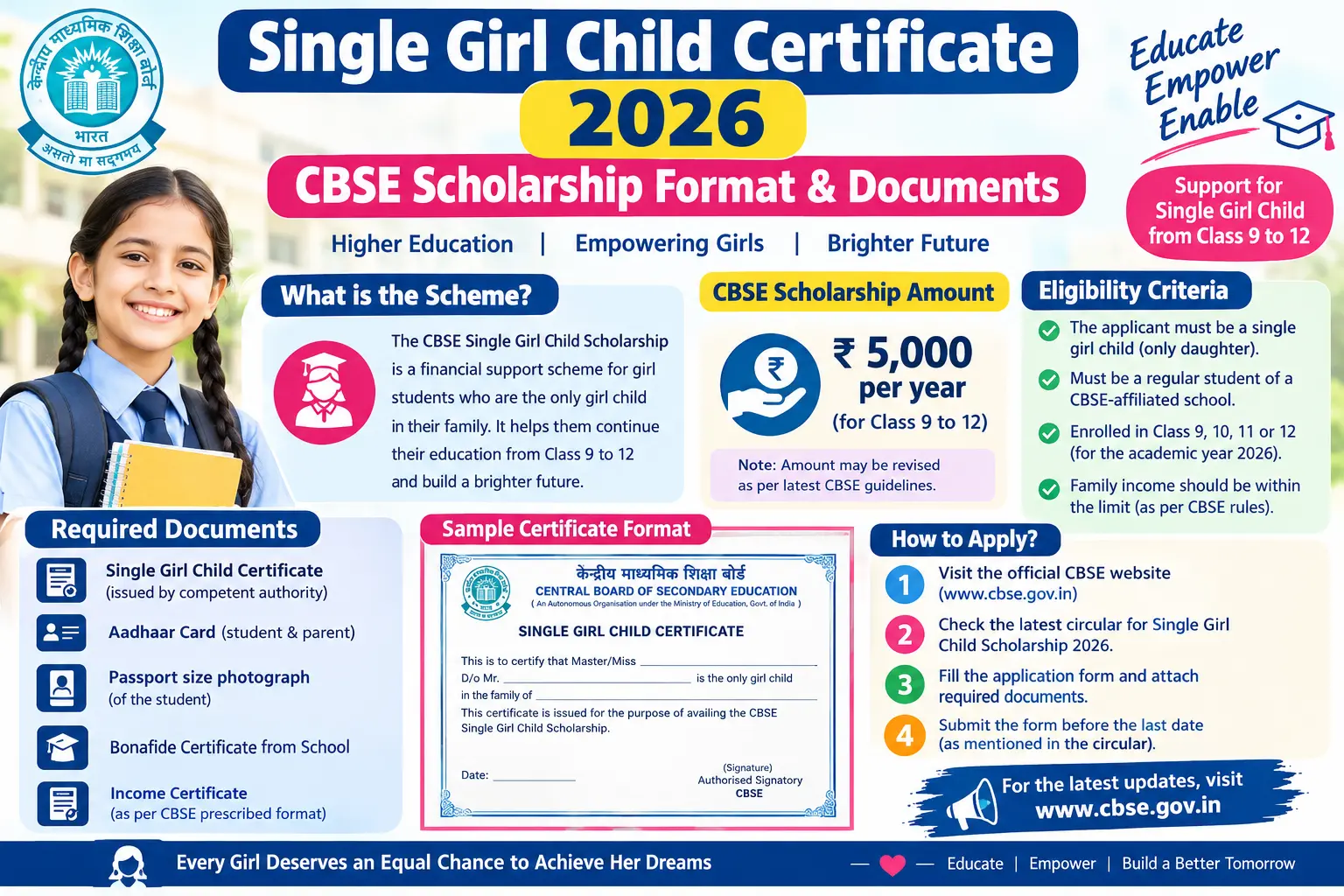
The CBSE Merit Scholarship Scheme for Single Girl Child is meant for girls who are the only child of their parents and have done well in the Class 10 board examination. Selected students generally receive a monthly stipend for up to two years, covering Classes 11 and 12, as long as they continue studying in a CBSE-affiliated school. The amount is transferred directly to the student’s bank account, usually through NEFT or ECS. Exact monthly amounts and renewal conditions change from year to year, so check the current CBSE scholarship notification before applying.
Eligibility is stricter than many families expect. “Single girl child” here does not mean “only daughter.” It means the girl has no brother and no sister. If she has a brother, she is not eligible under this particular scheme, even if she is the only daughter. If you have twins or multiple girls born together, do not assume eligibility—check the current definition in the official guidelines, because different schemes treat this differently.
Other common criteria include:
- Academic performance: Typically 60% or more marks in the CBSE Class 10 board examination. Some years the cutoff has been higher, so verify the current requirement.
- Current enrolment: The student must be studying in Class 11 or 12 in a CBSE-affiliated school.
- Tuition fee limits: CBSE sets fee ceilings for Class 10 and for Classes 11–12, with a separate limit for NRI students. The figures change, so confirm them in the current notification.
- Family income: The annual family income must be within the limit notified by CBSE. A self-declaration on non-judicial stamp paper is commonly required.
- Citizenship: The applicant must be an Indian citizen.
The Single Girl Child Certificate: Format, Affidavit and Attestation
What most CBSE applicants call the “single girl child certificate” is usually an affidavit—a sworn declaration signed by the parents or guardians. It is prepared on non-judicial stamp paper and attested by a competent authority, such as a First Class Judicial Magistrate, Sub-Divisional Magistrate (SDM), Executive Magistrate, or Notary Public. Some states also issue a formal single girl child certificate, but for this scholarship the affidavit is the key document.
The affidavit should clearly state that the parents have only one child—the applicant—and no other son or daughter. A typical format includes:
- Full names of the father and mother, along with their Aadhaar numbers. Aadhaar is the 12-digit identity number issued by the Unique Identification Authority of India (UIDAI).
- The applicant’s name, date of birth, and residential address.
- The school where she is studying, her admission number, and class.
- A declaration that the information is true and that the parents will inform the school authorities if another child is born in the family.
- Signatures of both parents and verification by the attesting authority.
A sample clause often reads: “We, [Father’s Name] and [Mother’s Name], declare that we have no other child except [Name of Single Girl Child]. She is our real daughter, born on [Date of Birth], and we have a single daughter and no other child in our family.” Do not leave blanks. If Aadhaar copies are required with the affidavit, attach self-attested copies.
The stamp paper value and the attesting authority requirements vary by state and can change. Confirm the exact requirements from the current CBSE scholarship guidelines before drafting the document.
Discover More About:👇
Caste Certificate 2026: Documents Required, Apply Online & Category Meaning
Documents Required for the CBSE Single Girl Child Scholarship
Along with the affidavit, you will typically need to upload several supporting documents. The exact list can change slightly each year, but the commonly required papers include:
- Class 10 marksheet: The official CBSE marksheet showing the minimum marks requirement.
- Single girl child affidavit: The notarised or attested declaration that the applicant is the only child.
- School undertaking: A certificate or undertaking from the school principal confirming enrolment, class, and fee details. This is often a prescribed format that the school fills and stamps.
- Aadhaar card: A copy of the student’s Aadhaar card, commonly used as identity proof and for linking the bank account.
- Bank account details: A copy of the bank passbook or a cancelled cheque showing the student’s name, account number, and IFSC code. The account should ideally be in the student’s own name and linked with Aadhaar for direct benefit transfer.
- Fee receipt: Proof of tuition fee payment for the current academic year, verified by the school principal.
- Photograph: A recent passport-size photograph of the student.
- Income declaration: A self-declaration of the family’s annual income on non-judicial stamp paper, as per the prescribed format.
Scan every document clearly. The portal usually accepts JPG or PDF files within a specified size limit. Check the current application page for the exact format and size rules.
Step-by-Step Application Process for 2026
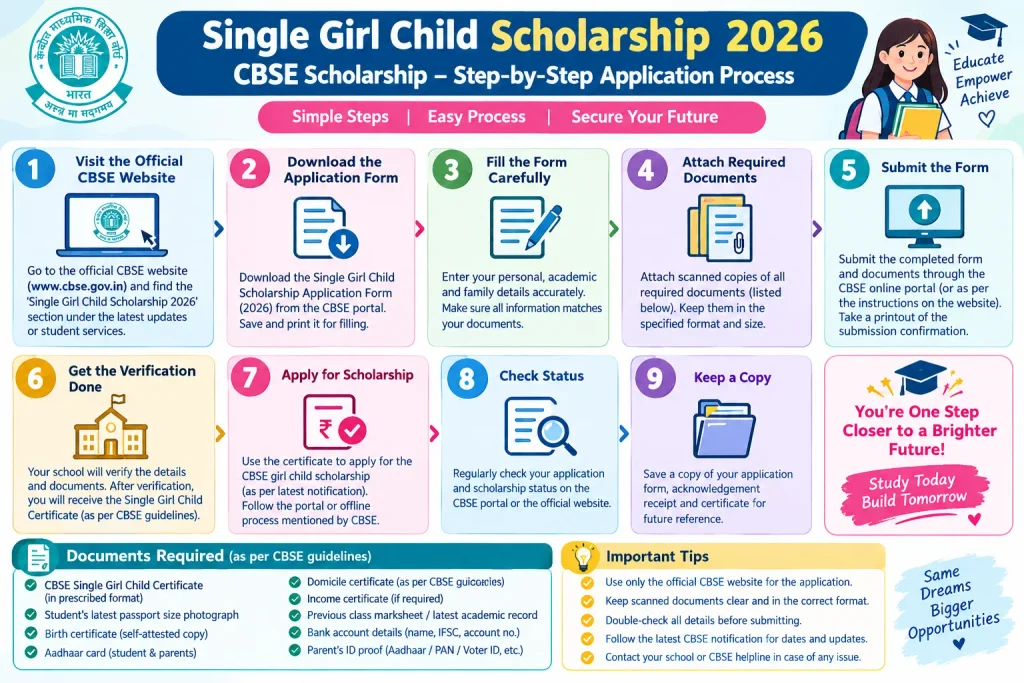
The application is completed online through the official CBSE scholarship portal. Keep your Class 10 roll number, school code, registered mobile number, and bank details handy before you begin.
Before You Start
Scan the marksheet, Aadhaar, bank passbook, fee receipt, photograph, attested undertaking, and affidavit. Save them in a folder with clear names. This avoids the most common delay: hunting for documents while the portal session times out.
- Download the current notification and formats. Go to the official CBSE scholarship (https://www.cbse.gov.in/) section and download the latest guidelines, school undertaking format, and affidavit format. Do not use an old format from a previous year.
- Register or log in. First-time applicants click “Fresh Application” and enter the Class 10 roll number and date of birth. Renewal applicants use the “Renewal” option with their previous credentials. If the roll number or date of birth does not match CBSE records, registration will fail.
- Fill the application form. Enter personal, academic, and bank details exactly as they appear on the marksheet, Aadhaar, and passbook. A name spelling mismatch or a parent’s bank account instead of the student’s account can lead to rejection or payment failure.
- Prepare the undertaking and affidavit. Fill the school undertaking and get it signed and stamped by the principal. Prepare the affidavit on the correct stamp paper and get it attested by a Notary, SDM, or First Class Magistrate. Using the wrong authority is a frequent reason for rejection.
- Upload the documents. Upload the attested undertaking, affidavit, and all other required scans. Check file size and format. If the portal logs you out mid-way, log in again and re-upload; keep the confirmation page only after everything is submitted.
- Submit and print the confirmation. After submission, print the confirmation page. The school must then verify the application online through its login. An application often remains “pending” until the school completes this step, so follow up with the school office.
Common Mistakes to Avoid
- Wrong affidavit format or authority: An affidavit attested by someone not recognised in the guidelines can be rejected.
- Mismatched details: Name, date of birth, parent details, and bank account information must match across the marksheet, Aadhaar, passbook, and affidavit.
- Incomplete school verification: The school must verify the application online. If it does not, the application will not move forward.
- Poor-quality scans: Blurred or oversized files may fail upload or be rejected later.
- Missing the deadline: The application window is usually open for a limited period. Submit well before the last date to avoid portal slowdowns.
- Ignoring renewal: The scholarship is not automatically renewed for Class 12. A separate renewal application is generally required after passing Class 11 with the minimum marks.
Frequently Asked Questions
Q1: Can a girl with a brother apply for the CBSE Single Girl Child Scholarship?
No. The scheme defines a single girl child as the only child of her parents, with no brother or sister. If there is a brother, the applicant is not eligible under this scheme.
Q2: Is Aadhaar mandatory for this scholarship?
Aadhaar is commonly required as identity proof and for linking the bank account for direct benefit transfer. Requirements can vary, but it is best to have the student’s Aadhaar and ensure it is linked to her bank account.
Q3: How much is the scholarship amount?
The amount has varied in recent years. It is typically a monthly stipend paid for up to two years. For the exact current amount, check the official CBSE scholarship guidelines.
Q4: Can I apply if I am studying in a school not affiliated with CBSE?
No. The scholarship is specifically for students continuing their education in CBSE-affiliated schools for Classes 11 and 12.
Q5: What is the last date to apply for the 2026 scholarship?
Application dates are announced by CBSE each year, usually between September and November. Visit the official CBSE website for the exact dates for the current academic year.
Q6: Is the scholarship renewed automatically for Class 12?
No. You must apply for renewal separately after passing Class 11 with the minimum required marks. Renewal applications are also submitted online through the CBSE portal.
If you are applying in 2026, start with the affidavit—not the online form. That one document tends to cause the most back-and-forth. Once it is attested correctly and the Aadhaar and bank details match across all papers, the portal itself is usually the easy part. If the school verification is still pending a week after submission, follow up in person; online applications rarely move on their own.
