

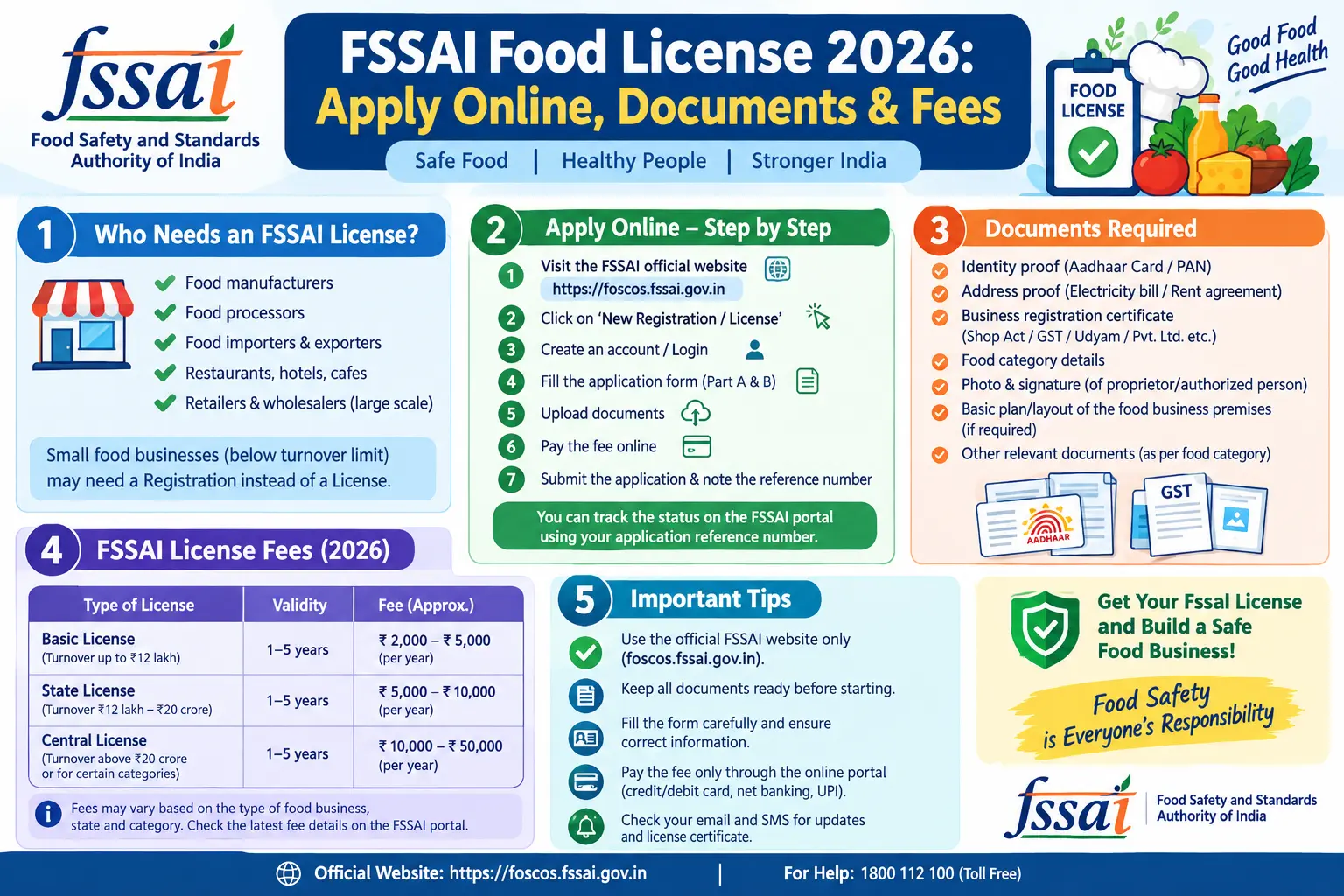
Your kitchen is ready. Your first Swiggy or Zomato order is waiting. And the platform won’t publish your listing until you upload a valid 14-digit FSSAI number. Or perhaps you’ve already filed the application, and the FoSCoS dashboard has been sitting on “Under Process” for three weeks while the rent falls due.
Either way, the question is the same: how to apply FSSAI license correctly the first time, so you aren’t stuck resubmitting paperwork. This guide covers the three licence categories, the fees, the exact document list, and the FoSCoS application process — including the small errors that cause most of the delays.
What Is an FSSAI Food License, and Who Needs One?
The Food Safety and Standards Authority of India (FSSAI) is the regulator under the Ministry of Health and Family Welfare that sets and enforces food safety standards nationwide. A food license — formally an FSSAI registration or licence — is the certificate confirming your business meets those standards.
Once approved, you receive a 14-digit licence number. That number goes on your packaging, your premises signage, your menu, and your invoices.
Who needs it? Any Food Business Operator (FBO) — a term that covers manufacturing, processing, packaging, storage, transport, distribution, and sale. Restaurants, cloud kitchens, tiffin services, street vendors, home bakers, grocery stores, importers, exporters, and e-commerce food sellers all fall inside it. The single exemption is food cooked at home purely for family consumption.
Basic, State, or Central: Which FSSAI License Fits Your Business?
FSSAI runs a three-tier system based on annual turnover. The thresholds have been revised over the years, so older guides quote different limits — confirm the current slabs on the FoSCoS portal before picking a form.
| Category | Annual Turnover | Form | Typical Applicants |
|---|---|---|---|
| Basic Registration | Up to ₹1.5 crore | Form A | Home bakers, kirana shops, tea stalls, petty vendors |
| State License | ₹1.5 crore – ₹50 crore | Form B | Restaurants, mid-size manufacturers, single-state distributors |
| Central License | Above ₹50 crore | Form B | Large manufacturers, importers, multi-state operators |
Basic Registration is the lightest tier. It generally requires no premises inspection and no layout plan. State and Central Licences both involve a physical inspection and a considerably longer form.
FSSAI License Fees and Validity
Fees are paid annually and scale with the category. As per current published information, they commonly work out to:
- Basic Registration: ₹100 per year
- State License: roughly ₹2,000 to ₹5,000 per year, depending on the nature of the business
- Central License: ₹7,500 per year
You can pay for one to five years upfront.
On validity: recent amendments have moved FSSAI registrations and licences toward perpetual validity, easing the old renewal cycle. If your licence was issued under the earlier framework, check the validity dates printed on the certificate itself. Either way, the annual return obligation still applies — commonly Form D-1, due by 31 May — along with ongoing hygiene and safety compliance. Fees and rules are revised periodically, so verify current figures on FoSCoS rather than relying on any blog, this one included.
Discover More About:👇
Udyog Aadhaar (Udyam) Registration: How to Register & Download Certificate
Aadhaar eSign: How to Digitally Sign Documents Using Aadhaar OTP
Documents Required for FSSAI License
The document required for FSSAI license depends on the tier. For Basic Registration, the list is short:
- Photo ID of the applicant (Aadhaar, PAN, Voter ID, or Passport)
- Passport-size photograph
- Proof of business address (electricity bill, rent agreement, or property tax receipt)
- A self-declared list of the food categories you’ll handle
- Bank proof (cancelled cheque or passbook copy) — often requested, though not universally enforced
For a State or Central License, add:
- PAN of the business entity
- Proof of business constitution — partnership deed, Certificate of Incorporation, LLP agreement, or MOA/AOA
- Shop & Establishment Certificate or Trade Licence, where the state mandates it
- Layout plan of the unit showing dimensions and how space is allocated
- Food Safety Management System (FSMS) plan — a written description of your hygiene and quality-control practices
- NOC from the local municipal authority or panchayat
- Equipment and machinery list with installed capacity, for manufacturing units
- Water test report from a NABL-accredited lab, mandatory where water is an ingredient
Keep clean, legible scans ready before you begin. A blurry Aadhaar scan is the single most common reason an application bounces back.
How to Apply FSSAI License Online: Step-by-Step
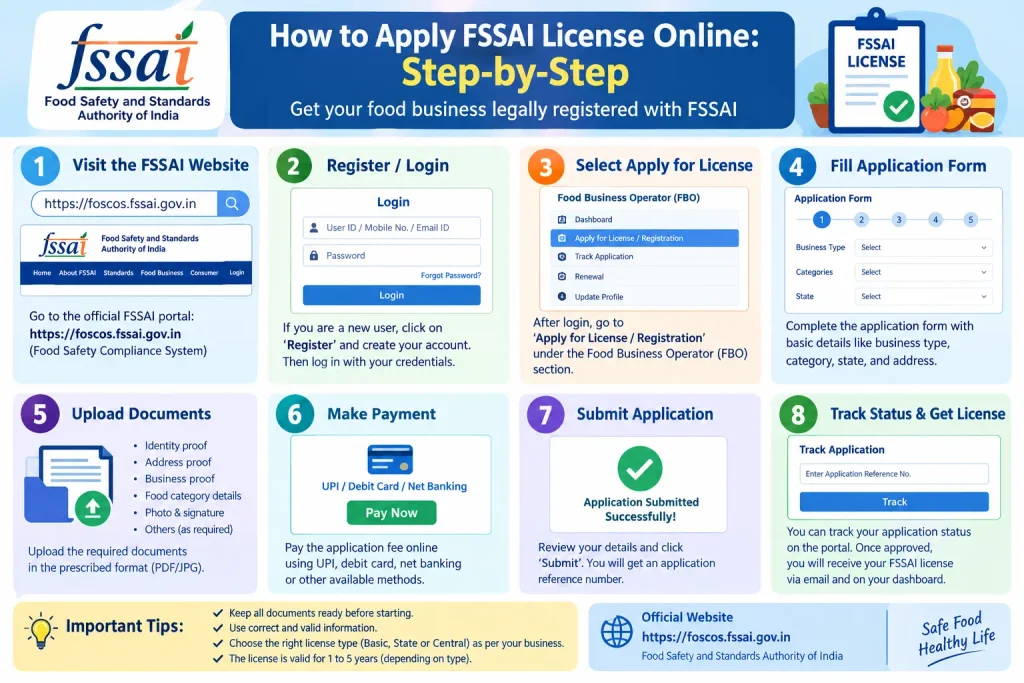
Every application is filed on the FoSCoS portal (foscos.fssai.gov.in). One portal handles all three tiers, so whether you’re filing a basic registration or a full food licence, you start in the same place — only the depth of information changes.
Step 1: Fix your category first. Work out your expected annual turnover and match it to the correct tier. This is the decision that causes the most trouble later. Filing Form A when you should have filed Form B means starting over.
Step 2: Register on FoSCoS. Sign up with a valid email and mobile number. The OTP arrives on that mobile, so use a number you’ll still have access to in six months. Applicants who register with a number that later gets disconnected often struggle to recover the account.
Step 3: Choose the right form. After logging in, select “Apply for License/Registration,” then Form A for Basic or Form B for State/Central. Pick your state from the dropdown — the fee and the inspection workflow are state-specific.
Step 4: Fill in the business details. Name, address, nature of activity, food categories, turnover. For Form B, this is where you attach the layout plan and the FSMS plan.
Step 5: Upload documents. Match each file to the correct field. Multi-page documents must be complete — a rent agreement uploaded without its middle pages will be flagged. Stay within the portal’s stated file size and format limits.
Step 6: Pay the fee. Net banking, debit card, credit card, or UPI. Choose your payment period (one to five years) before you pay, because changing it afterwards is not straightforward.
Step 7: Track and respond. You’ll receive a reference number. Watch the FoSCoS dashboard. If the Designated Officer raises a clarification, respond through the portal — documents emailed separately won’t attach to your file. For State and Central Licences, an inspector will schedule a premises visit, so keep the unit accessible and reasonably organised.
Pitfall to watch: if the OTP doesn’t arrive, check whether your number is on DND and retry after a few minutes rather than creating a second account. Duplicate accounts spawn duplicate applications, and both get held up.
Processing time varies. Basic Registration commonly comes through within about a week. State and Central Licences take longer because of the inspection — often a month or more. Check the portal for current timelines rather than planning around a fixed number.
Frequently Asked Questions
How long does it take to get an FSSAI license?
Basic Registration is generally issued within about 7 working days. State and Central Licences commonly take 30 to 90 working days because of the premises inspection. Timelines vary by state and by how complete your application is.
Do I need to renew my FSSAI license?
Under recent amendments, FSSAI registrations and licences carry perpetual validity, so the periodic renewal requirement has been eased. Check the validity dates on your own certificate, and remember the annual return obligation still applies.
What is the difference between a food license and a food registration?
“Food license” is used loosely for all three tiers. Technically, Basic Registration is the lighter compliance route for small businesses, while State and Central Licences require a fuller application and an inspection. All three result in a 14-digit FSSAI number.
Can I apply for an FSSAI license for a home-based food business?
Yes. Home bakers, tiffin services, and small home kitchens typically fall under Basic Registration if turnover is within the threshold. You’ll need address proof and photo ID; a premises inspection is usually not required.
What happens if I operate without an FSSAI license?
It is a punishable offence under the Food Safety and Standards Act, 2006, carrying fines and, in serious cases, imprisonment. Online delivery platforms will also refuse to onboard you.
Where can I check the latest fees and rules?
FSSAI revises fees and regulations periodically. Check the FoSCoS portal (foscos.fssai.gov.in) or the FSSAI website, or contact your State Food Safety Department for guidance specific to your business type.
The one step worth slowing down for is the first one. Choose the wrong tier and everything downstream — the fee, the inspection, the document set — has to be redone. And if your application has been sitting without movement for more than a fortnight, log in and look for a pending clarification rather than waiting on an email; FoSCoS notifications have a habit of landing in spam.
