
By the time a parent turns 80, the paperwork around their pension, bank deposits, health cover and state certificate often changes—but the rules do not announce themselves. If you have ever wondered why a 60-year-old and an 80-year-old are treated differently on an income tax return, or why one family gets a higher central pension than another, the answer usually starts with one number: the super senior citizen age. This guide explains that threshold, the tax limits attached to it, and the welfare schemes that open up once you cross it. Use it to check eligibility, not to replace the official rulebook.
What Is the Super Senior Citizen Age in India?
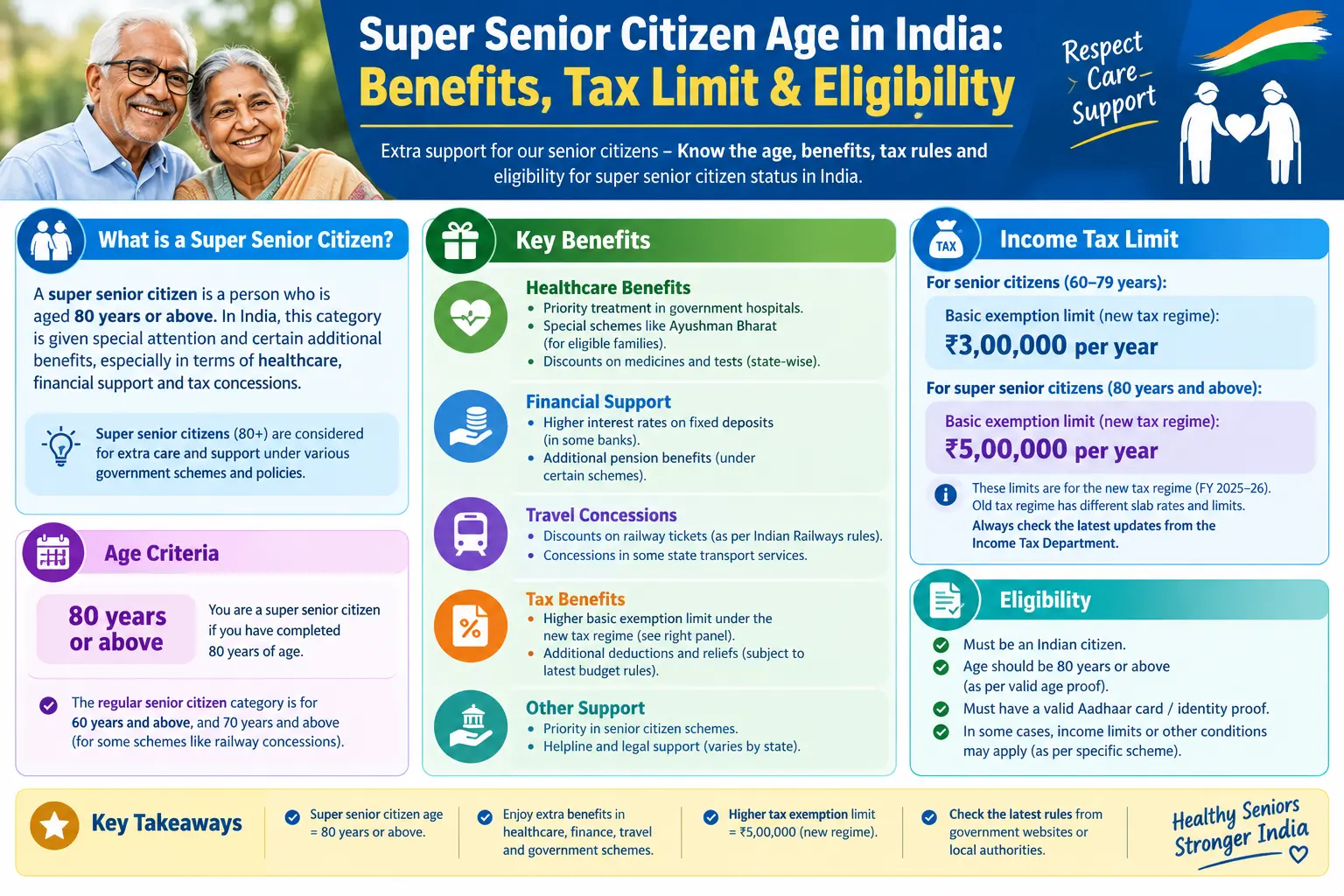
For income tax and most central government schemes, a senior citizen is a resident individual who turns 60 at any point in the financial year. The senior citizen age in India for male and female applicants is the same: 60. There is no separate higher or lower bar based on gender.
The super senior citizen age limit is 80. Once a resident individual is 80 or above at any time during the previous year, they are treated as a super senior citizen for that entire financial year. A person whose 80th birthday falls on 31 March, for example, still qualifies for the whole year.
State schemes can set different gates. In Maharashtra, the senior citizen age for most certificates and concessions is 60, while some programmes use 65 or 75. Some central health schemes, such as Ayushman Bharat cover for seniors, use 70. So the income tax definition is uniform; welfare eligibility is not. Always read the scheme’s own fine print.
Discover More About:👇
UP Senior Citizen Card: Eligibility & Documents Required (Kaise Banaye)
Income Tax Benefits and Limits for Super Senior Citizens
The clearest financial advantage of crossing the super senior citizen age in India is a higher basic exemption limit. Under the old tax regime, a super senior citizen can earn up to ₹5 lakh before income tax applies. A senior citizen aged 60 to 79 gets ₹3 lakh, and everyone else gets ₹2.5 lakh.
Under the new tax regime, which is the default, the basic exemption is ₹4 lakh for all age groups, including super senior citizens. The higher ₹5 lakh old-regime limit is not automatic. If you want it, you must choose the old regime when filing. That choice makes sense only if your deductions are large enough to offset the new regime’s lower rates.
Other old-regime deductions commonly used by this age group include:
- Section 80D: Up to ₹50,000 for health insurance premiums for self, spouse and dependent children, plus another ₹50,000 for parents’ premiums. If no insurance is in place, up to ₹50,000 may be claimed for actual medical expenditure.
- Section 80DDB: Up to ₹1 lakh for treating specified diseases, for self or dependents.
- Section 80TTB: Up to ₹50,000 on interest from bank, post office or cooperative society deposits. This matters for retirees who live on interest income.
- Standard deduction: ₹50,000 under the old regime and ₹75,000 under the new regime for FY 2025-26, where applicable to pension income.
Super senior citizens without business or professional income are also exempt from advance tax. Eligible filers can use ITR-1 or ITR-4 in paper mode, subject to Income Tax Department conditions. That helps those who are not comfortable with the e-filing portal. Tax rules change; confirm current slabs and deduction caps before filing.
Welfare Schemes Open to Super Senior Citizens
Tax relief is only one part. The super senior citizen age also triggers higher central assistance and dedicated support programmes.
Under the National Social Assistance Programme, the central old-age pension contribution is commonly ₹200 per month for beneficiaries aged 60 to 79 and ₹500 per month for those aged 80 and above. States often add their own top-up, so the final amount varies.
Ayushman Bharat–Pradhan Mantri Jan Arogya Yojana offers ₹5 lakh per family per year for hospitalisation. All senior citizens aged 70 and above are eligible regardless of socio-economic status. The Rashtriya Vayoshri Yojana gives free physical aids and assisted-living devices to senior citizens with age-related disabilities, generally subject to a monthly income limit. It is implemented through ALIMCO.
Elderline, the national helpline 14567, provides free information, emotional support and field intervention for seniors in distress. It operates from 8 AM to 8 PM daily.
In Maharashtra, a senior citizen certificate is issued to residents aged 60 and above and can be used for state concessions, including bus fare benefits. Some state schemes, such as the Chief Minister Vayoshree Scheme, target those above 65 for medical equipment assistance. Check the current state portal or local office for the latest eligibility.
How to Apply for a Senior Citizen Certificate and Documents Required
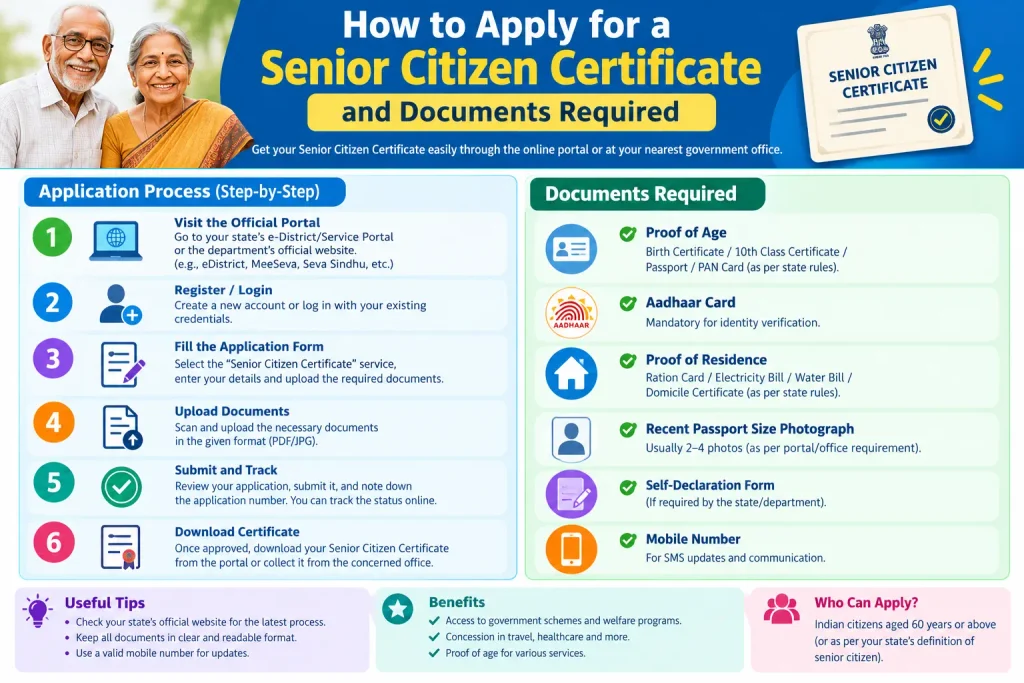
A senior citizen certificate is often the first document needed for state-level benefits. The exact process varies by state, but the pattern is similar.
- Confirm your state’s age rule. In Maharashtra, the general threshold is 60. Some schemes may require 65 or 75, so check the specific benefit first.
- Gather proof. You will typically need Aadhaar for identity and address, an age proof such as a birth certificate, school leaving certificate, PAN card or passport, a recent passport-sized photograph, and a residence proof such as voter ID, ration card or electricity bill.
- Apply online or offline. In Maharashtra, applications can be submitted through the Aaple Sarkar portal (https://aaplesarkar.mahaonline.gov.in) or at the Tehsil, Talathi or District Collector’s office. For central schemes, use the relevant ministry portal or Common Service Centre.
- Track and collect. After submission, note the application number. If you apply online, check the portal for status. If you apply offline, ask for an acknowledgment receipt.
- Keep a copy. Once issued, store a photocopy and a digital scan. Many concessions require the certificate number, not the original.
There is generally no government fee for the certificate itself, though a Common Service Centre may charge a service fee. For central schemes, an income certificate or disability certificate may also be required. Two common snags: the name on your Aadhaar and your age proof may not match, and the online form may log you out before upload. Keep scanned copies ready and save the application number. Requirements change, so verify on the official portal before you travel to an office.
Common Mistakes to Avoid
- Assuming every scheme uses 80. The super senior citizen age for income tax is 80. Many state and health schemes use 60, 65 or 70. Match the age to the scheme.
- Ignoring the old-versus-new tax regime choice. The ₹5 lakh exemption is old-regime only. Run both calculations before filing.
- Forgetting Section 87A. Under the old regime, taxable income up to ₹5 lakh may attract no tax due to the rebate. Under the new regime, the rebate threshold is different. Make sure your return reflects the correct regime.
- Missing the standard deduction on pension. Pensioners often overlook this deduction, which can lower taxable income.
- Letting KYC go stale. Banks and post offices need current KYC for deposits and interest credits. Update your mobile number and address if they have changed.
FAQs
What is the exact super senior citizen age in India?
A resident Indian who is 80 or above at any time during the financial year is classified as a super senior citizen for income tax purposes.
Is the senior citizen age in India for male and female applicants different?
No. For income tax and most central schemes, the senior citizen age is 60 for both men and women. Some state schemes may use a different threshold.
What is the basic exemption limit for a super senior citizen?
Under the old tax regime, it is ₹5 lakh. Under the new tax regime, it is ₹4 lakh for all age groups.
What is the senior citizen age in Maharashtra?
Maharashtra generally treats a person aged 60 or above as a senior citizen for certificates and many state concessions. Specific schemes may set a higher age.
Can a super senior citizen file income tax returns offline?
Eligible super senior citizens can file in paper mode using ITR-1 or ITR-4, subject to Income Tax Department conditions.
What is the central pension amount for super senior citizens?
Under the National Social Assistance Programme, central assistance is commonly ₹500 per month for those aged 80 and above, compared with ₹200 for those aged 60 to 79. State top-ups vary.
Closing Thoughts
The 80-year mark is not just a birthday. It changes tax limits, pension rates, health cover and state benefits—but only if the right form is filed or the right certificate is produced. If you are helping a parent or relative, start with the income tax regime choice and the senior citizen certificate, then work through the scheme list one by one. If a rule seems unclear, verify it on the official Income Tax Department or UIDAI portal where Aadhaar details are involved, or consult a tax professional. The cost of checking is small; the cost of missing an entitlement can last for years.

1 Comment
Pingback: Vayoshri Yojana 2026: Eligibility & Benefits