
A wheelchair costs money. So does a hearing aid, a walker, a set of dentures, a pair of spectacles thick enough to actually read with. For a household already stretched thin, these are not minor purchases — they decide whether an elderly parent stays mobile or gradually stops leaving the house. The Vayoshri Yojana was created for exactly that gap. It supplies assistive devices free of cost to senior citizens who cannot afford them, and it has quietly helped lakhs of families since 2017. What follows covers who qualifies, what you can get, how the camp-based process actually runs, and which paperwork tends to trip people up.
What the Scheme Actually Does
The Vayoshri Yojana — formally the Rashtriya Vayoshri Yojana (RVY) — is a central sector scheme run by the Ministry of Social Justice and Empowerment. Its implementing agency is the Artificial Limbs Manufacturing Corporation of India (ALIMCO), a public sector undertaking under the Department of Empowerment of Persons with Disabilities. ALIMCO manufactures the devices; the government pays for them through the Senior Citizens’ Welfare Fund.
Nothing arrives by courier. Instead, ALIMCO holds assessment and distribution camps in districts, usually in coordination with the state government and the local administration. A medical officer or rehabilitation specialist examines each applicant at the camp, decides which device fits their condition, and the device is fitted and handed over — often the same day, sometimes at a follow-up distribution camp. Distribution has also been extended to elderly residents of old-age homes in recent years. For a beneficiary, the cost is zero. No application fee, no fitting charge, no deposit.
Who Is Eligible for the Vayoshri Yojana?
Three conditions decide eligibility: age, income, and a genuine need for a device.
Age. The applicant must be 60 or older.
Income. The scheme began as a BPL-only programme and has since been widened. Under the current framework, senior citizens with a monthly income of up to ₹15,000 are generally eligible. State-level variations exist, so confirm the applicable threshold with your district social welfare office or on the official ALIMCO site before you travel to a camp.
Medical need. The applicant must have an age-related condition that an assistive device can address — low vision, hearing loss, difficulty walking, missing teeth, and similar. A medical officer certifies this at the camp. There is also a condition that the person has not already received the same type of device free from another government source; a short self-declaration covers this.
Discover More About:👇
Super Senior Citizen Age in India: Benefits, Tax Limit & Eligibility
Devices Provided Under the Scheme
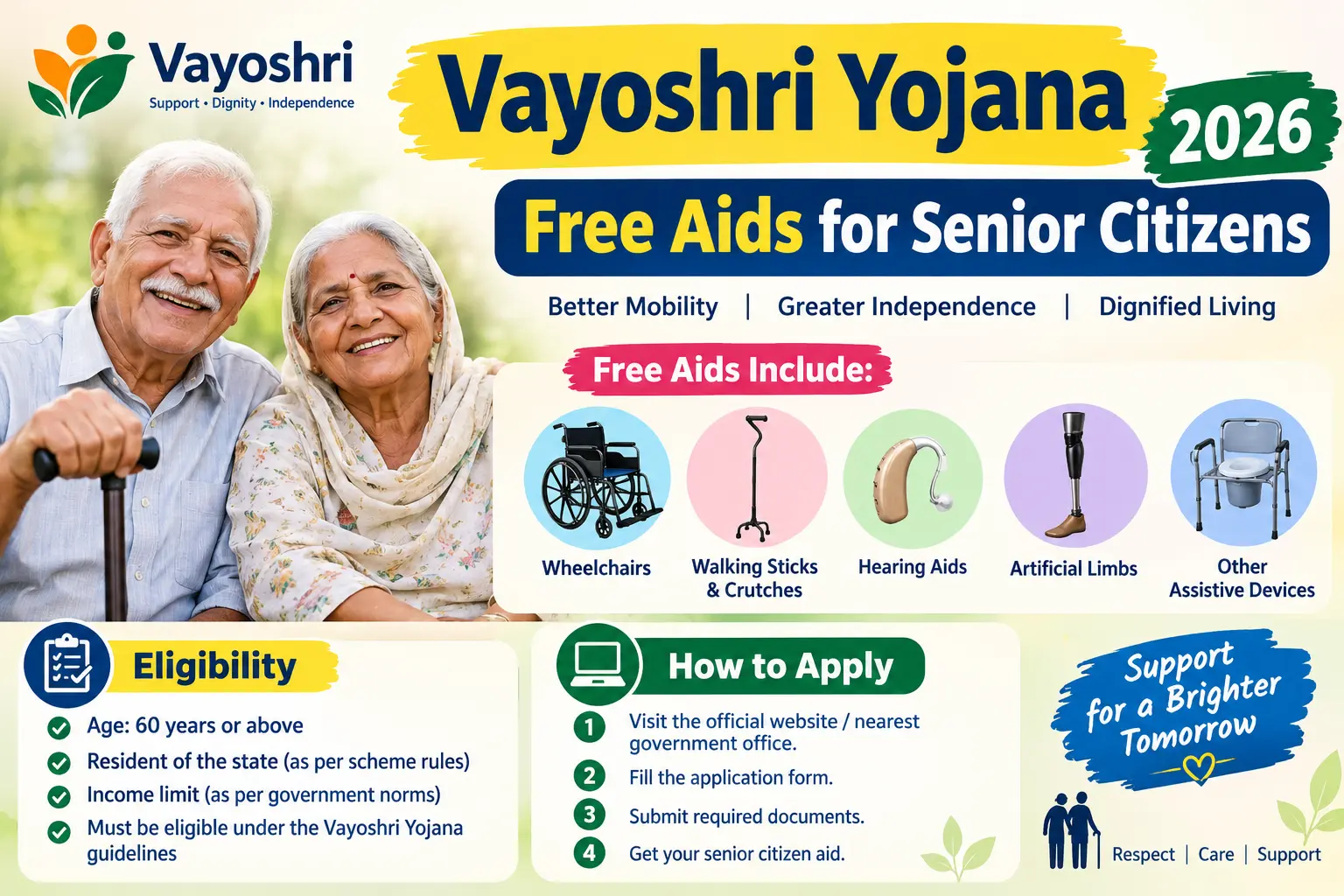
The device list is broader than most people expect. Generic aids include walking sticks, elbow crutches, walkers, tripods, quadpods, hearing aids, spectacles, and artificial dentures. The assisted-living category covers wheelchairs (including commode models), rollators with brakes, walking sticks with attached seats, silicon foam cushions, knee braces, spinal supports, cervical collars, lumbosacral belts, commode chairs and stools, and foot care kits containing items like flexi gel socks, cushion sandals, and silicone insoles.
Everything on that list is free. Which is why the single most useful thing to remember is this: nobody legitimate will ask you for money under this scheme. Anyone charging a “registration fee” or promising a faster device for a payment is running a racket on elderly applicants.
How to Apply: Step by Step
There is no single online form you fill in and then wait for a parcel. The process is physical, camp-based, and slightly old-fashioned — which is also why so many people miss it.
Step 1 — Check eligibility and assemble documents first. Age, income, and medical need are the three filters. Get the paperwork together before you start hunting for a camp, because camp days are short and incomplete files often mean being turned away.
Step 2 — Find out when a camp is coming to your district. Camps rotate, so there may not be one next week. Check the ALIMCO website (alimco.in) or the Ministry of Social Justice and Empowerment portal (socialjustice.gov.in) for schedules. The Elderline helpline, 14567, operates from 8:00 AM to 8:00 PM on all days except national holidays and can tell you about camps and enrolment. Your district Social Welfare Officer or the District Magistrate’s office will also have local dates.
Step 3 — Register. You can register by walking in to an ALIMCO Auxiliary Production Centre, Regional Marketing Centre, or a designated camp venue. Registration is also routed through the ARJUN Portal, ALIMCO’s platform for assistive device distribution schemes, and through district administration lists built from state pension or National Social Assistance Programme (NSAP) beneficiary data. If a parent already receives an old-age pension, their name may already be on a district list — worth asking.
Step 4 — Attend the assessment camp. A medical officer or rehabilitation expert examines the applicant and decides the appropriate device. For hearing aids, an audiogram is commonly required; ask ahead whether it will be done at the camp or whether you need to bring one.
Step 5 — Collect the device. Fitting and a basic walkthrough on using the device usually happen at the camp itself. If an item needs customisation or is out of stock, ALIMCO will give you the next distribution date. Keep that slip — it is your only proof of registration.
Two pitfalls worth knowing before you go. First, camps often run on a token or daily-capacity basis in many districts, so arriving early in the morning matters far more than people expect. Second, camp staff typically retain photocopies of your documents, so carry a full set of originals and copies — not just originals. Losing a day of travel because one photocopy was missing is a common and entirely avoidable frustration.
Documents to Carry
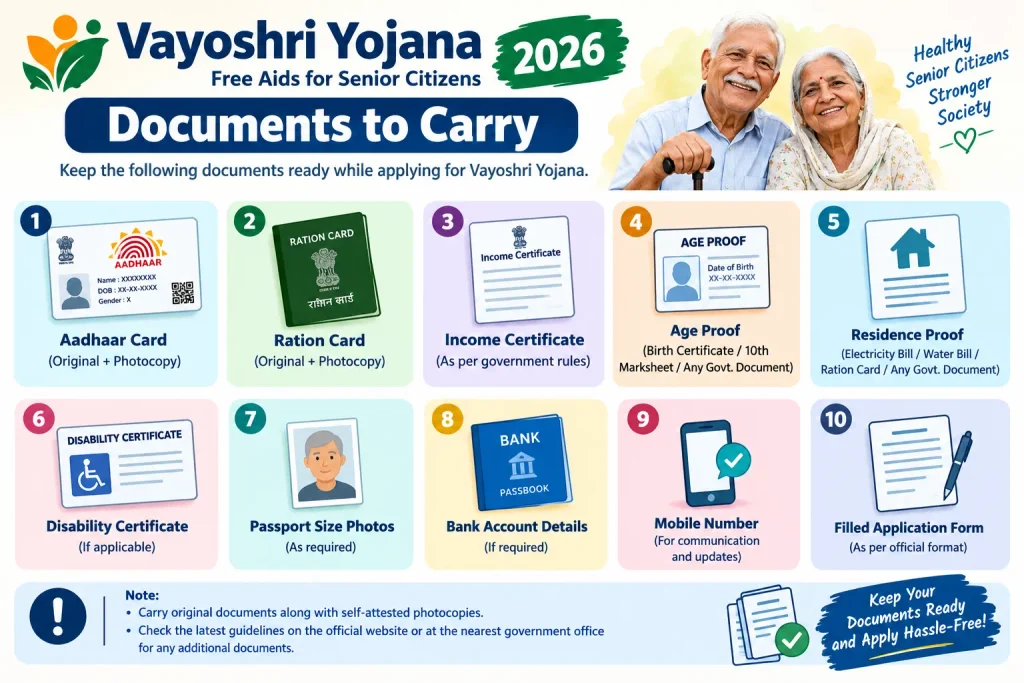
- Aadhaar card — the primary identity and age proof. If unavailable, an Aadhaar acknowledgement slip or another government-issued photo ID is generally accepted.
- Income certificate — from the Tehsil, District Administration, or a competent authority, showing monthly income within the prescribed limit. A self-written declaration is usually not enough.
- BPL ration card, or proof of old-age pension under NSAP or a state pension scheme.
- Two passport-sized photographs.
- Medical report or certificate from a medical officer noting the condition requiring the device.
- Bank passbook copy — devices are free, but administrative records sometimes need bank details.
- Self-declaration that the same device has not been received free from another government source.
Requirements vary slightly by district and camp, so carry originals plus photocopies of everything.
Common Mistakes to Avoid
Hunting for an “online apply” link. Plenty of unofficial websites mimic a government application form for this scheme. No such direct form exists. The ALIMCO site is where you check camp schedules and scheme information, not where you submit a personal application the way you would for a scholarship.
Assuming the income certificate can be skipped. It cannot. This is the single most frequent reason applications stall at the camp desk.
Paying an agent. ALIMCO officials and government staff do not collect money for RVY devices. Any demand for payment should be reported.
Checking camp schedules only once. Camps are not held daily. If you miss one cycle, the wait for the next can be weeks or months. A monthly check of alimco.in or a call to 14567 is a small habit that saves a long wait.
Frequently Asked Questions
Can I apply for the Vayoshri Yojana online?
Not through a direct personal application form. Registration happens at ALIMCO centres, via the ARJUN Portal, or at district camps. Online channels are mainly for checking camp schedules and scheme details.
Is there any fee for the device or the assessment?
No. Assessment and devices are free, funded by the Central Government. Payments demanded by anyone in connection with RVY should be treated as fraudulent.
What is the income limit?
Originally BPL-only, the scheme now generally covers senior citizens with monthly income up to ₹15,000. Verification methods differ by state, so confirm the current threshold locally.
My parent is over 80. Is there a special provision?
Senior citizens aged 80 and above may be eligible for doorstep distribution of assisted-living devices in certain areas, depending on how the scheme is being implemented locally. Ask your district administration or ALIMCO whether it is available where you live.
Where do I find camp dates for my district?
alimco.in, socialjustice.gov.in, or the Elderline helpline on 14567.
What if there is no Aadhaar card?
Alternatives are generally accepted — Aadhaar acknowledgement slip, BPL ration card, voter ID, or pension proof. Carry whichever government-issued ID you have.
A Final Point Worth Knowing
If you attend a camp and the device you need is out of stock, do not assume the application has lapsed. ALIMCO usually schedules a follow-up distribution round, and your registration slip is what gets you on that list. Chasing the district office or calling Elderline a few weeks later is far more productive than starting over at the next camp. Rules and income thresholds do get revised from time to time, so a quick check on the official ALIMCO site before travelling is worth the five minutes it takes.
