
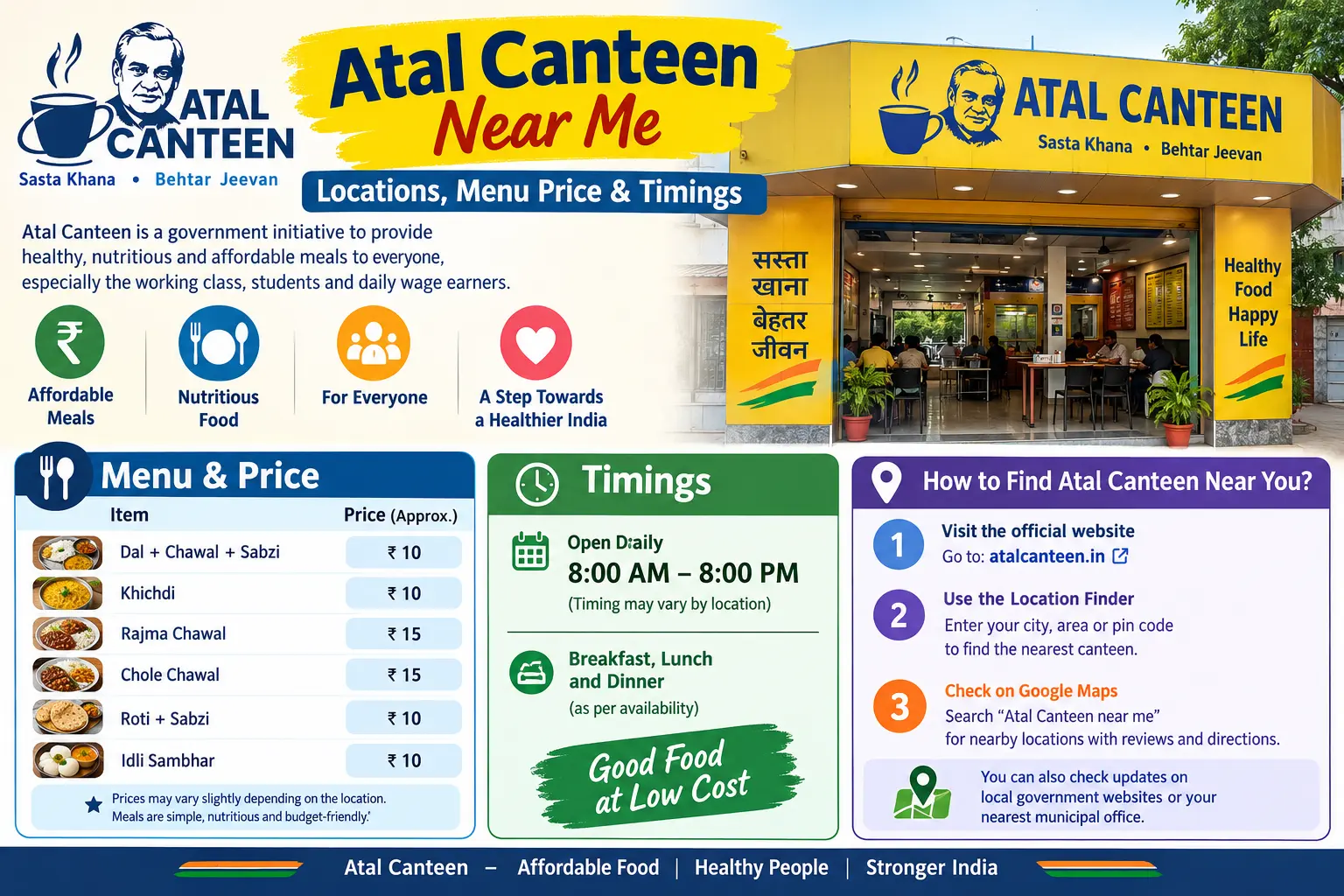
You have heard about the ₹5 thali. You may have also walked to a canteen only to find the shutter down, or stood in a queue that moved slower than you expected. The frustrating part of the atal canteen near me search is rarely the price — it is figuring out which of the roughly 100 Delhi government canteens is actually running in your area, what time the counter really opens, and whether you need to carry anything beyond a five-rupee coin. This guide covers the scheme’s current shape, the areas where canteens are operational, the menu and timings as last revised, how the digital token system works in practice, and the small details that decide whether your trip is worth it.
Discover More About:👇
Aadhaar Status Check – How to Check Enrolment & Update Status Online
What the Atal Canteen Scheme Actually Offers
The Atal Canteen scheme is a subsidised meal programme run by the Delhi government and named after former Prime Minister Atal Bihari Vajpayee. It was inaugurated on 25 December 2025, his 101st birth anniversary, and replaced the earlier Jan Aahar scheme with a sharper focus on hygiene, technology-based monitoring, and consistent food quality.
The economics are deliberately simple. A thali costs ₹5. Officials have put the actual preparation cost at roughly ₹30, with the government absorbing the difference — about ₹25 per meal. That ₹5 charge is not meant to recover costs; it is meant to discourage wastage and let people pay for their food rather than receive it as charity. Once all 100 canteens are fully operational, the scheme is designed to serve over one lakh meals a day.
Who can eat here
Anyone can buy a thali. There is no ration card requirement, no income certificate, and no eligibility document to produce at the counter. The locations are chosen for high footfall of daily-wage workers, industrial labourers, rickshaw pullers, street vendors, and residents of JJ clusters — but the canteens do not turn away anyone else who wants to eat. Some centres may run separate queues during peak hours, and local practice can differ slightly from one location to another, so it is worth asking the staff on your first visit.
How to Find an Atal Canteen Near Me Without Wasting a Trip
The canteens are spread across all 70 Assembly constituencies, with priority given to industrial areas, labour hubs, and densely populated settlements. The rollout happened in phases — 45 in the first phase, expanding to 100 — so a location that was not operational a few months ago may well be running now.
Well-known operational areas include:
- Narela – Vacant land, Pocket-11, Sector A-6, Narela (HUDCO), and CS Plot, B-Block, Holambi Kalan
- Bawana – C-Block, Shahbad Daulatpur (Dairy), and CS Land, A-Block, SRS Bawana
- Wazirpur – Near C-35 JSC, Wazirpur Industrial Area
- Shalimar Bagh – Near Mohalla Clinic, AA Block, Kela Godown Road
- Jahangirpuri / Adarsh Nagar – G-Block Cluster, Jahangirpuri, Azadpur
- Mangolpuri – N-Block and land near BVK, G-Block
- Rajouri Garden – Vacant land between JJ Cluster, Shyam Nagar, and Shikhri Bhatta
- Madipur – R-Block JJC, Raghubir Nagar, and near B1 & K Block JJC
- Rajinder Nagar – B-Block, Budh Nagar, Inderpuri, and Shivaji Park, Naraina Industrial Area
- Lajpat Nagar – Near Apna Bazaar, Nehru Nagar
This is not the full list, and third-party listings online are frequently out of date. The reliable route is the official location list published by the Delhi government or DUSIB, or a quick check with your local municipal office. One caution: similar-sounding subsidised canteen schemes exist in other states and under other names, so confirm that the canteen you are heading to is run by DUSIB or the Delhi government before you travel.
The ₹5 Thali: What You Get and What Changes
A standard Atal Canteen thali weighs around 600 grams and is built to feed a working adult. As per official descriptions, the composition is:
- Chapati / roti / paratha: around 300 grams
- Dal / rajma / chhole or mixed pulses: around 100 grams
- Seasonal vegetable: around 100 grams
- Rice (or millets at some locations): around 100 grams
- Pickle: as required
That adds up to roughly 700–800 calories and 20–25 grams of protein. The menu is vegetarian. The core items — roti, dal, rice, pickle — stay the same across the week; the vegetable dish rotates with the season and what is available locally. The price does not change between lunch and dinner.
The kitchens are equipped with LPG cooking systems, industrial RO water facilities, and cold storage. CCTV cameras feed into the DUSIB digital platform in real time, which is how officials track service volumes and flag hygiene or supply problems at individual centres.
Lunch and Dinner Timings — and Why They Keep Getting Revised
Timings have moved twice since launch, which is why so much of the information circulating online is stale.
When the canteens opened in December 2025, lunch ran from 11:30 am to 2 pm and dinner from 6:30 pm to 9 pm. Some early reports also described a wider lunch window of 11 am to 4 pm. In April 2026, a DUSIB board meeting revised the schedule to:
- Lunch: 10:30 am to 2 pm
- Dinner: 6 pm to 9:30 pm
- A 30-minute buffer before each service for preparation and setup
Each session is designed to serve around 500 plates, or about 1,000 meals per canteen per day across both services. Two practical consequences follow from this. First, lunch now starts an hour earlier than the original schedule, so if you were turned away at 11 am under the old rules, that window is now open. Second, because the buffer is built into the timetable, the serving counter genuinely closes at 2 pm and 9:30 pm — arriving at 1:50 pm or 9:20 pm means you are relying on thalis still being available, not on the counter staying open.
How the Digital Token System Works
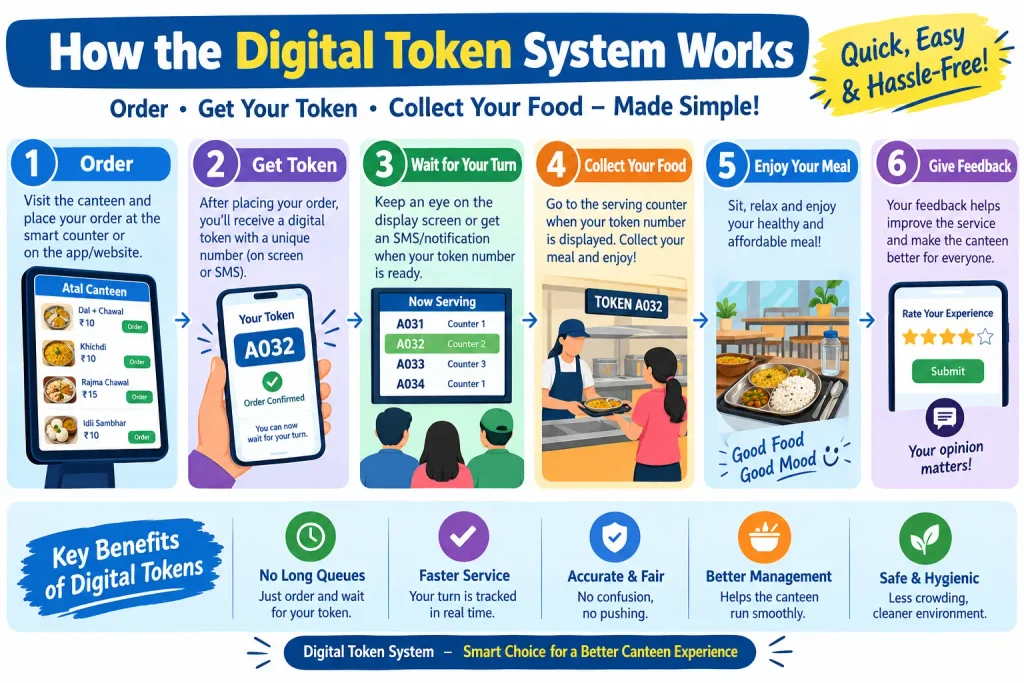
What separates Atal Canteens from earlier subsidised meal programmes is the shift from paper coupons to digital tokens, linked to the DUSIB platform. The aim is smoother distribution, shorter queues, and less scope for misuse.
The process generally works like this:
- Reach the canteen inside the meal window — not at the tail end of it. Queues build fastest in the first 45 minutes of each service.
- Register or verify your details at the counter if you are a first-time visitor. The exact process varies by location; some centres ask for a mobile number, others record basic details on the spot. Ask the staff what applies at that canteen.
- Pay ₹5 and collect your digital token. Carry exact change if you can. It is not mandatory, but it visibly speeds up the line.
- Wait for your token to be called or scanned, then collect your thali from the serving counter.
- Eat at the canteen, or carry the meal out if that particular location permits takeaway in your own container. Takeaway rules are not uniform, so do not assume it.
The pitfalls are mundane but real. First-time registration takes longer than repeat visits, so budget an extra few minutes on your first trip. Canteens can run short of thalis near the end of a session even when the counter is technically open. And the digital token system depends on the counter’s device working — on the rare occasion it does not, staff may fall back to manual distribution, which slows everything down.
Practical Things to Know Before You Go
- Check the current timings, not the launch-day ones. Lunch begins at 10:30 am and dinner at 6 pm as per the latest revision.
- Do not expect a rotating daily menu. The structure is fixed; only the vegetable changes. If you are looking for variety, that is not what this scheme is designed to provide.
- Leave the ration card at home. You do not need it, and you do not need an Aadhaar card either, to buy a thali.
- Follow queue discipline. The centres are CCTV-monitored and staff are expected to follow food safety protocols. If you spot a hygiene problem, report it to local authorities or the DUSIB helpline rather than letting it slide.
- Confirm before a long trip. If the canteen is far from where you live, a phone call to the local municipal office or a check of the latest Delhi government update will save you a wasted journey.
Frequently Asked Questions About Atal Canteen
Q1: How do I find the Atal Canteen (https://atalcanteen.com/) closest to my location?
Check the official list of operational canteens published by the Delhi government or DUSIB, or ask at your local municipal office. Online searches for “atal canteen near me” often surface outdated third-party listings, so treat those as a starting point only.
Q2: What are the current Atal Canteen timings?
Lunch is served from 10:30 am to 2 pm and dinner from 6 pm to 9:30 pm, with a 30-minute preparation buffer before each service. Local variations are possible, so confirm at the canteen if your trip depends on a tight window.
Q3: Can anyone eat at an Atal Canteen, or is it only for low-income workers?
Anyone can buy a ₹5 thali. The scheme is targeted at low-income workers and vulnerable groups, but there is no eligibility barrier stopping other citizens from eating there.
Q4: What food items are included in the ₹5 thali?
Roti or chapati, dal or pulses, a seasonal vegetable, rice, and pickle — roughly 700–800 calories and 20–25 grams of protein per thali.
Q5: Is the Atal Canteen menu the same every day?
The staples — roti, dal, rice, pickle — stay constant. The vegetable changes with the season. A few locations may serve millets instead of rice on certain days.
Q6: Are the Atal Canteens clean and safe to eat at?
The kitchens have modern cooking and water facilities and are monitored through CCTV via the DUSIB digital platform, with periodic official checks. If you notice a problem, report it to the local authorities or the DUSIB helpline.
If the canteen nearest to you is not on the current list, that does not mean it never will be — the rollout has been phase-wise, and new locations have been added after launch. Check back periodically rather than concluding the scheme has passed your area by. And if you do make the trip, aim for the first half of the service window; that is when the food is freshest, the queue moves fastest, and you are least likely to be told the thalis are over.
