
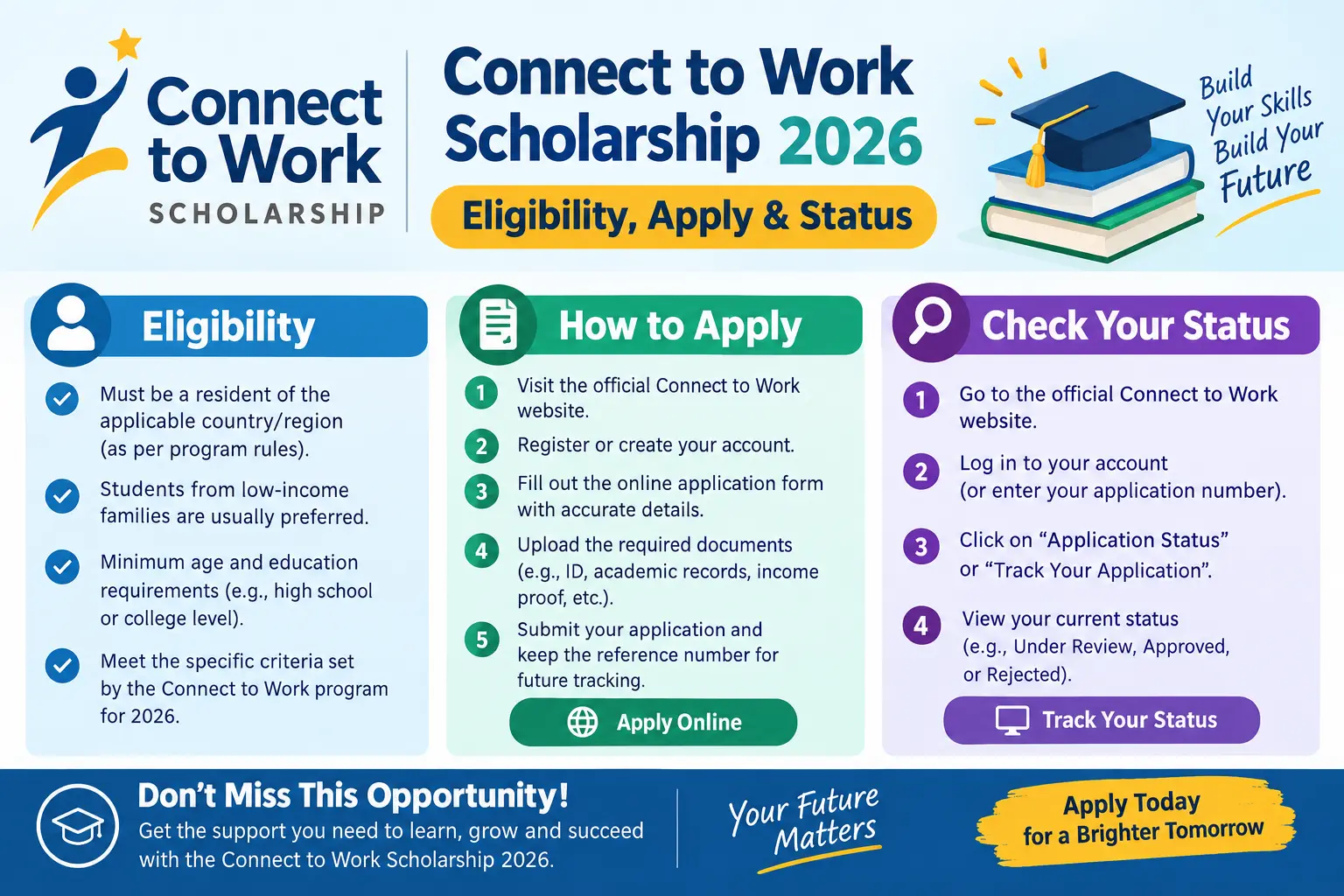
You’ve cleared your degree. You’re six months into PSC preparation. The books, the travel to mock tests, the coaching fees — they all cost money, and nothing is coming in yet. The connect to work scholarship exists for precisely this gap: the stretch between finishing your education and drawing your first salary. Run by Kerala’s Employment Department, the scheme pays a small monthly stipend into your bank account while you complete skill training or prepare for a recruitment exam. Below is what it actually pays, who qualifies, how to apply on the official portal, and the mistakes that get applications rejected.
What the Connect to Work Scholarship Pays — and How Long
The scheme is formally called the Chief Minister’s Connect to Work Scheme. It is a Kerala state initiative designed to keep educated youth financially afloat during the transition from classroom to workplace, rather than pushing them into low-skill work simply to survive.
Under the current guidelines, the scholarship pays ₹1,000 per month for a maximum of 12 months. The money moves through Direct Benefit Transfer (DBT) — a system where government payments are credited straight into your bank account, bypassing any intermediary. There is no cash disbursement and no cheque.
The scheme is limited to the first five lakh eligible applicants. That cap matters more than any other detail on this page: eligibility alone does not secure you a slot, and applications are processed in the order they arrive. If you qualify, apply the week you confirm it.
Eligibility Criteria: Who Qualifies and Who Doesn’t
Five conditions decide your eligibility.
- Age. You must be at least 18 and under 30 on the date of application.
- Residency. You must be a permanent resident of Kerala.
- Family income. Your household’s annual income must be ₹5 lakh or below. This limit was revised by the Kerala Cabinet, and your income certificate must reflect the current figure.
- Education. You should have completed Plus Two, VHSE, ITI, a diploma, or an undergraduate degree.
- Current activity. You must either be enrolled in skill training at a recognised institution — government, public sector, or private — or actively preparing for a competitive examination (UPSC, Kerala PSC, SSC, bank, railway, armed forces, or any other central or state recruitment).
The exclusions are just as important. You cannot apply if you already receive another government scholarship, a social welfare pension, a service pension, a family pension, or an EPF pension. Government employees are also barred. If you’re drawing benefits under another scholarship scheme, wait until that ends before applying here.
Discover More About:👇
Aadhaar Status Check – How to Check Enrolment & Update Status Online
How to Apply: Step-by-Step on the Official Portal
Applications are accepted only online, through the Kerala Employment Department’s portal. There is no offline form and no agent-based route.
- Open the portal. Go to eeemployment.kerala.gov.in — the sole official channel for this scheme. Bookmark it; you’ll return to check status.
- Register. New users create an account with name, date of birth, mobile number, and email. Use a mobile number you’ll keep for the next year — this is where OTPs and status alerts arrive.
- Log in and select the scheme. From the dashboard, find the active-schemes section and pick “Connect to Work Scholarship.” Don’t confuse it with unrelated state welfare schemes listed alongside it.
- Fill the form. Enter personal details, educational qualifications, family income, and the specifics of your training course or exam preparation. Every field must match your documents exactly — the name on your application and the name on your bank passbook must be identical.
- Upload documents. Scan each one clearly and stay within the portal’s file-size and format limits. Blurred or oversized scans are one of the most common reasons for rejection.
- Review, then submit. Once submitted, key fields are locked. Read the whole form once before clicking submit.
- Save your application number. The portal generates a reference ID after submission. Photograph it, email it to yourself, write it down — you’ll need it for every status check.
Two pitfalls worth knowing. First, if the OTP never arrives, the problem is usually a mobile number that isn’t updated in your profile — log out, verify the registered number, and try again rather than repeatedly clicking “resend.” Second, the portal session times out fairly quickly; keep your documents scanned and saved on the device before you start filling the form, so you’re not hunting for files while the page expires.
Documents You’ll Need Ready
Scan these before you begin — the portal is unforgiving about interruptions.
- Proof of age — Aadhaar, birth certificate, or SSLC book
- Proof of Kerala residency — Aadhaar with a Kerala address, ration card, or voter ID
- Educational certificates — Plus Two, VHSE, ITI, diploma, or degree as applicable
- Income certificate — issued by the Village Officer or another competent revenue authority, showing family income within the ₹5 lakh limit
- Proof of training or exam preparation — an exam registration slip (PSC, UPSC, SSC, bank, railway) or enrolment proof from your training institution
- Bank account details — passbook or cancelled cheque showing account number, IFSC, and branch
- A recent passport-sized photograph
Your bank account must be in your own name and linked to your Aadhaar. DBT payments fail silently on joint accounts or on accounts where the name doesn’t match the application — and a failed payment is harder to correct after the fact than to prevent before it.
How to Check Your Application Status
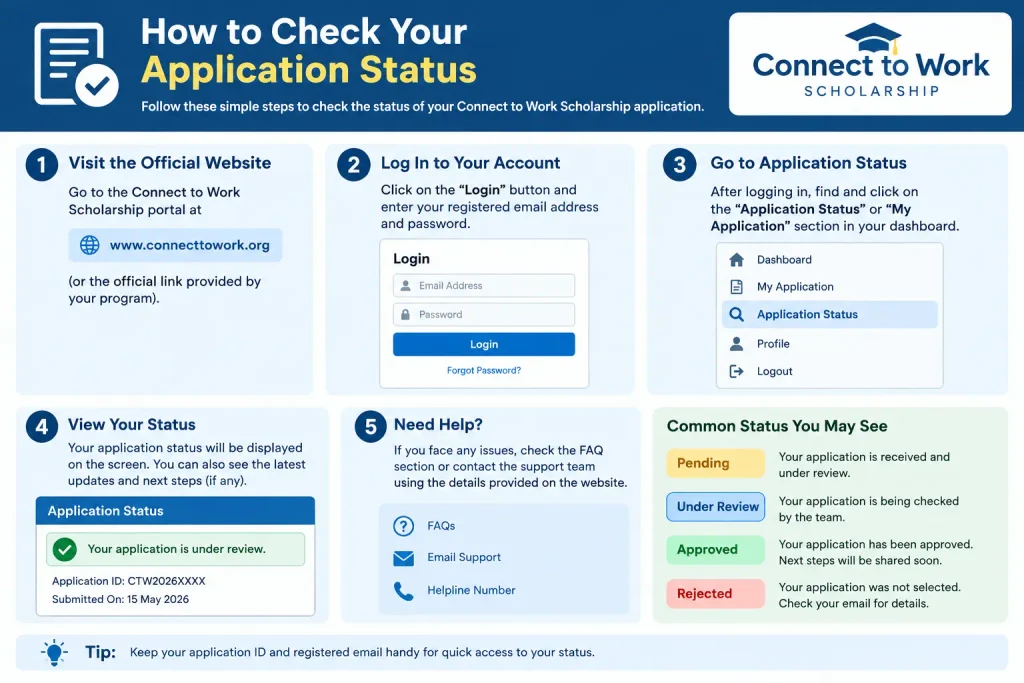
- Return to eeemployment.kerala.gov.in and log in.
- Open “Application Status” or “My Applications.”
- Enter your application number if prompted, or view the applications tied to your account.
- Read the status label carefully: Submitted, Under Verification, Approved, Rejected, or Payment Initiated.
If you see “Approved,” the first instalment typically follows after processing, though there can be a delay before the initial credit. If you see “Rejected,” read the remarks — most rejections cite a document mismatch, an expired income certificate, or an ineligible bank account, and some can be corrected by reapplying. For anything unclear, visit your nearest employment exchange office with your application number; the department also runs helpline numbers for scheme queries.
Common Mistakes That Get Applications Rejected
- Stale income certificate. An expired certificate, or one not issued by the Village Officer or competent revenue authority, will fail verification. Get a fresh one.
- Name mismatches. The name on your application, your Aadhaar, your certificates, and your bank passbook must align. Even a missing initial can stall the process.
- Incomplete or unreadable uploads. Missing documents, files over the size limit, or scans too blurry to read.
- Applying while on another scholarship. This is an automatic disqualification.
- A bank account that isn’t DBT-ready. Joint accounts and accounts without Aadhaar seeding often fail.
- Applying late. With a five-lakh cap and first-come-first-served processing, delay is its own rejection.
FAQs
How much does the Connect to Work Scholarship pay?
₹1,000 per month, for up to 12 months, credited directly to your bank account via DBT.
Can I apply while preparing for Kerala PSC?
Yes — PSC, UPSC, SSC, bank, railway, and armed forces aspirants all qualify, provided you meet the age, income, and residency conditions.
Is there an offline application form?
No. Applications are submitted only through eeemployment.kerala.gov.in.
What is the current income limit?
₹5 lakh per year for the family. Confirm the current figure on the portal before you apply, since limits can be revised.
Can I hold another government scholarship and this one together?
No. Beneficiaries of other government scholarships or social welfare pensions are excluded.
How do I know if I’ve been approved?
Check the application status section after logging in, or ask at your nearest employment exchange office.
Before You Apply
The five-lakh cap makes this a race as much as a scheme. If you’re eligible, the most useful thing you can do today is confirm your income certificate is current and your bank account is Aadhaar-seeded, then submit. And if your status sits on “Under Verification” for more than a few weeks, don’t wait passively — take your application number to the local employment exchange and ask. Corrections are almost always easier before a rejection is formally recorded than after.
Note for the editor before publishing: A few specifics in this draft — the ₹1,000 monthly amount, the 12-month duration, the ₹5 lakh income ceiling, the “five lakh applicants” cap, the “January 2026” launch, and the portal URL — should be verified against the Kerala Employment Department’s current notification before publication. I kept them as stated in the draft but hedged the surrounding language; drop or update any that don’t match the live scheme guidelines.
