

You applied for a tap connection months ago. The pipeline runs past your gate, but no water flows. Or your village was declared “Har Ghar Jal” at a Gram Sabha meeting, yet the tap in your courtyard stays dry. If either sounds familiar, the problem is rarely eligibility — it is almost always a gap between infrastructure laid and water actually supplied, or an application stuck somewhere between the VWSC and the block office. This article walks through what the har ghar nal jal yojana (Jal Jeevan Mission) actually promises, where implementation currently stands, how the Bihar rollout differs, and how to apply or follow up on a pending connection without paying a single rupee to a middleman.
What the Jal Jeevan Mission Actually Promises
Launched on 15 August 2019 by the Ministry of Jal Shakti, the Jal Jeevan Mission (JJM) is a centrally sponsored scheme run in partnership with states and union territories. Its headline commitment: a functional household tap connection (FHTC) delivering at least 55 litres of potable water per person per day, to every rural household.
The word “functional” matters. A connection that exists on paper but delivers water for two hours a week does not count. Villages qualify as “Har Ghar Jal” only when every household has a working tap with a regular supply — a distinction that explains why some villages celebrate the declaration while others dispute it.
Implementation runs through Village Water and Sanitation Committees (VWSCs), which plan and monitor local water systems. SC/ST-dominated habitations, aspirational districts, drought-prone blocks, schools, and Anganwadi centres receive priority. Capital costs are shared between the Centre and states — households do not pay for pipeline laying or the connection itself.
Where the Mission Stands Today
More than 15 crore rural households have received tap connections, and over 2.63 lakh villages have been declared Har Ghar Jal by their Gram Sabhas. The original 2024 deadline has been extended to December 2028 under an enhanced outlay of ₹8.69 lakh crore — an extension often referred to as JJM 2.0.
Separately, over 24.80 lakh rural women have been trained to use field test kits for water quality checks. That number reflects a deliberate design choice: putting testing in the hands of the community rather than waiting for distant labs.
For live coverage figures by state and district, the official dashboard at ejalshakti.gov.in is the only reliable source. Figures quoted in news reports are often months old.
Discover More About:👇
Aadhaar Status Check – How to Check Enrolment & Update Status Online
What Households Actually Gain
The obvious benefit is water at the doorstep. The less obvious one is time. In villages where the scheme has worked as intended, women and girls who once walked two kilometres at 4 AM for a single trip now use that time for school, work, or rest.
Clean piped water also cuts waterborne disease, which reduces household medical spending — a benefit that rarely shows up in scheme brochures but matters more than most. Gram Panchayats typically set a monthly water tariff, commonly in the ₹30–100 range, to cover pump maintenance and repairs. That tariff varies widely and is decided locally, not by the central scheme.
Nal Jal Yojna Bihar: What’s Different
Bihar runs the mission through its Public Health Engineering Department (PHED), branding it locally as Har Ghar Nal Ka Jal. SC/ST and BPL households receive free connections; other households may pay a nominal one-time contribution.
Roughly 86% of rural households in the state have been covered so far, against a target of about 1.83 crore households. Two factors make Bihar’s rollout harder than most: the Ganga flood plains, where pipelines need flood-resistant design, and tribal belts with scattered habitations.
The gap between pipeline and supply is the state’s most persistent complaint. Audits have flagged mismatches between money spent and coverage achieved, and several villages report pumps lying idle due to faulty motors. The state government has since directed officials to ensure 100% supply coverage, with warnings that negligence will not be tolerated.
How to Apply for a New Connection
The process is deliberately local — there is no national online form. Here is how it works in practice, along with the points where applications usually stall.
- Approach your Gram Panchayat or a VWSC member. The VWSC handles water supply planning for your village. Ask specifically about your household’s eligibility and whether a pipeline already runs near your home.
- Submit a written application. Most Gram Panchayat offices have a standard form. In Bihar, you can also apply through the PHED Bihar portal (phed.bih.nic.in). Keep a photocopy or photograph of whatever you submit — this is the single most useful habit if your application later goes missing.
- Household survey. A VWSC member or JJM field team visits to check feasibility. If your home sits on higher ground or far from the main line, the survey may flag it for a later phase. Ask which phase your household falls under before the team leaves.
- Forwarding for approval. The Gram Panchayat sends your application to the Block Development Officer (BDO) or the state implementing agency. This is where delays usually begin. Follow up at the block office roughly two to three weeks after submission rather than waiting indefinitely.
- Installation. Once approved, a plumber appointed by the VWSC or implementing agency installs the connection. Timelines vary by district and are communicated locally — no fixed national deadline applies to individual households.
- Water tariff. Your Gram Panchayat sets a monthly maintenance charge. This is separate from installation, which the government funds.
One warning worth repeating: the application is free. Anyone demanding money for “fast approval” or a “guaranteed connection” is exploiting the backlog, not expediting it. Report such demands to your BDO or the JJM helpline.
Documents You Will Typically Need
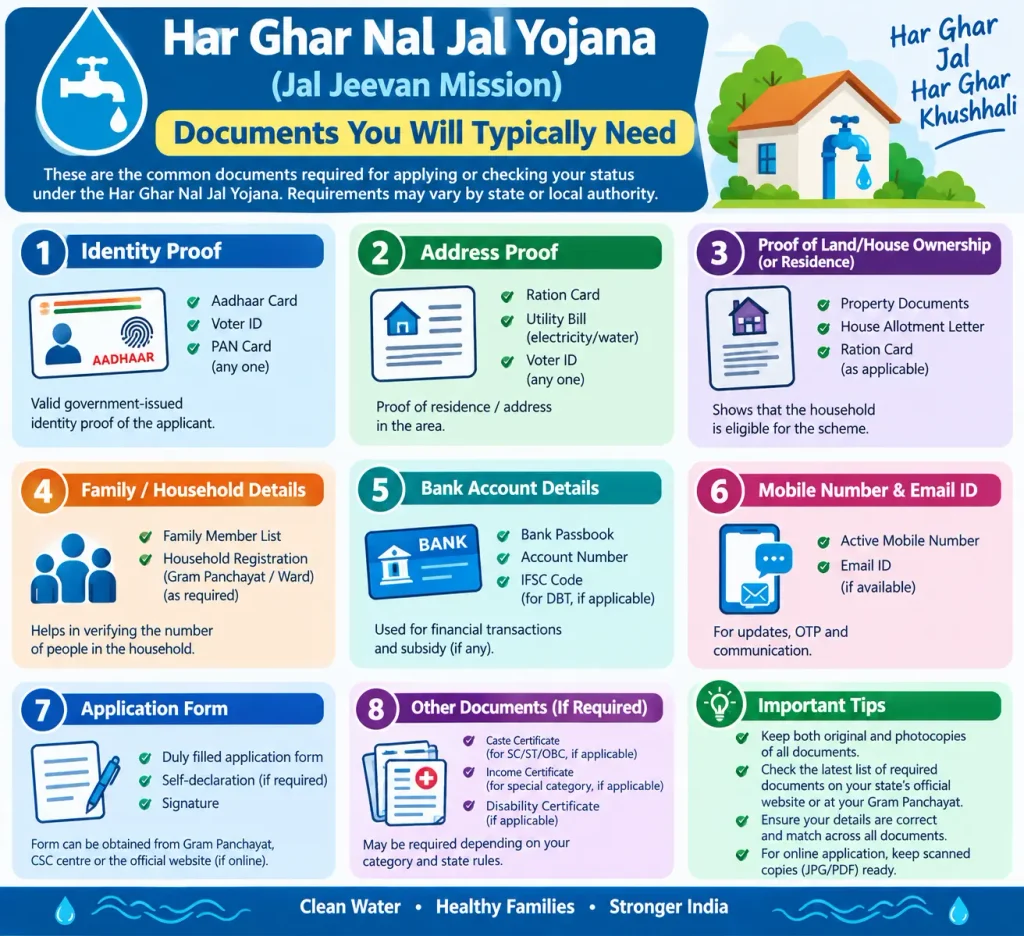
Requirements differ by state, but most Gram Panchayats ask for:
- Aadhaar card of the head of household or applicant
- Residence proof — voter ID, ration card, or a recent utility bill
- House ownership document or rent agreement, confirming you live at the stated address
- Passport-size photograph (in some states)
- Caste certificate, if applying under SC/ST category for a free connection
Some states add a self-declaration. Confirm the exact list with your Gram Panchayat before submitting — carrying one extra document is easier than making a second trip.
Common Mistakes That Delay Connections
Mismatched documents top the list. If your Aadhaar address differs from your residence proof, the application may be returned for clarification. Getting both to match beforehand saves weeks.
Not following up is the second. The chain runs from VWSC to Gram Panchayat to BDO, and files do occasionally sit. A polite visit every few weeks keeps your application visible.
The third is paying an intermediary. No legitimate step in this process requires a fee beyond the sanctioned water tariff.
FAQs
What is the official JJM complaint helpline?
The national helpline for water supply complaints is 1916. Complaints can also be registered on the JJM dashboard at ejalshakti.gov.in.
Is the tap connection free for every household?
Infrastructure costs are government-funded nationally. In Bihar, SC/ST and BPL households get free connections; others may pay a nominal one-time contribution. Gram Panchayats separately charge a small monthly maintenance tariff.
How do I check if my village is declared “Har Ghar Jal”?
The Gram Sabha makes the declaration once 100% functional tap coverage is verified. Village status is viewable on the JJM dashboard at ejalshakti.gov.in.
My tap was installed but water supply is irregular. What now?
File a complaint on 1916 and raise it with your Gram Panchayat and VWSC. Irregular supply usually traces back to pump failures or power issues, not to your connection.
Can tenants apply?
The scheme targets rural households with permanent structures. Tenants may need a rent agreement and a no-objection certificate from the owner, depending on the state. Confirm with your Gram Panchayat.
Is there an application fee?
No. There is no application fee under JJM. Only the monthly water tariff set by your Gram Panchayat applies.
If your application has been pending for more than a month without a survey visit, that is your signal to escalate — first to the VWSC, then to the BDO. And if a pipeline was laid but water never arrived, the issue is a maintenance failure, not an eligibility one; pursue it through the 1916 helpline with your village name and connection details rather than filing a fresh application.
