
Every day, thousands of sanitation workers in Indian cities descend into sewers and septic tanks without protective gear, health cover, or any formal record of their employment. When an accident happens, there is often no insurance, no compensation, and no official proof that they were ever part of the workforce. The namaste portal exists to change that—by creating a verified national database of sanitation workers and linking each one to health insurance, safety equipment, training, and financial support. This article breaks down who qualifies, what the scheme offers, and exactly how the registration process works—including the practical hurdles that can delay or derail it.
Discover More About:👇
E Shram Card Download by Mobile Number
What Is the NAMASTE Scheme?
NAMASTE—National Action for Mechanised Sanitation Ecosystem—is a central sector scheme launched in July 2023 by the Ministry of Social Justice and Empowerment (MoSJE) and the Ministry of Housing and Urban Affairs (MoHUA). It replaced the Self-Employment Scheme for Rehabilitation of Manual Scavengers (SRMS) with a sharper goal: zero fatalities in sanitation work. That means eliminating direct contact with human faecal matter, pushing mechanised cleaning over manual entry, and giving workers a formal identity within the system.
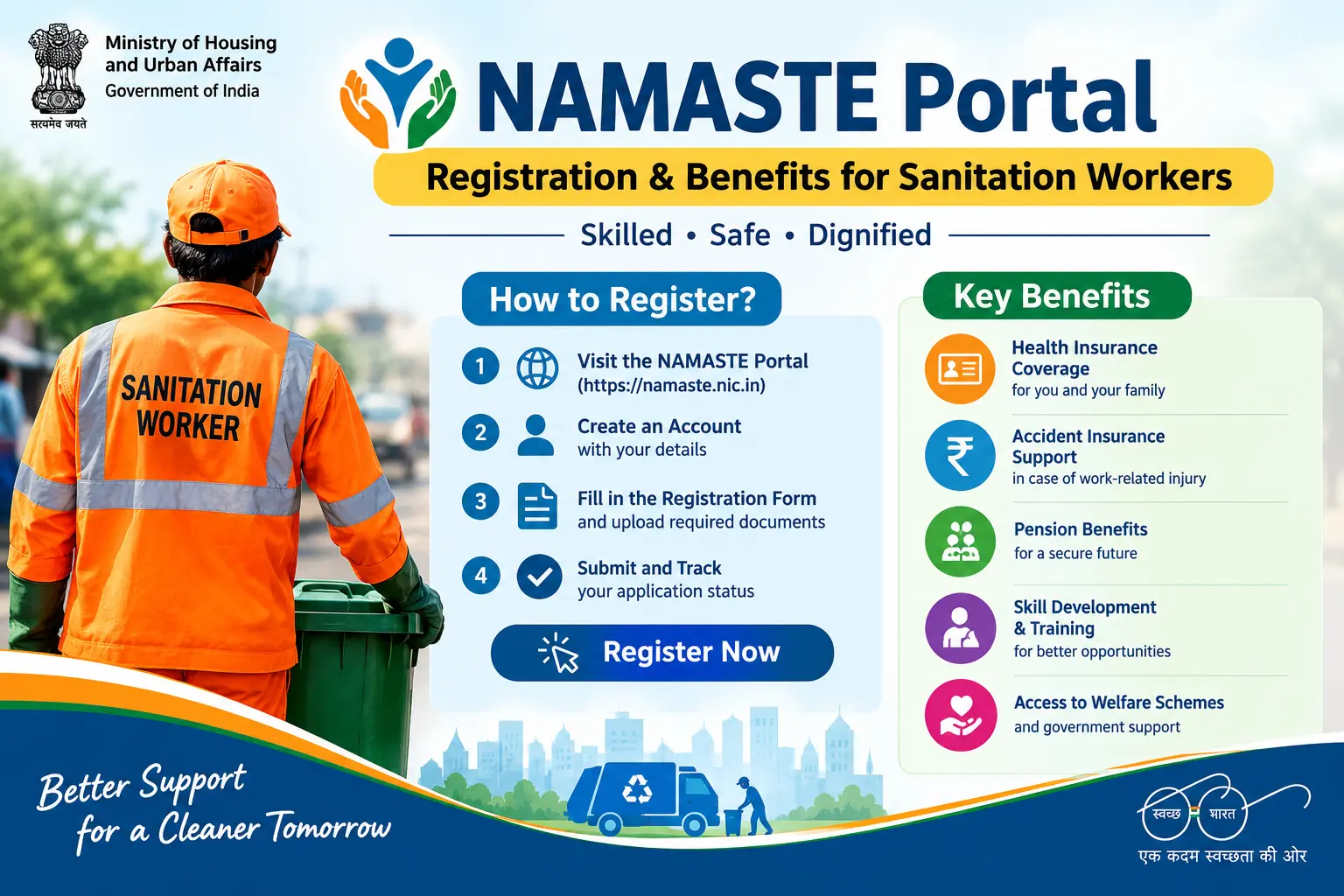
The namaste portal is the digital spine of this effort. It is where sanitation workers are enumerated, profiled, and validated. Each verified worker receives a unique NAMASTE ID—the single reference point for everything from Ayushman Bharat enrollment to PPE kit distribution. Without this ID, a worker remains invisible to the scheme.
Who Is Eligible for the NAMASTE Portal?
The scheme covers Sewer and Septic Tank Workers (SSWs) in urban areas—whether employed by Urban Local Bodies (ULBs), parastatal agencies, private sanitation service organisations (PSSOs), or working independently. Since 2024, waste pickers in solid waste management have also been included.
Eligibility generally requires the worker to have been engaged in sanitation work for at least six months, be 18 or older, and hold a valid government-issued photo ID. Domestic workers are not covered. If your role involves sewers, septic tanks, or municipal waste handling, you likely qualify—but confirmation comes from your ULB or the city’s NAMASTE nodal officer.
What Benefits Does the Portal Unlock?
Once profiled and validated, a worker becomes eligible for a package of benefits that address both immediate risk and long-term stability.
Health Insurance Under AB-PMJAY
Validated SSWs and their families are enrolled under Ayushman Bharat – Pradhan Mantri Jan Arogya Yojana (AB-PMJAY). The enrollment is facilitated through the NAMASTE portal and funded by MoSJE. This means hospitalisation cover for illness or accidents—without the worker having to navigate the enrollment process separately.
Safety Training and PPE Kits
Workers receive capacity-building programmes on mechanised sanitation techniques and occupational hazard awareness. They are also issued Personal Protective Equipment (PPE) kits—gloves, masks, boots, and other gear. The portal tracks training completion and kit distribution, so there is a record of who received what.
Livelihood Support and “Sanipreneur” Funding
For those who want to move away from hazardous cleaning, the scheme offers capital subsidies through the National Safai Karamcharis Finance & Development Corporation (NSKFDC). This supports the purchase of sanitation-related vehicles and equipment under the Swachhata Udyami Yojana. The portal connects beneficiaries to these funding pathways and to skill development training, including a monthly stipend for eligible dependents in training programmes up to two years.
Equipment for Emergency Response Units
ULBs and Emergency Response Sanitation Units (ERSUs) receive modern safety devices through the scheme. The portal helps track how these are allocated and used at the local level.
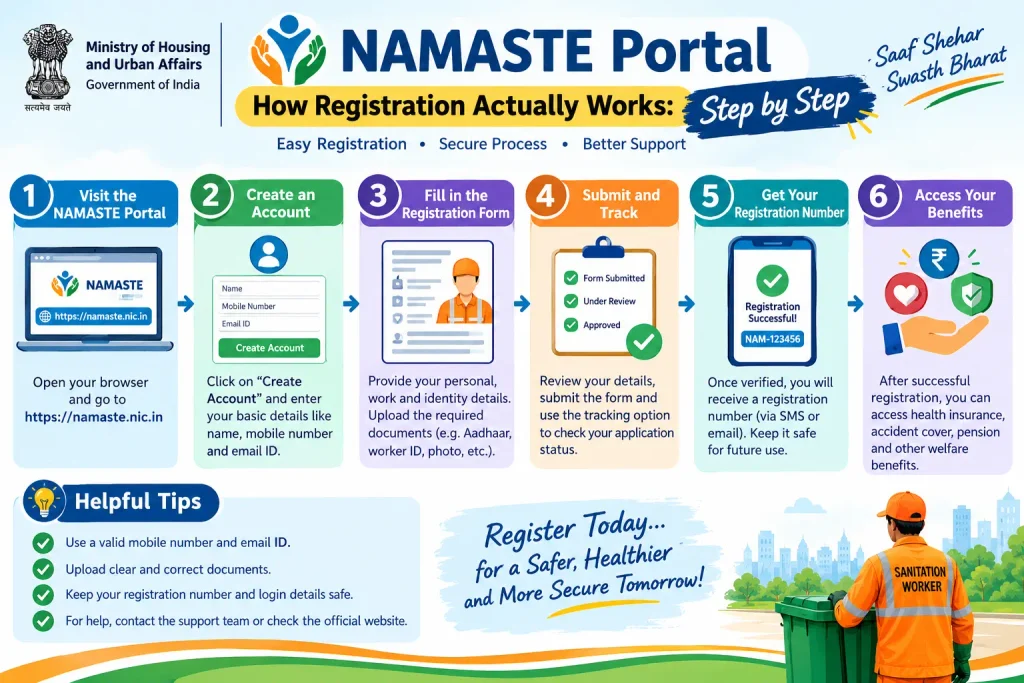
How Registration Actually Works: Step by Step
Registration is not something a worker does alone on a website. It is driven by profiling camps organised by your ULB. Here is what the process typically looks like on the ground.
Step 1: Your Name Gets on the ULB’s List
The ULB or parastatal agency compiles a list of sanitation workers—those directly employed, those working for private contractors, and independent workers. This is done through enumeration drives. Pitfall to watch: If your employer is a private contractor and does not forward your name, you may not be called for the camp. It is worth asking your ULB directly whether your name is on the list, or checking with the nodal officer if you haven’t heard anything.
Step 2: Attend the Profiling Camp with Documents
At the camp, surveyors verify you in person. You’ll be asked for identification and basic details about your work and family. This is where most delays happen: people arrive without the right documents or without complete family details. Since health insurance covers dependents, missing a family member’s name at this stage can mean they are left out later. Carry originals and photocopies of your Aadhaar (or Voter ID/PAN/Driving License), proof of occupation, bank details, address proof, and passport-size photos.
Step 3: Data Entry and NAMASTE ID Generation
Your verified details are entered into the NAMASTE portal or Beneficiary Management System. After validation, you receive your unique NAMASTE ID. Pitfall to watch: spelling errors in names or incorrect Aadhaar numbers at this stage can cause problems later when linking benefits. Check the screen or printout before you leave the camp if possible.
Step 4: Benefits Get Linked
With a validated ID, the portal initiates your AB-PMJAY enrollment, allocates PPE kits, and makes you eligible for training and livelihood programmes. The ULB and NSKFDC coordinate to ensure benefits reach you.
Step 5: Keep Your Profile Updated
If your family situation changes or you shift to a different type of sanitation work, inform your ULB so your profile can be updated. Periodic verification may also be conducted to keep the national database accurate.
A note on Aadhaar: The NAMASTE portal is separate from UIDAI systems. A valid government photo ID—usually Aadhaar—is required during profiling to establish identity. If your Aadhaar details need updating, do that through the UIDAI portal (uidai.gov.in) or the mAadhaar app before attending a camp. NAMASTE does not create or modify Aadhaar records; it only uses your existing ID for verification.
Documents Commonly Required
The exact list can vary by ULB, but profiling camps typically ask for:
- Aadhaar card (or Voter ID, PAN card, or Driving License as alternate photo ID)
- Proof of occupation (employer letter, work ID, or self-declaration in the prescribed format)
- Bank account details (for direct benefit transfers, where applicable)
- Proof of address (Ration Card, BPL Card, or Labour Card)
- Passport-size photographs
- Details of family members/dependents (for health insurance enrollment)
Carry originals and photocopies. If you’re unsure about any document, call your ULB’s NAMASTE nodal officer before the camp—it saves a wasted trip.
FAQs
Q1: Is there a fee to register on the NAMASTE portal?
No. Profiling and registration are conducted free of charge by ULBs. If anyone demands money to “register” you, report it to your ULB or local authorities.
Q2: I work as a waste picker. Can I get a NAMASTE ID?
Yes. Waste pickers were included as a target group in 2024. A separate Waste Picker Enumeration App has been launched to profile them. Validated waste pickers are eligible for PPE kits, health insurance, and capital subsidy for waste collection vehicles.
Q3: What is the NAMASTE ID used for?
It is your unique identifier in the scheme’s database—used to track eligibility for health insurance, training, PPE distribution, and financial assistance. Keep it safe and provide it whenever accessing benefits.
Q4: Does the NAMASTE portal replace Aadhaar?
No. It is a scheme-specific database. Aadhaar (or another valid ID) is used for identity verification during profiling, but the portal does not replace Aadhaar or alter your UIDAI records.
Q5: My family members aren’t covered under Ayushman Bharat. Will NAMASTE help?
Yes. Once you’re validated as an SSW, your family members are enrolled under AB-PMJAY as part of the scheme’s health insurance component. You don’t need to apply separately.
Q6: Where can I check current fees or timelines?
Fees and timelines for government schemes change. For Aadhaar-related matters, check the official UIDAI portal (uidai.gov.in). For NAMASTE-specific details, contact your ULB or check the official scheme website. Don’t rely on unofficial sources.
The NAMASTE portal will only work if the people it is meant to serve actually get on it. If you are eligible but haven’t been called for a profiling camp, don’t wait—ask your ULB why. And if you have attended a camp but haven’t received your NAMASTE ID or benefits after a reasonable period, follow up with the nodal officer. The scheme’s promise of safety and dignity depends on that follow-through, from both sides.
