
Pregnancy brings enough worries without adding money stress to the list. For thousands of women in Gujarat, the Namo Shree Yojana exists precisely to remove that worry — offering up to ₹12,000 in direct cash support for check-ups, nutrition, and safe delivery. Yet many eligible mothers either don’t know they qualify or get stuck during registration because a document doesn’t match or a bank account isn’t linked properly. This guide walks you through who qualifies, how the payments work, and exactly how to register without unnecessary delays.
What Is the Namo Shree Yojana Gujarat?
The Namo Shree Yojana is a maternal benefit scheme run by Gujarat’s Women and Child Development Department. Launched in February 2024, it aims to bring down maternal and infant mortality by making sure no woman skips medical care or proper food during pregnancy because of money. Eligible mothers receive up to ₹12,000 for their first two live births — transferred straight to their bank account through Direct Benefit Transfer (DBT), with no middleman involved.
Discover More About:👇
Aadhaar Status Check – How to Check Enrolment & Update Status Online
How the ₹12,000 Is Paid Out
The amount is not handed over at once. It is released in stages tied to pregnancy milestones, and the split differs for the first and second child.
| Pregnancy | Stage | Amount |
|---|---|---|
| First | Registration | ₹5,000 |
| First | After 6 months | ₹2,000 |
| First | After delivery | ₹3,000 |
| First | After 14-week vaccination | ₹2,000 |
| Second | Registration | ₹2,000 |
| Second | After 6 months | ₹3,000 |
| Second | After delivery | ₹6,000 |
| Second | After 14-week vaccination | ₹1,000 |
For the second pregnancy, the ₹6,000 post-delivery installment comes from the central government if the baby is a girl, and from the state government if it’s a boy. This phased approach puts money in the mother’s hands at the moments she actually needs it — before delivery, right after, and during the baby’s early vaccinations.
Who Is Eligible for Namo Shree Yojana?
The scheme targets women who are economically or socially vulnerable. To qualify, a woman generally needs to meet these conditions:
- Residency: Permanent resident of Gujarat.
- Status: Currently pregnant or a lactating mother.
- Category: Belongs to at least one prescribed group — SC, ST, BPL families, E-Shram card holders, women farmers, NFSA beneficiaries, PM-JAY/Ayushman Bharat beneficiaries, MGNREGA job card holders, or women with 40% or more disability.
- Income: Annual family income typically ₹8,00,000 or less.
The benefit is available for the first two live births only. Women who have already had two or more live children are generally not eligible for further assistance.
Is an E-Shram Card Mandatory?
No. An E-Shram card is just one of several accepted categories. If a woman belongs to SC, ST, BPL, NFSA, or PM-JAY, or is a registered woman farmer or MGNREGA worker, she can apply using proof of that category instead. The requirement is simply proof of belonging to at least one eligible group.
How to Apply: Step-by-Step Registration
There is no separate online portal for Namo Shree Yojana. Registration happens offline through Gujarat’s Anganwadi and public health network — a system designed to reach women in rural areas who may not have easy internet access.
- Go to your Anganwadi Centre or government health facility during your first antenatal check-up (ANC). This is the natural starting point. You can also approach the ASHA (Accredited Social Health Activist) or ANM (Auxiliary Nurse Midwife) worker in your village or ward.
- Ask the ASHA or ANM worker to register you. These frontline workers are trained to fill the form and check your eligibility on the spot.
- Hand over your documents. The worker uploads them to Gujarat’s TeCHO+ portal, the state’s digital health data platform.
- Verification at health centre and taluka level. Your details are checked at the health centre and then at the block (taluka) level to confirm eligibility.
- State-level clearance. Once taluka verification is done, the application moves to the state level for final approval through the Public Financial Management System (PFMS).
- Payment arrives via DBT. The first installment lands in your bank account after clearance. Later installments release automatically as you hit each milestone.
Two pitfalls worth watching: First, your bank account must be linked to your Aadhaar, or the DBT payment will bounce. Second, if your name, date of birth, or address differs across your documents (say, your Aadhaar says one spelling and your bank passbook says another), verification can stall for weeks. Get those details corrected before you register. The scheme itself is free — nobody should ask you for money to enroll.
Documents Required for Namo Shree Yojana
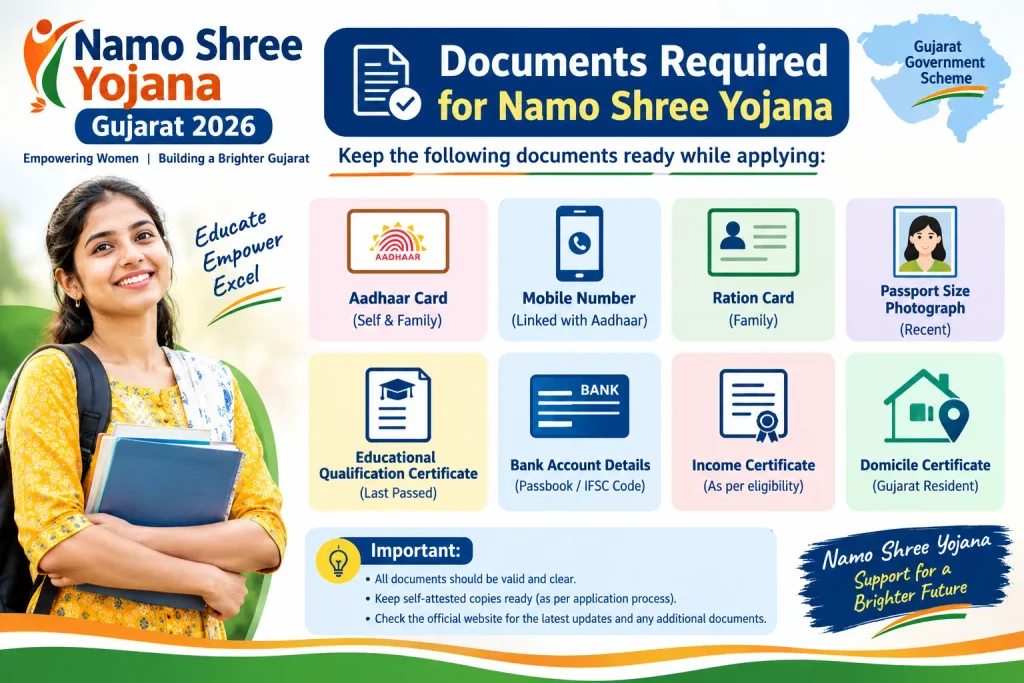
Keep these ready before your registration visit. The exact list can vary by category, so confirm with your ASHA or ANM worker:
- Aadhaar Card of the applicant (identity verification)
- Bank passbook copy or cancelled cheque (for DBT)
- Mobile number linked to your bank account (for payment alerts)
- MAMTA card or pregnancy registration details from the health centre
- Proof of residence — Ration Card, Voter ID, or Domicile Certificate
- Proof of eligibility category — Caste Certificate (SC/ST), BPL Ration Card, E-Shram card, NFSA card, PM-JAY/Ayushman card, or MGNREGA job card
- Hospital delivery certificate — needed after delivery to claim the post-delivery installment
Self-attest documents where required. Mismatched information across documents is one of the most common reasons for delayed verification.
Common Questions About Namo Shree Yojana (FAQs)
Q1: Can I apply for Namo Shree Yojana online?
No. Registration is done offline at your nearest Anganwadi Centre or government health facility, with help from ASHA or ANM workers. Your documents are uploaded to the TeCHO+ portal by the health worker — you don’t need to fill any online form yourself.
Q2: Is the benefit available for more than two children?
The scheme generally covers only the first two live births. Women who have already had two or more live children are typically not eligible for further assistance.
Q3: Can I receive Namo Shree Yojana along with PMMVY or JSY?
Yes. This scheme is designed to work alongside central schemes like Pradhan Mantri Matritva Vandana Yojana (PMMVY) and Janani Suraksha Yojana (JSY). Eligible women can apply for those separately for additional support.
Q4: What should I do if my payment is delayed?
First, check with your ASHA or ANM worker to confirm your documents were uploaded correctly and your bank account details are accurate. If everything looks right, contact the Gujarat Women and Child Development Department helpline.
Q5: Do I need an E-Shram card to apply?
No. An E-Shram card is one of several accepted eligibility categories. SC, ST, BPL, NFSA, PM-JAY, woman farmer, and MGNREGA worker categories all qualify independently.
Q6: Is there a fee to register?
No. Registration is completely free. Be cautious of anyone asking for money to enroll you.
What to Keep in Mind
The Namo Shree Yojana is a Gujarat-specific scheme. The total ₹12,000 comes in phased installments, not as a single payment. Registration is offline — there is no separate online portal. And because scheme rules, income limits, and installment amounts can change over time, it’s worth confirming current details with your local Anganwadi Centre or the Women and Child Development Department before you rely on any figure you read online.
If you’re expecting, the single most useful thing you can do is mention the scheme during your first ANC visit. That’s when registration is simplest, and it ensures your first installment is processed without delay. And if you’ve already registered but the payment hasn’t arrived within a reasonable window, follow up with your ASHA worker first — most delays trace back to a bank account that isn’t linked to Aadhaar or a name mismatch in documents, both of which are fixable.
