
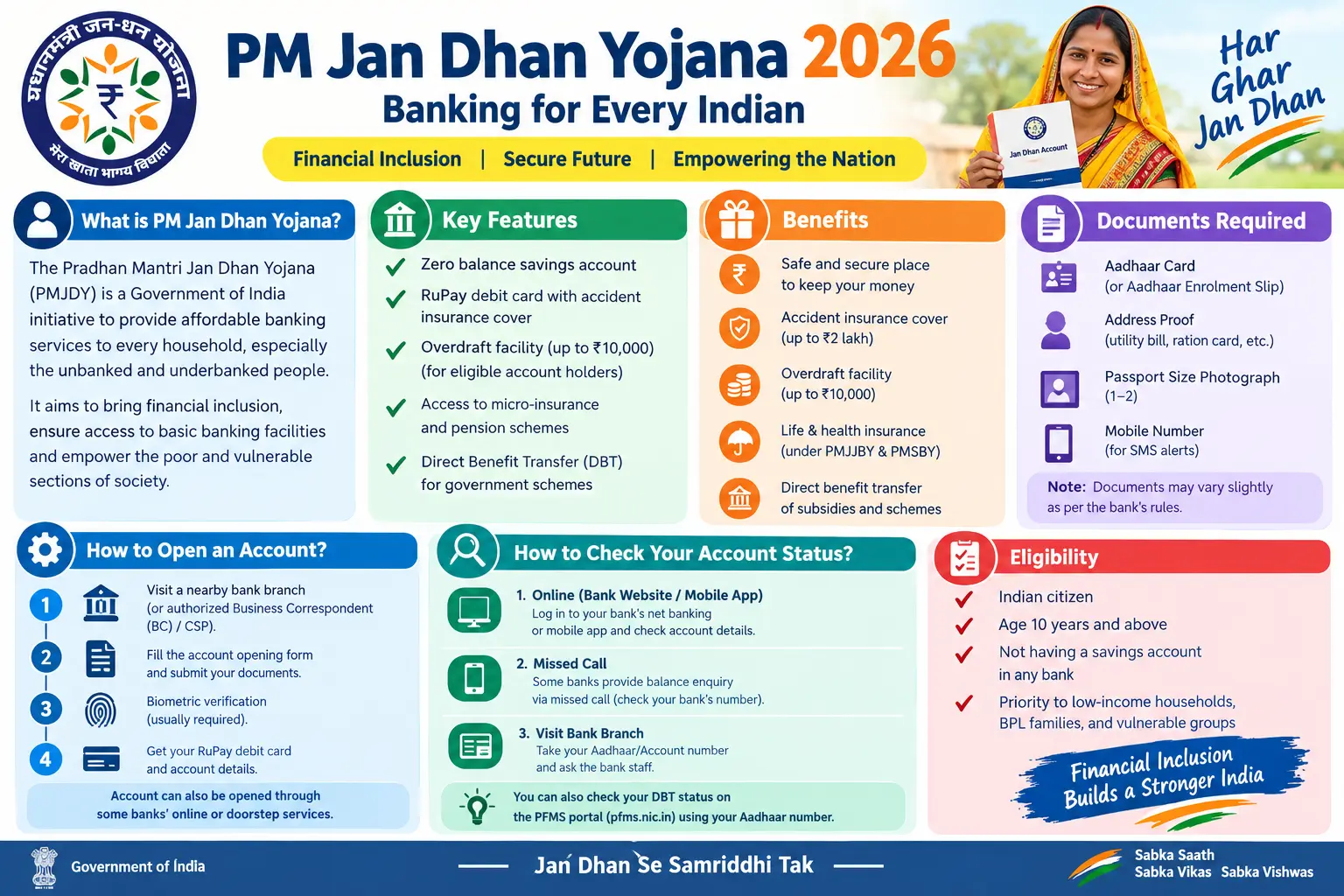
Your PM Kisan instalment hasn’t landed. The LPG subsidy that used to arrive on time is now missing. Or you’ve been told at the bank that your account has gone dormant and your Aadhaar isn’t seeded. All three problems usually trace back to the same place — a Jan Dhan account that was opened once and then forgotten. The प्रधानमंत्री जन धन योजना (PMJDY) is more than a zero-balance savings account; it is the pipeline through which most government benefits reach you. This guide covers how to open an account, what documents work, what the scheme actually gives you, and how to check whether an old account is still active.
What PM Jan Dhan Yojana Actually Does
Launched on 28 August 2014, PMJDY was designed to pull unbanked adults into the formal banking system. The original target was one account per household; that was later widened to one account per unbanked adult. Accounts are opened as Basic Savings Bank Deposit Accounts (BSBDA) at any bank branch, or through a Business Correspondent — commonly called a Bank Mitr — who operates in villages and underserved areas.
The scheme runs on four stated principles: banking the unbanked, securing the unsecured, funding the unfunded, and serving underserved areas. The numbers reflect how far it has come — over 59 crore accounts opened, cumulative deposits above ₹3.17 lakh crore, more than 41 crore RuPay cards issued, with roughly 56% of account holders being women and 78% of accounts in rural or semi-urban areas.
Two Types of Jan Dhan Accounts
Basic Savings Bank Deposit Account (BSBDA)
This is the standard Jan Dhan account. No minimum balance, no account-opening charges. You can deposit and withdraw at branches, ATMs, or through a Bank Mitr. One limit worth knowing: cash withdrawals — including ATM withdrawals — are capped at four per month. Digital transactions via UPI, NEFT, RTGS, and IMPS don’t carry that restriction. If you want a cheque book, the bank may ask you to meet its minimum balance criteria for that add-on.
Discover More About:👇
Aadhaar Bank Seeding Status: How to Check Aadhaar Card Link With Bank Account
Aadhaar Bank Seeding Status for DBT: How to Check Aadhaar Bank Link Status
Small Account (Chota Khata)
If you don’t have full KYC documents, the bank can open a Small Account. It stays operational for twelve months and can be extended by another twelve months if you show proof of having applied for an Officially Valid Document. Small accounts carry caps on maximum balance and transaction size. Use this as a stopgap, not a destination — complete full KYC at the earliest.
How to Open a PM Jan Dhan Account
Most accounts are still opened offline. Some banks have added online or video-KYC routes, but availability varies by bank and region — check with your specific bank before assuming it’s an option.
Step 1: Go to a Bank Branch or Bank Mitr
At a Bank Mitr outlet, accounts can be opened for applicants aged 10 and above via Aadhaar-based e-KYC. At a bank branch, there’s no specified age limit. If you plan to use the Bank Mitr route, carry your Aadhaar — the e-KYC needs it, and the fingerprint or OTP authentication happens on the spot.
Common pitfall: If the mobile number linked to your Aadhaar is not the one you’re carrying, the OTP authentication will fail. The same applies if your name on Aadhaar doesn’t match the name you’re giving the bank (spelling variations, initials vs. full name). Fix the Aadhaar record first, or ask the bank what alternate KYC they can accept.
Step 2: Fill the Application Form
The bank or Bank Mitr provides the PMJDY form. You’ll enter your name, address, mobile number, and nomination details. You’ll also be asked to consent to Aadhaar seeding — this links your Aadhaar number to the account and is what makes Direct Benefit Transfer (DBT) work. DBT is simply the system where government subsidies and welfare payments are credited straight to your bank account instead of being routed through intermediaries.
Step 3: Submit KYC Documents and Photograph
Hand over the documents listed in the next section, along with a recent passport-size photograph. If you’re at a Bank Mitr outlet, Aadhaar e-KYC may be completed immediately.
Common pitfall: If the e-KYC authentication fails midway — a network drop, a fingerprint mismatch, an OTP that doesn’t arrive — the form may need to be restarted. Keep a photocopy of everything you submit so you’re not scrambling to reconstruct it.
Step 4: Collect Passbook and RuPay Card
Once the account is active, you receive a passbook and a free RuPay debit card. The card carries an inbuilt accident insurance cover — details in the benefits section.
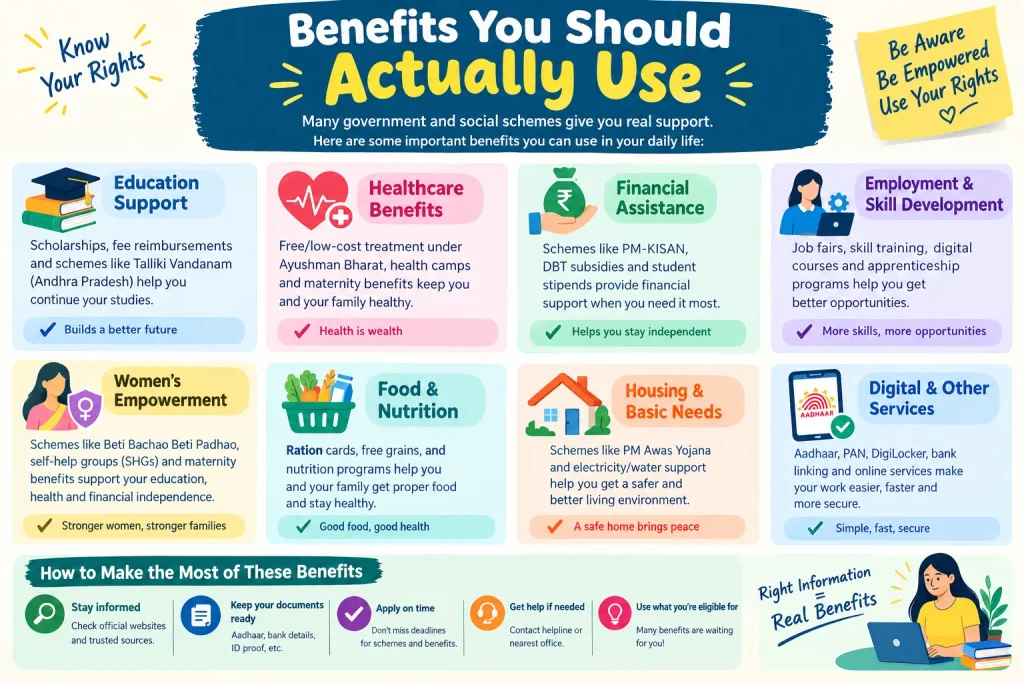
Benefits You Should Actually Use
Zero Balance, No Penalty
No minimum balance, no maintenance charges. BSBDA accounts, including Jan Dhan accounts, are explicitly exempt from minimum balance penalties. This is the single most useful feature for anyone with irregular income.
RuPay Card with Accident Insurance
Every Jan Dhan account comes with a free RuPay debit card carrying ₹2 lakh accident insurance cover. Accounts opened before 28 August 2018 had a ₹1 lakh cover. To claim, the cardholder must have completed at least one successful financial or non-financial transaction through the RuPay card within 90 days before the accident.
Overdraft Facility
After six months of satisfactory operation, you become eligible for an overdraft of up to ₹10,000. It’s typically granted to the earning member, with a stated preference for the woman of the household. The applicant should generally be between 18 and 65, with no overdue overdraft on the same account. Overdrafts up to ₹2,000 usually have no additional conditions; larger amounts may be subject to average monthly balance calculations.
DBT and Social Security Access
The account is built to receive DBT from various government schemes; Aadhaar seeding is what makes that work. Eligible account holders are also encouraged to enrol in Pradhan Mantri Jeevan Jyoti Bima Yojana (PMJJBY) and Pradhan Mantri Suraksha Bima Yojana (PMSBY), which offer life and accident cover at affordable premiums.
Documents Required
If you have Aadhaar, that’s the only document you need. If your address has changed, a self-certification of the current address is generally sufficient.
Without Aadhaar, any one of these Officially Valid Documents works:
- Voter ID Card
- Driving Licence
- PAN Card
- Passport
- NREGA Card
If the document contains your address, it serves as both identity and address proof.
If you hold none of these and the bank classifies you as low-risk, you can still open an account using a photo identity card issued by a Central or State Government department, a statutory or regulatory authority, a public sector undertaking, a scheduled commercial bank, or a public financial institution. A letter from a gazette officer with an attested photograph may also be accepted.
Checking Your Account Status
An account you haven’t used in a long time may have turned inactive. As per RBI guidelines, a savings account is treated as inoperative or dormant if there are no customer-induced transactions for over two years — and the bank is required to notify you by letter, email, or SMS.
To check status:
- Visit the branch with your passbook and ask directly.
- Call the bank’s toll-free helpline from your registered mobile number. Several banks also offer a missed-call balance check — SBI customers, for instance, can give a missed call to 9223766666.
- Use an ATM to print a mini statement and see recent activity.
- Check DBT credit status on the PFMS portal (pfms.nic.in) by selecting “Know Your Payment,” choosing your bank, entering your account number, and completing the CAPTCHA.
If the account is inactive, the branch can tell you exactly what’s needed to reactivate it.
Mistakes That Cost People Their Benefits
The overdraft is the most misunderstood feature. It is a credit facility that must be repaid — not a grant. Treating it as free money leads to recovery action and blocks future eligibility.
Duplicate accounts are the second recurring problem. In the scheme’s early years, some people ended up with two or more Jan Dhan accounts, usually without realising it. If you’re unsure whether you already have one, check with your bank before opening another.
The third, and most damaging, is an unseeded Aadhaar. Without Aadhaar linked to the account, DBT credits can fail, and overdraft eligibility can be affected. An outdated mobile number compounds the problem — it’s what enables missed-call balance checks, transaction alerts, and OTP verification.
Frequently Asked Questions
Can I open a Jan Dhan account online?
Mostly offline, through branches and Bank Mitr outlets. Some banks — SBI and Bank of Baroda among them — offer limited online opening via video KYC. Availability varies, so confirm with your bank first.
What is the minimum balance for a PM Jan Dhan Yojana account?
None. It’s a zero-balance account, and BSBDA accounts including Jan Dhan are exempt from non-maintenance penalties.
How do I know if my account is DBT-linked?
Check the PFMS portal (pfms.nic.in) using “Know Your Payment,” or simply ask your bank whether your Aadhaar is seeded to the account.
What is the RuPay accident insurance cover?
₹2 lakh for accounts opened on or after 28 August 2018; ₹1 lakh for earlier accounts. At least one successful RuPay card transaction within 90 days before the accident is required for a claim.
How long can a dormant Jan Dhan account stay inactive?
There’s no expiry as such, but the account is classified inoperative after two years without customer-induced transactions. Reactivation is done at the branch.
Can I open an account without Aadhaar?
Yes — using Voter ID, Driving Licence, PAN, Passport, or NREGA Card. If you have none of these, a Small Account (Chota Khata) is available with limited validity and transaction caps.
If your account has gone dormant, reactivation usually takes a branch visit and one or two working days — so don’t wait until a subsidy is due. And if a DBT credit still doesn’t arrive after reactivation and Aadhaar seeding, the issue is often at the scheme level, not the bank — follow up with the department running that scheme, carrying your bank’s confirmation that the account is active and seeded.
