
You need working capital—maybe to stock up before the festival season, repair your cart, or simply keep the business running through a slow month. A bank loan feels out of reach without collateral or a credit history. That is exactly the gap the PM SVANidhi scheme was designed to fill. But the scheme has changed since it first launched, and if you are relying on old information, you could apply for the wrong tranche, miss a crucial document, or wait weeks for an approval that was never going to come through. This article covers the current loan amounts, who actually qualifies, the exact application steps, and the mistakes that trip up even eligible vendors.
What Is PM SVANidhi?
PM SVANidhi—Pradhan Mantri Street Vendor’s AtmaNirbhar Nidhi—is a Central Sector Scheme launched in June 2020 to provide collateral-free working capital loans to street vendors. It is run jointly by the Ministry of Housing and Urban Affairs (MoHUA) and the Department of Financial Services (DFS).
The logic is straightforward: street vendors often lack the credit history or collateral that banks demand. By offering small loans in progressive tranches, the scheme brings them into the formal credit system. More than 75 lakh vendors have already taken loans under it, and the lending period now runs until March 2030.
Discover More About:👇
Aadhaar Status Check – How to Check Enrolment & Update Status Online
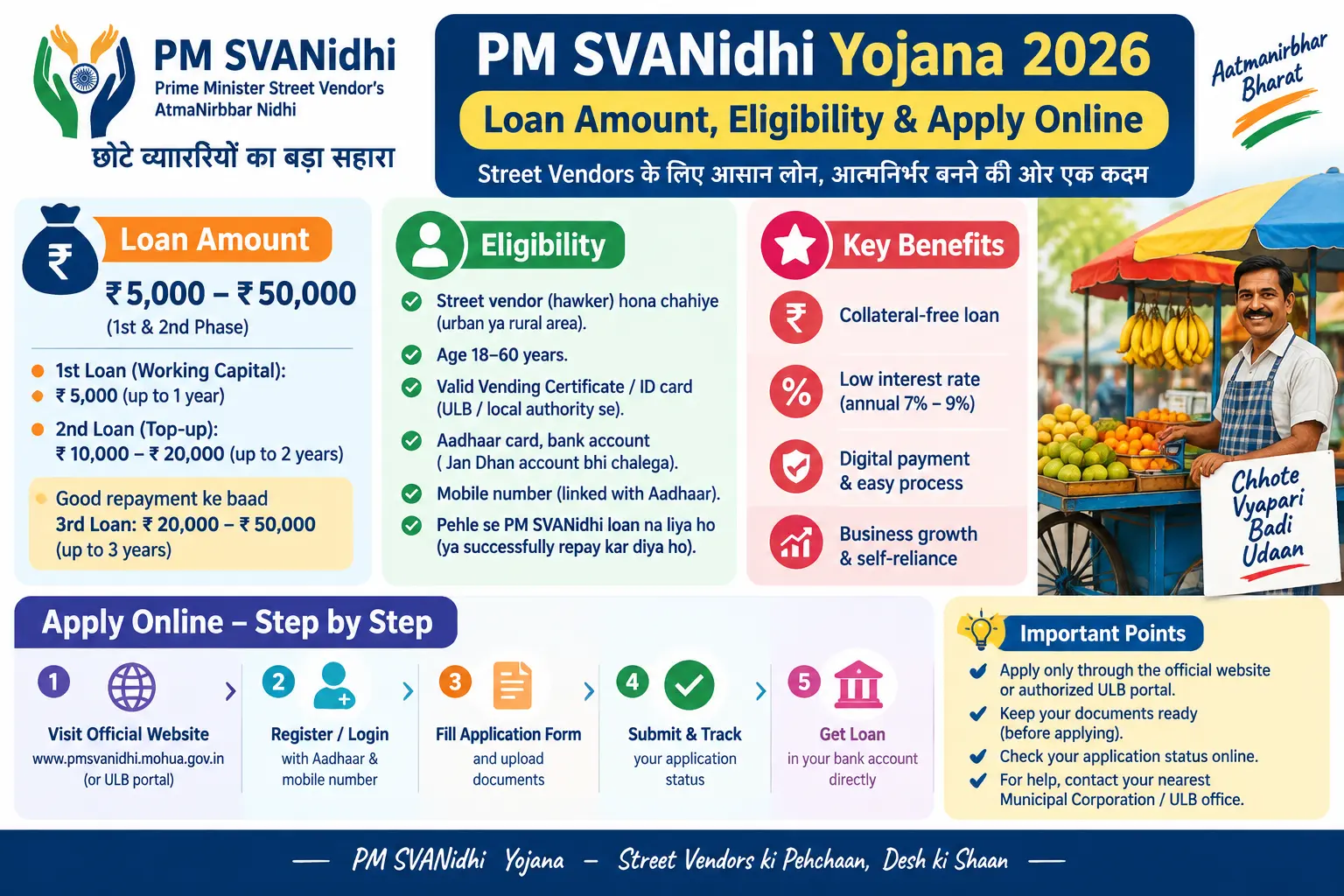
PM SVANidhi Loan Amount: What You Can Get in 2026
Loans are disbursed in three tranches, and the amounts for the first two have been revised upward. If you last checked the scheme a couple of years ago, the numbers you remember are outdated.
| Tranche | Maximum Loan Amount | Minimum Loan Amount | Repayment Tenure |
|---|---|---|---|
| 1st Tranche | ₹15,000 | ₹5,000 | 12 months |
| 2nd Tranche | ₹25,000 | ₹15,000 | 18 months |
| 3rd Tranche | ₹50,000 | ₹30,000 | 36 months |
All loans are collateral-free. The interest rate is linked to the bank’s repo rate-linked lending rate (RLLR), and an interest subsidy of 7% per annum is credited to your account if you repay on time. There is no penalty for early repayment, and you can pre-pay without any extra cost.
You must fully repay each tranche before you become eligible for the next one. That condition is non-negotiable.
PM SVANidhi Credit Card
A newer addition is the UPI-linked RuPay Credit Card. Vendors who have successfully repaid their second tranche can apply for it separately. The credit limit can go up to ₹30,000 for eligible vendors, giving them a digital spending tool beyond the tranche loans.
PM SVANidhi Eligibility: Who Can Apply?
Not every vendor automatically qualifies. The scheme hinges on your vending credentials—documents issued by local authorities that prove you are a recognised street vendor in a covered area.
Who Is Considered a Street Vendor?
Under the scheme, a street vendor is anyone selling articles, goods, food items, or daily-use merchandise, or offering services to the public on a street, footpath, or pavement—whether from a temporary structure or by moving from place to place. Vegetable sellers, food vendors, barbers, cobblers, and laundry service providers all fall within this definition.
Key Eligibility Conditions
- Valid vending document: You need a Certificate of Vending (CoV), a Vendor Identity Card from your Urban Local Body (ULB) or Town Vending Committee (TVC), or a Letter of Recommendation (LoR) approved through the PM SVANidhi Portal. In census towns and peri-urban areas, an LoR approved by the Block Development Officer (BDO) is also accepted.
- Minimum age: 18 years. No upper limit.
- Location: You must vend in an area covered by a ULB, census town, or peri-urban area that has notified rules under the Street Vendors Act, 2014.
- Bank account: An active savings account with a valid UPI ID linked to it.
- Credit history: No minimum CIC score is required—applicants with no credit history are allowed. However, an existing loan classified as a Non-Performing Asset (NPA) or a written-off account with any lending institution can lead to rejection.
- Udyam Registration: Not required. No project proposal is needed either.
How to Apply for PM SVANidhi Online: Step-by-Step
The process is largely digital, but offline help is available for vendors who need it.
Step 1: Get Your Vending Document in Order
Before anything else, confirm you have a valid CoV, Vendor ID, or LoR. If you do not, apply for it through your local ULB or TVC first. One critical detail: all LoRs must be issued through the PM SVANidhi Portal. A manually issued LoR from a local body will not be accepted by the bank.
Step 2: Keep Your Documents Ready
You will typically need a digital copy of your Aadhaar card, your bank passbook or statement, and your vending document. A recent passport-size photograph may also be asked for. For vendors in Assam and Meghalaya who do not have Aadhaar, a Voter Identity Card is generally accepted.
Step 3: Apply Through the Official Portal or App
Go to the PM SVANidhi portal at pmsvanidhi.mohua.gov.in and register as a new user. Fill in your personal details, bank account information, and upload the documents. You can also apply through the PM SVANidhi mobile app or with help from your ULB.
A pitfall to watch for: If the portal times out or your session expires mid-application, your uploaded documents may not save. Complete the form in one sitting if possible, and keep soft copies of every document on your phone.
Step 4: Offline Application (If You Prefer It)
You can visit your bank branch, municipal office, or a Common Service Centre (CSC) to apply in person. Bank officials or ULB staff can help you complete the formalities.
Step 5: Track Your Application
Once submitted, your application moves through the digital platform. On average, approval takes about 23 days, though some cases stretch to 30 days depending on verification and document completeness. You can track the status through the portal or app.
Common pitfall: If you enter the wrong bank account number or IFSC code, the application will be rejected or stuck. Double-check those details against your passbook before submitting.
Step 6: Loan Disbursement and Digital Setup
After approval, the loan amount is credited to your bank account. Set up your UPI ID if you have not already—digital transactions earn you cashback. The scheme offers ₹1 per transaction up to ₹100 per month, with a maximum of ₹1,200 per year per tranche. There is also additional cashback for wholesale digital purchases of at least ₹2,000, up to ₹400 per year.
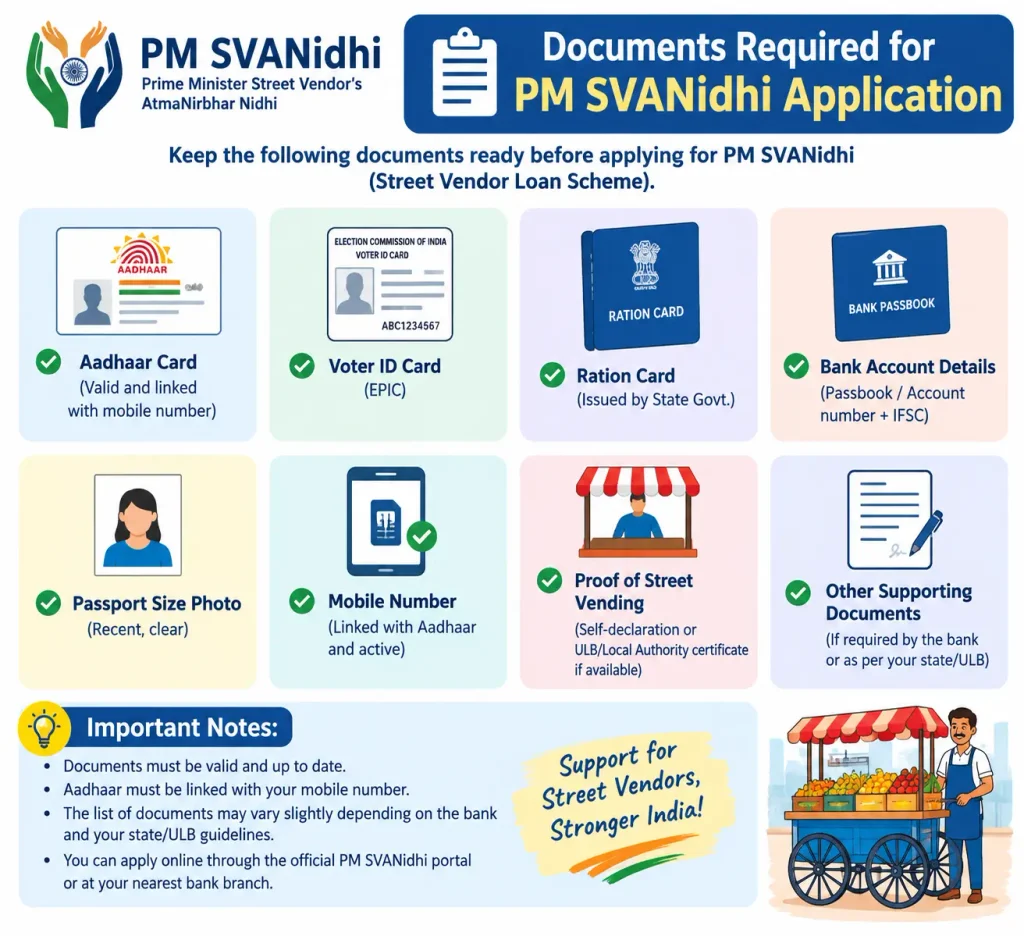
Documents Required for PM SVANidhi Application
Typically, you will need:
- Certificate of Vending (CoV) / Vendor ID Card / Letter of Recommendation (LoR) issued by your ULB or TVC. In census towns and peri-urban areas, an LoR approved by the BDO is required.
- Aadhaar Card as identity and address proof. (For Assam and Meghalaya vendors without Aadhaar, a Voter Identity Card is accepted.)
- Savings Bank Account Passbook or Bank Statement in the vendor’s name.
- Valid UPI ID linked to your bank account.
- Passport-size photograph (if required).
There is no processing fee, no margin money requirement, and no security deposit for these loans.
Common Mistakes to Avoid
- Using a manually issued LoR: Only LoRs issued through the PM SVANidhi Portal are valid. A manually issued one will be rejected.
- Applying without a vending document: The vending credential is the most critical eligibility document. Without a CoV, ID card, or LoR, your application cannot proceed. Get the document first.
- Skipping the UPI setup: A UPI-linked bank account is not just for cashback—it is part of the scheme’s digital transaction requirements. Set it up before applying.
- Assuming a low credit score disqualifies you: No minimum CIC score is required. However, an existing NPA or written-off account can be grounds for rejection.
- Expecting automatic tranche upgrades: You must successfully repay the previous tranche to qualify for the next one. There is no automatic progression.
Frequently Asked Questions (FAQs)
Q1: Is PM SVANidhi Yojana still active in 2026?
Yes. The scheme has been extended with a lending period until March 2030, and it has been restructured with higher loan amounts and the UPI-linked credit card.
Q2: Can I apply for PM SVANidhi without Aadhaar?
Generally, Aadhaar is required. Vendors from Assam and Meghalaya who do not have Aadhaar can use a Voter Identity Card as an alternative. For all other states, Aadhaar is typically mandatory.
Q3: How long does it take to get a PM SVANidhi loan approved?
On average, about 23 days, subject to verification. Some cases take up to 30 days. Timelines vary based on document completeness and bank processing.
Q4: What is the interest rate on PM SVANidhi loans?
The rate is linked to the bank’s RLLR. Eligible borrowers receive an interest subsidy of 7% per annum, credited directly to their account on a quarterly basis.
Q5: Can I get a second loan if I repay the first one early?
Yes. Early repayment is encouraged. Once you repay the first tranche in full, you become eligible for the second, and timely repayment of the second makes you eligible for the third. There is no penalty for early repayment.
Q6: What is the PM SVANidhi credit card and who can get it?
The UPI-linked RuPay Credit Card is a newer feature. Vendors who have successfully repaid their second tranche can apply for it on a standalone basis. The credit limit can be up to ₹30,000 for eligible vendors.
Final Thoughts
If your application is rejected or stuck, do not assume you are ineligible. In most cases, the issue is a missing vending document, a mismatch in bank details, or an LoR that was not issued through the portal. Fix that specific gap and reapply. And if your first tranche is approved, mark the repayment date on your calendar—your eligibility for the next tranche depends entirely on that repayment, not on how long you have been vending. For the latest fees, timelines, and scheme updates, check the official PM SVANidhi portal or your local ULB office.
