
Your caste certificate application was returned because the portal could not find your community name. Or your family has always used one name, but the official list spells it differently. These are common reasons people search for sc caste in hindi, SC me kitni jati hai, or अनुसूचित जाति लिस्ट. This guide explains how the Scheduled Caste list works in India in 2026, why it is state-wise, how to check whether your caste is notified in your state, and what documents are commonly required. For any official decision, verify with your state social welfare or revenue department.
SC Caste in Hindi: What Does Anusuchit Jati Mean?
Anusuchit jati simply means a caste that has been officially notified by the government. Under Article 341 of the Constitution, the President notifies which castes are treated as Scheduled Castes for a particular State or Union Territory. Parliament can later amend that list.
So SC caste konsi hoti hai? It is not one single caste. It is a legal category that includes many communities. Once a community is notified as SC for a state, people belonging to it can apply for a caste certificate and may become eligible for reservation benefits in education and government jobs. But the same community may not be SC in another state.
Why the SC List Is State-Specific, Not National
A caste that is SC in Bihar is not automatically SC in Maharashtra. The list is tied to your state or UT of domicile. Even the official name can change from region to region. A community might be listed as one name in Rajasthan and under a different spelling or sub-group in Gujarat.
This is why anusuchit jaati kaun si hoti hai has no single answer for all of India. You must check the list for the state mentioned in your school records, domicile certificate, or family documents. Migration alone does not change your SC status.
Discover More About:👇
Caste Certificate 2026: Documents Required, Apply Online & Category Meaning
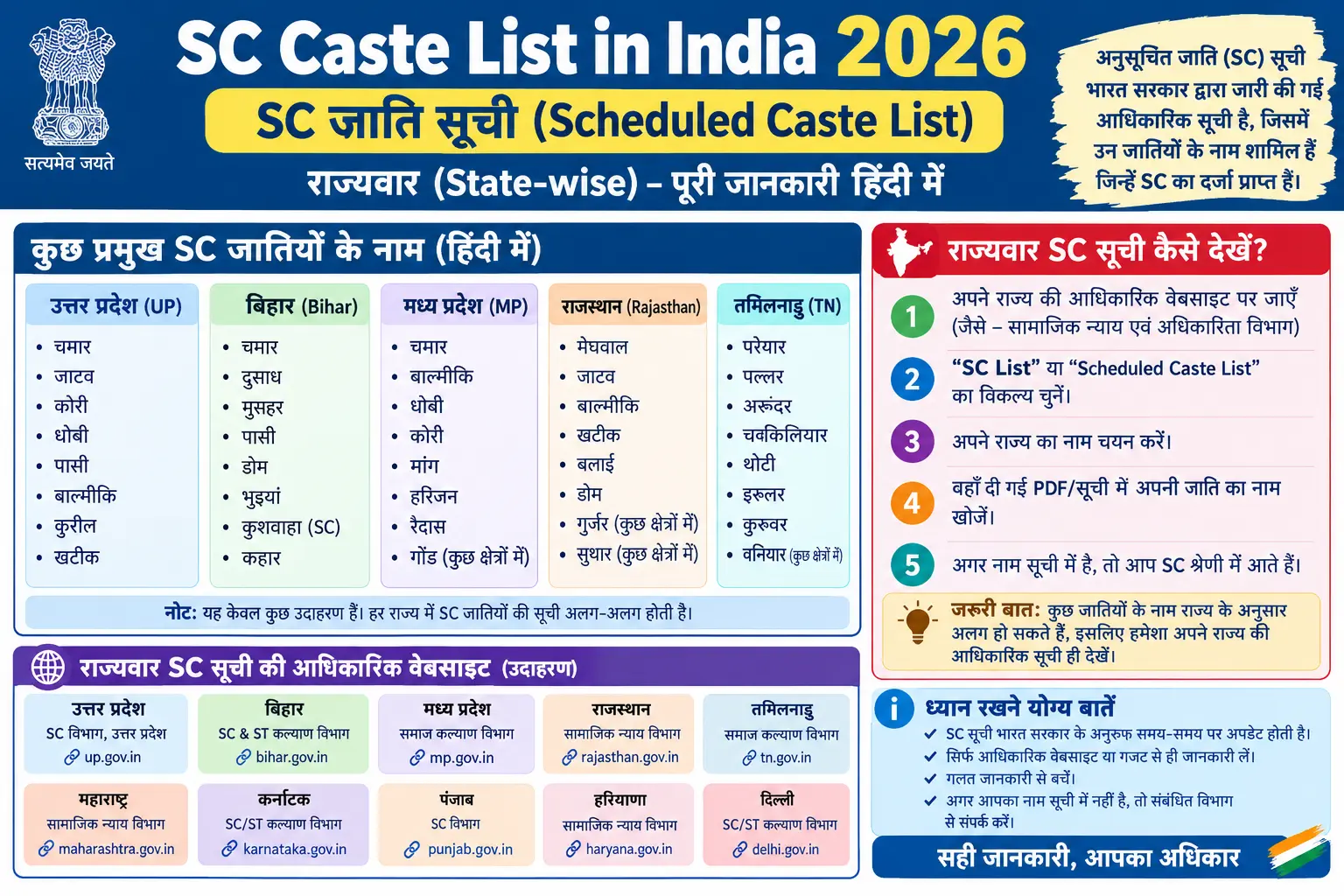
SC Caste List in India 2026: State-wise Examples
The full lists are long and published in official gazette notifications. Below are common examples only. They are not exhaustive, and entries can carry district or sub-caste conditions.
Northern India
Haryana, Himachal Pradesh, Punjab, Rajasthan, Uttar Pradesh, Uttarakhand, and Delhi have their own lists. Commonly notified communities include Chamar, Balmiki, Valmiki, Bhangi, Chuhra, Mazhabi, Khatik, Kori, Pasi, and Dhobi. In Punjab and Haryana, Mazhabi Sikh and Ravidasia are important entries. Himachal Pradesh includes Ad Dharmi, Jatia, Ramdasi, and Ravidasia.
Central India
Madhya Pradesh, Chhattisgarh, and parts of Maharashtra include communities such as Chamar, Jatav, Mahar, Mang, Chambhar, Bhangi, Dom, Pardhi, and Basor. Some Pardhi sub-groups are notified only for particular districts in Madhya Pradesh.
Western India
Maharashtra’s list includes Mahar, Mang, Chambhar, Dhor, Holi, Bhangi, and Mochi. Gujarat includes Bhanghi, Chambhar, Dhed, and Vankar. Rajasthan includes Bairwa, Chamar, Bhangi, and Dhanak. Goa also has its own notified entries.
Eastern India
Bihar includes Chamar, Musahar, Dusadh, Pasi, Bhuiya, Dom, and Nat. West Bengal includes Namasudra, Bagdi, Bauri, and Pod. Odisha includes Bauri, Bhadala, Dhoba, and Pan. Jharkhand has its own separate list.
Southern India
Kerala includes Adi Dravida, Chakkiliyan, Cheruman, and Pulayan. Tamil Nadu includes Adi Dravida, Arunthathiyar, Chakkiliyan, and Pallan. Karnataka includes Adi Karnataka, Bhovi, and Holeya. Andhra Pradesh and Telangana have detailed district-wise entries.
North-East and Union Territories
Assam, Manipur, Tripura, and Meghalaya have shorter lists with communities such as Bansphor, Bhuinmali, Brittial Bania, and Namasudra. Delhi includes Balmiki, Bhangi, Chamar, and Chuhra. Puducherry includes Adi Dravida and Chakkiliyan. Jammu & Kashmir, Chandigarh, and other UTs also have notified lists.
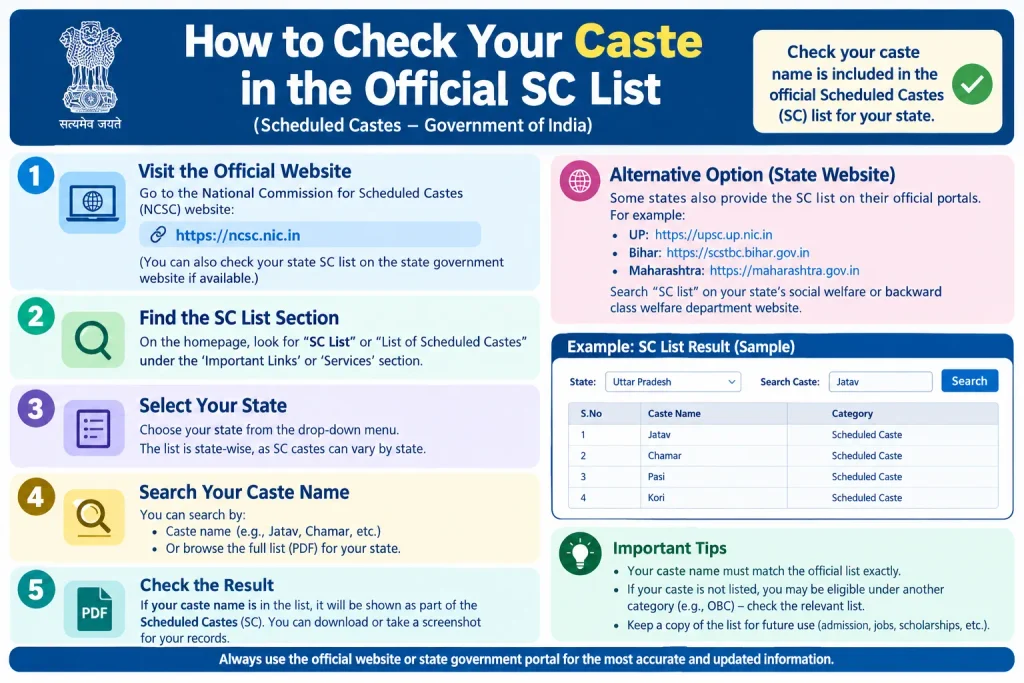
How to Check Your Caste in the Official SC List
Follow these steps if you need to confirm whether your community is SC in your state.
- Confirm your State or UT of domicile. Use the state on your school leaving certificate, domicile certificate, or family records. This is the list that usually applies to you.
- Find the official SC list for that state. Check the Ministry of Social Justice and Empowerment, your state social welfare department, the National Portal of India, or Census India. Avoid random PDFs or social media images.
- Search the exact notified name. Look for spelling variants. For example, “Balmiki” may also appear as “Valmiki” in some lists. Check sub-caste names too.
- Read the footnotes and territorial limits. Some entries apply only to certain districts, tehsils, or sub-groups. A community may be SC in one district but not another.
- Cross-check with family documents. An old family caste certificate or school record can help confirm the exact name used in your area.
- Apply for a caste certificate through the proper authority. In most states, this is done through the state e-district portal or at the Tehsil/SDM office. Commonly required documents include Aadhaar or another photo ID, domicile proof, school leaving certificate, father’s caste certificate (if available), passport-size photo, and a self-declaration. Fees and processing timelines vary by state, so check the state portal for current details.
Aadhaar is often accepted as identity proof. If your name spelling differs across documents, you can update Aadhaar through the UIDAI portal (uidai.gov.in) or an Aadhaar Seva Kendra. But UIDAI does not issue or verify caste certificates.
Common pitfalls: the e-district portal may log you out if you take too long; OTP may not arrive if your mobile number is not linked; uploading a blurry document can cause rejection; and selecting the wrong district can send your file to the wrong office. Keep scanned copies ready before you start.
Common Mistakes to Avoid
- Assuming the SC list is the same across India. It is not.
- Relying on a surname alone. The notified community name and official certificate matter.
- Using an old list. The SC list can be amended.
- Confusing SC with ST. अनुसूचित जाति और अनुसूचित जनजाति list are separate.
- Ignoring district or sub-caste conditions in the notification.
- Changing documents yourself to match a spelling. Ask the issuing authority to correct it properly.
FAQs About SC Caste List
Q1. SC me kitni jati hai?
There is no single nationwide number. Each state has its own list, and some states have more than 50 entries. Across India, the total runs into several hundred when all state lists are added.
Q2. SC me kon kon aata hai?
Communities like Chamar, Balmiki, Mahar, Musahar, Pasi, Dhobi, Khatik, Mazhabi, Ravidasia, and Namasudra are commonly notified. The exact list depends on your state.
Q3. SC mein kaun si jaati aati hai?
SC mein kaun si jaati aati hai depends on your domicile state. In Punjab, Mazhabi Sikh and Ravidasia are SC. In Tamil Nadu, Adi Dravida and Arunthathiyar are SC. Always check your state’s notification.
Q4. Anusuchit jati me kon aate hai?
Anusuchit jati me kon aate hai — those communities that the government has officially notified for a particular state or UT. The list includes many Dalit communities that historically faced untouchability and discrimination.
Q5. Kya SC list har saal badalti hai?
Not every year. It can be amended through parliamentary law or presidential notification. Check the latest official list before applying for any benefit.
Q6. SC caste certificate kaise banwayein?
Apply through your state’s e-district portal or the Tehsil/SDM office. Documents and fees vary by state. For Aadhaar corrections, use the UIDAI portal or Aadhaar Seva Kendra; for caste certificates, the revenue department is the right authority.
If your community name appears in the list but the portal rejects it, do not alter the certificate yourself. Ask the issuing authority to match the spelling exactly as in the state gazette. If the list was amended recently, carry a copy of that notification when you visit the Tehsil or SDM office. That single step often clears more confusion than repeated online searches.
