
Your Annasaheb Patil loan application can stall even when your business plan is solid—because your Aadhaar is not seeded in your bank account, your caste certificate came from the wrong office, or you filled the form on an old Maharashtra self-employment portal. Families waiting for the Ramai Awas first instalment hit a different wall: name mismatches between the 7/12 extract and Aadhaar, or a duplicate application from another family member. This guide covers the sarkari yojana maharashtra list for 2026, with practical steps for the Annasaheb Patil Loan Yojana and Ramai Awas Yojana, plus the documents and mistakes that decide whether your file moves or sits in a pile.
What Are the Key Sarkari Yojana Maharashtra Schemes in 2026?
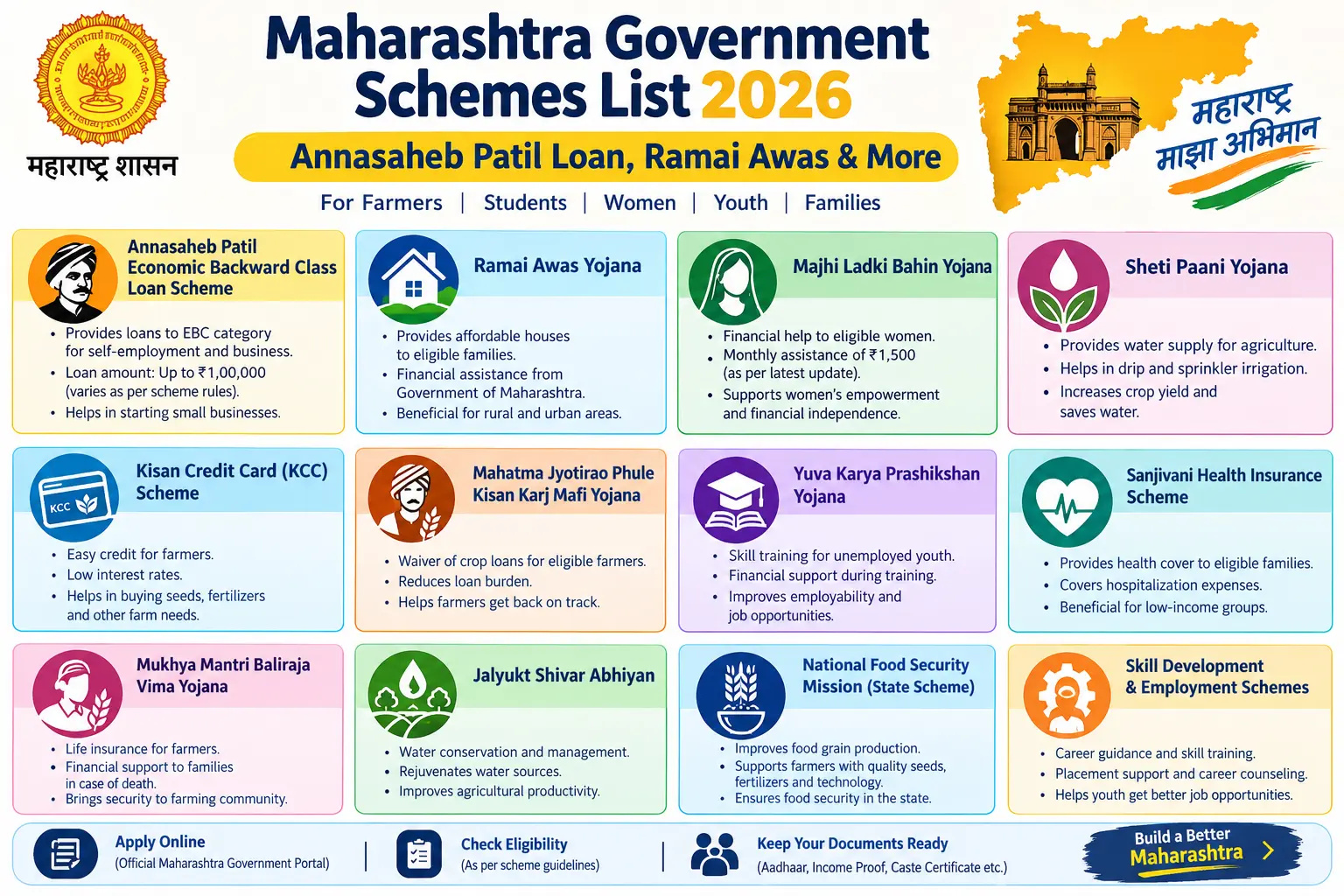
Maharashtra runs welfare and self-employment schemes through Social Justice, Rural Development, Finance, and other departments. Some target specific communities; others are open to women, farmers, and low-income households. Recent state budget announcements have continued support for Mukhyamantri Majhi Ladki Bahin Yojana for women and the Punyashlok Ahilyabai Holkar Farmers’ Loan Waiver Scheme up to ₹2 lakh. Newer announcements include Mukhyamantri Gramin Pashudhan Udyojakta Yojana for livestock entrepreneurship and Mukhyamantri Matsya Sampada Yojana for fisheries.
Two schemes draw the most queries from Maratha youth and SC/Nav-Buddha families: Annasaheb Patil Loan Yojana and Ramai Awas (Gharkul) Yojana. Both route benefits through Aadhaar-linked bank accounts.
Discover More About:👇
Majhi Ladki Bahin Yojana 2026: Online Apply, Eligibility, Benefits & Official Website
Bandhkam Kamgar Yojana 2026: Registration, Benefits & Online Apply (Maharashtra)
Annasaheb Patil Loan Yojana: How the Interest Refund Works
The annasaheb patil loan yojana is run by the annasaheb patil arthik mahamandal (Annasaheb Patil Arthik Magas Vikas Mahamandal). It is not a direct cash grant. You take a business loan from a participating bank; if you repay on time, the government refunds the interest into your Aadhaar-linked account. Miss instalments, and you can lose the subsidy for that period. That single condition—disciplined repayment—is what makes the scheme work.
Loan amounts, eligibility, and the 30% rule
Indicative limits commonly cited: individual loans up to ₹10 lakh, group or enterprise loans up to ₹50 lakh, and a separate tractor loan up to ₹15 lakh. Repayment typically runs up to seven years. Applicants are generally aged 18–60, must be Maharashtra residents, and belong to the Maratha / economically backward class as defined by the Mahamandal. Family annual income is generally below ₹8 lakh, and the Mahamandal has linked loan size to income: your income should be at least 30% of the loan amount. Verify current norms on the portal before applying.
How to apply for the Annasaheb Patil loan
- Open the current Maharashtra Udyog Samvardhan portal at
udyog.mahaswayam.gov.in. Do not use old bookmarks formahaswayamrojgar.maharashtra.gov.in—they may lead to outdated forms. - Register with your mobile number and Aadhaar. You will need an OTP on the mobile number linked to Aadhaar. If the OTP does not arrive, your mobile is probably not Aadhaar-linked; update it at an Aadhaar Seva Kendra or via the UIDAI portal first.
- Select Annasaheb Patil Loan Yojana (also labelled APAVMC). This is where people slip: Annabhau Sathe Loan Yojana and other loan schemes sit on the same portal. Choosing the wrong one sends your file to the wrong department.
- Fill personal, income, and business details. Keep your income certificate handy—the 30% income-to-loan ratio is checked here. A mismatch between your stated income and the certificate is a common rejection reason.
- Upload scanned Aadhaar, income certificate, caste certificate (if applicable), bank details, and business plan or quotation. Keep files clear and within the portal’s size limits. Blurry or expired documents will be returned.
- Submit and save your application number. The Mahamandal and bank review the case. If approved, a Letter of Intent (LOI) or eligibility certificate may be issued before bank sanction. Portal sessions can time out while uploading; save drafts as you go.
The interest refund is not automatic. Repay on time, then the refund is credited after verification. If you miss payments, you may lose the subsidy for that period.
Ramai Awas Yojana: Housing Support for SC and Nav-Buddha Families
The ramai awas yojana (Ramai Awas Gharkul Yojana) is administered by the Social Justice and Special Assistance Department. It helps Scheduled Caste and Nav-Buddha families who do not own a pucca house. Money is released in instalments through Direct Benefit Transfer (DBT) to an Aadhaar-linked bank account.
Assistance amounts and eligibility
Indicative amounts vary by area: rural ₹1.32 lakh (including ₹12,000 for a toilet), hilly or Naxal-affected ₹1.42 lakh, and Municipal Council/Nagar Parishad or Municipal Corporation areas ₹2.50 lakh. The first instalment was recently increased to ₹50,000 to help start construction earlier. Eligibility generally requires SC or Nav-Buddha status, at least 15 years of Maharashtra residence, land or a temporary house (not a pucca house), annual family income within ₹1.20 lakh rural or ₹3 lakh urban, an Aadhaar-linked bank account, and no benefit from another government housing scheme. Only one person per family can receive it.
How to apply for Ramai Awas Yojana
- Get the form from your Gram Panchayat, Social Justice Department office, or Municipal Corporation/Municipal Council office. Some districts let you download it from the Social Justice Department portal (
sjsa.maharashtra.gov.in). - Fill in personal details, land details, income, and caste information. The name on the form should match your Aadhaar, caste certificate, and land records.
- Attach self-attested documents—see the checklist below.
- Submit to the designated local office (Gram Panchayat, Panchayat Samiti, or Municipal Corporation as applicable). Keep a receipt or acknowledgement.
- Officials verify eligibility, land ownership, and income. A site inspection may follow. If your 7/12 extract is in a relative’s name or has an old mutation entry, resolve that before applying.
- After approval, the first instalment reaches your Aadhaar-linked bank account. Further instalments follow as construction progresses and is verified.
A frequent pitfall: two members of the same family apply, hoping one will be approved. Duplicate applications are rejected. Another: the bank account is joint or not Aadhaar-seeded, so DBT fails.
Documents Required for Both Schemes
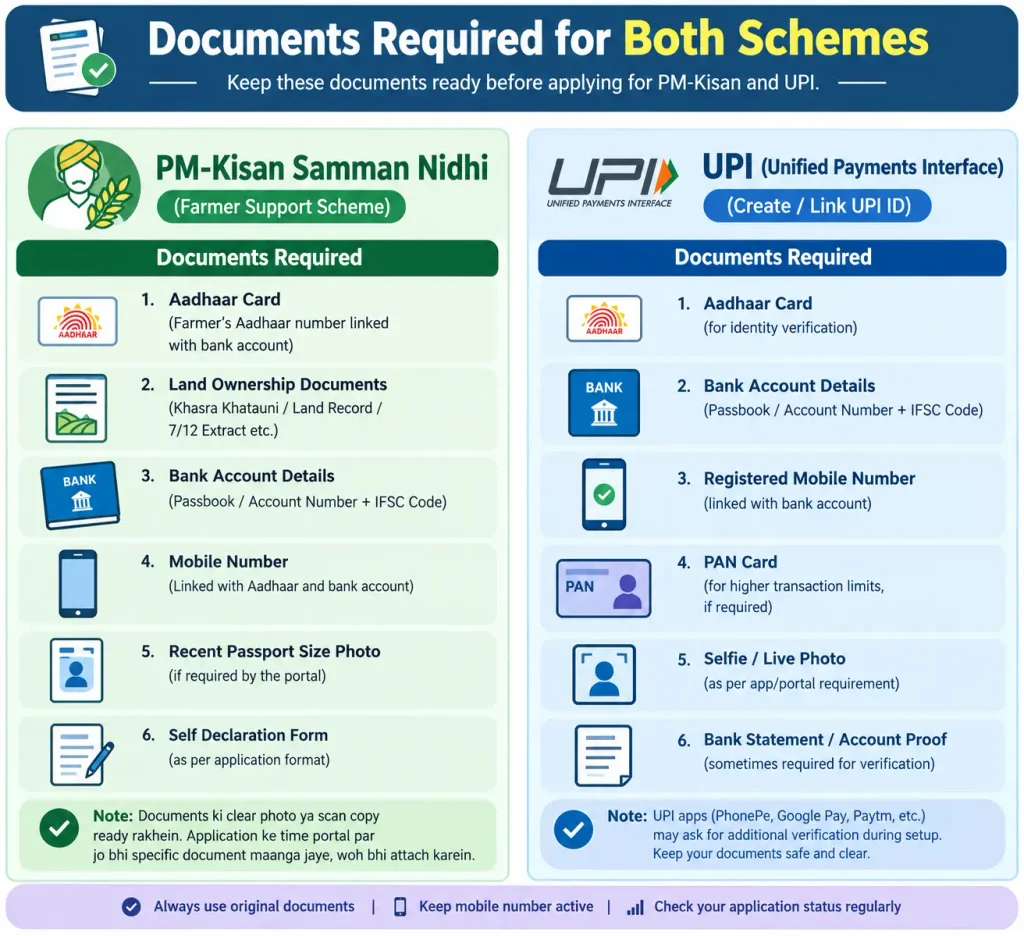
Keep these ready before you start. For both schemes you will typically need:
- Aadhaar card with an active, Aadhaar-linked bank account.
- Domicile or residence certificate; for Ramai Awas, proof of 15 years’ Maharashtra residence.
- Caste certificate from a competent authority (for Ramai Awas; for Annasaheb Patil if applying under the Maratha/EBC category).
- Income certificate from the Tehsildar or competent authority.
- Bank passbook copy or cancelled cheque.
- Passport-size photographs.
For the Annasaheb Patil loan, add a business plan or quotation and any bank-specific documents. For Ramai Awas, add land ownership papers (7/12 extract, property registration document, or Gram Panchayat property register extract) and a house tax, water tax, or electricity bill for the existing dwelling.
Common Mistakes That Delay or Sink Applications
- Aadhaar not seeded to the bank account. DBT and interest refunds fail silently. Check at your bank branch before applying.
- Expired or wrong-authority caste certificate. Renew or reissue it first.
- Income certificate mismatch. If your income changed, update the certificate; do not self-declare a different figure.
- Wrong scheme or wrong category. On the Udyog portal, confirm APAVMC/Annasaheb Patil. For Ramai Awas, only SC and Nav-Buddha families qualify.
- Duplicate family applications under Ramai Awas. One person per family.
- Not tracking the file. Save your application number, follow up with the office, and for the loan, watch for LOI issuance and bank sanction.
FAQs
Q1: What is the maximum loan under the Annasaheb Patil loan yojana?
Individual loans generally go up to ₹10 lakh; group or enterprise loans can reach ₹50 lakh; tractor loans have a separate limit up to ₹15 lakh. The sanctioned amount depends on your proposal and income eligibility.
Q2: Is the Annasaheb Patil loan interest-free?
Not at borrowing. You pay bank interest, and the government refunds it if you repay on time. Late payments can cost you the subsidy for that period.
Q3: Can I apply for Ramai Awas Yojana if I already own a pucca house?
No. The scheme is for families without a pucca house and those who have not received another government housing benefit.
Q4: What is the first instalment under Ramai Awas Yojana?
As per recent announcements, the first instalment is ₹50,000. Later instalments are released after construction progress is verified.
Q5: How do I check my Annasaheb Patil loan application status?
Log in to udyog.mahaswayam.gov.in with your registered mobile number and application details. You can also follow up with the Annasaheb Patil Arthik Magas Vikas Mahamandal office.
Q6: Where can I get the Ramai Awas Yojana form?
Gram Panchayat offices, Social Justice Department offices, and Municipal Corporation/Municipal Council offices. Some districts allow download from sjsa.maharashtra.gov.in.
If your application is rejected, do not resubmit the same file. Ask the local office for the specific rejection reason, fix that one document or mismatch, and reapply. Portals and local offices often update status in batches, so allow a reasonable gap before checking again—and confirm current amounts, eligibility, and timelines on the official portal rather than relying on forwarded messages. For Aadhaar-linked bank issues, the UIDAI portal (uidai.gov.in) or an Aadhaar Seva Kendra is the right place to start.
