

Your Class 12 marksheet shows first division. Admission is confirmed. Then the fee notice arrives — and the one support you were counting on, a monthly stipend from the state, depends on an application that can be rejected over a single mismatched digit in your Samagra ID. The Gaon Ki Beti scholarship is Madhya Pradesh’s answer to that gap: a monthly payment for rural girls who scored 60% or more in Class 12 and have enrolled in college. This guide covers who qualifies, the documents that actually get checked, a realistic walkthrough of the online application, and where the Gaon Ki Beti form PDF fits into it all.
What Is the Gaon Ki Beti Scholarship?
Run by the Department of Higher Education, Government of Madhya Pradesh, the scheme pays ₹500 a month for ten months — ₹5,000 an academic year — directly into the student’s bank account. Girls in professional courses such as engineering, medical, or nursing may receive up to ₹7,500 a year, subject to the course and current departmental norms.
Two features set it apart from most scholarships. There is no family income limit. And it is reserved for girls whose permanent residence is a village in Madhya Pradesh; an urban counterpart, Pratibha Kiran, covers city students. If you are unsure which applies to you, your residence certificate settles the question.
The scheme covers fresh applicants and renewals. If you received it last year, do not assume it will roll over — renewal is a separate step on the same portal.
Discover More About:👇
Aadhaar Status Check – How to Check Enrolment & Update Status Online
Who Is Eligible? Key Conditions
Every condition below is checked. Failing one at the college verification stage usually means rejection for that session, not a chance to correct it later.
- Rural residence: Permanent resident of a village in Madhya Pradesh, proved by a Rural Area Residence Certificate from the Tahsildar.
- Class 12 score: 60% or above. This is a hard cut-off; marks are not rounded up to reach it.
- College admission: Enrolled after Class 12 in a recognised institution — government, aided, or recognised private — in Arts, Science, Commerce, or an approved professional stream.
- Parental employment: Parents should not hold a government job, as per scheme guidelines.
- Samagra ID: Compulsory. This is Madhya Pradesh’s unique family-and-individual identification number, used across welfare schemes in the state.
How to Apply Online: Step-by-Step
Applications go through the MP Scholarship Portal 2.0 (scholarshipportal.mp.nic.in). The process is online, but students with unreliable internet often complete it at a CSC (Common Service Centre) or a college computer lab. Before you start, scan every document and keep the files ready — the portal can time you out mid-session, and re-entering data is worse than preparing first.
- Open the portal and start a new registration. On scholarshipportal.mp.nic.in, choose the “New Registration” or “Student Registration” link on the homepage.
- Register using your Samagra ID. Enter the ID and verify with the OTP. Here is the first common snag: the OTP goes to the mobile number registered against your Samagra profile — not necessarily the phone in your hand. If that number is old or inactive, get it updated at a Samagra centre before you begin.
- Fill your personal and course details. Name, date of birth, category, course, and institution. Create a username and password, and write them down.
- Log in and pick the scheme. Your dashboard lists the schemes your profile matches. Select Gaon Ki Beti Yojana. Many fields will already be filled from your registration.
- Upload the documents. Formats are usually PDF or JPEG, with a file-size cap. Oversized or blurry scans are a frequent reason for rejection — compress and check each file before uploading.
- Submit and save the application number. Print or screenshot the acknowledgement slip. Without the application number, tracking your status becomes difficult.
- Wait for college verification. The application routes to your college, where the scholarship coordinator or principal checks uploads against originals. Track progress under “Application Status” on the portal.
Where does the Gaon Ki Beti form PDF come in? Some colleges and district education offices circulate a printable version that mirrors the online fields. It is useful for collecting information on paper before typing it in, but it is not the application. Only the online submission generates a valid application number. Ask your college for the current session’s PDF, since formats change between years.
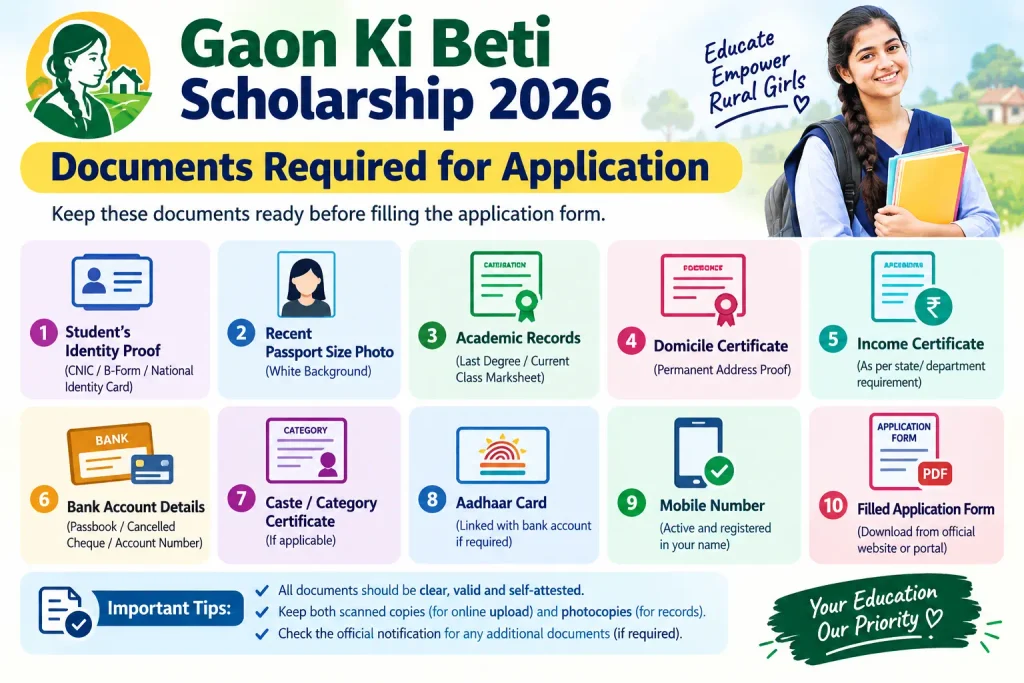
Documents Required for Application
Scanned copies, all in the student’s own name:
- Class 12 marksheet
- Samagra ID card
- Rural Area Residence Certificate from the Tahsildar
- Income certificate in the prevailing format
- Aadhaar card
- Bank passbook front page showing account number, IFSC code, and the student’s name
- College admission slip or fee receipt
- Recent passport-size photograph
- Caste certificate, if applicable
- Village Daughter Certificate (Gaon Ki Beti Praman Patra), where the institution asks for it
If the bank account is joint, the student should be the primary holder. Scholarship payments move through Direct Benefit Transfer (DBT), and an account that is dormant or held in a parent’s name can stall the credit.
Common Mistakes to Avoid
- A wrong Samagra ID. One incorrect digit fails verification. Read it off the card, not from memory.
- Illegible uploads. Blurry, cropped, or angled photos get rejected. Use a scanner app rather than a casual phone photo.
- An inactive or wrongly held bank account. DBT credits need an active account, linked to Aadhaar where required.
- Missing the college verification window. The portal may accept your form, but if the college does not verify it in time, nothing moves forward. Follow up in person.
- Treating the PDF as the final application. It is a worksheet. The portal submission is the application.
- Skipping renewal. Continuing students must complete the renewal process each session.
Frequently Asked Questions
Q1. What is the last date to apply for the Gaon Ki Beti scholarship in 2026?
The Higher Education Department announces dates each session, and they shift. Notifications in some cycles pointed to 15 May, while others ran later. Check the MP Scholarship Portal or your college notice board for the current date — last year’s deadline is not a safe guide.
Q2. Where can I get the Gaon Ki Beti form PDF?
The application itself is online. A reference PDF is sometimes posted on college websites or the department’s portal. Ask your college scholarship coordinator for the latest version, or look in the portal’s download section.
Q3. Is there an income limit?
No. Gaon Ki Beti has no family income ceiling. Rural residence, gender, Class 12 marks, and college admission are the filters.
Q4. Can I apply from a private college?
Generally yes, if the college is recognised by the Higher Education Department and can verify applications on the portal. Confirm with the institution before applying.
Q5. I missed last year’s application. Can I apply now?
In some cycles the portal has reopened for students who missed the previous session’s benefit. If you are still within the eligible course duration and meet the criteria, ask your college whether a late window is open.
Q6. How is the money paid?
Through DBT, usually as monthly instalments over ten months. Professional-course students may receive a higher annual amount. Actual credit depends on verification and fund release by the department.
What to Do If Your Application Stalls
Most delays happen at the college, not the department. If your status sits at “pending verification” for more than a week or two, a visit or call to the scholarship coordinator usually moves it faster than refreshing the portal. Once verified, keep the acknowledgement slip and your application number until the full year’s amount has been credited — you will need them if a payment fails. And before every new session, re-check the portal: rules, dates, and document formats are revised periodically, and the version that worked last year may not be the one that works now.
