
Your daughter’s Class 6 admission is next week, the school wants proof of her Ladli Laxmi enrolment, and the certificate page just won’t load. Or you’re a woman in Maharashtra whose ₹1,500 monthly instalment stopped arriving three months ago, and the portal shows nothing but an “ineligible” remark. Both situations are common, and both usually come down to one of a handful of fixable issues — a missing registration number, an Aadhaar mismatch, an incomplete e-KYC, or a bank account that was never seeded for DBT. This guide walks through the Ladli Laxmi Yojana certificate download process in Madhya Pradesh, how to check Ladli Behna Yojana eKYC online status in Maharashtra, and what to do when a payment or certificate simply refuses to appear.
One thing to get straight before anything else: these are state government schemes, not UIDAI schemes. Aadhaar enters the picture only as an identity check and as the link that connects your bank account to Direct Benefit Transfer (DBT). UIDAI does not run, approve, or reject these benefits. The state portal for your scheme is the only authority that matters for your case.
What the Ladli Laxmi Certificate Actually Is — and When You’ll Need It
The Ladli Laxmi Yojana is Madhya Pradesh’s girl-child scheme, started in 2007 and now running under the Ladli Laxmi 2.0 phase. The certificate is not an Aadhaar document. It is a scheme registration certificate issued in the girl’s name after her family enrols her at an anganwadi centre and the application clears verification.
Families reach for this certificate at predictable moments: at Class 6, Class 9, and Class 11 admissions to claim the stage-wise payouts; when applying for the higher-education incentive under Ladli Laxmi 2.0; and whenever the registration number needs to be produced for a future claim. The final payout arrives when the girl turns 21.
The money is released in stages. A total assurance of ₹30,000 is built over five years from registration. Then ₹2,000, ₹4,000, and ₹7,500 are released at Class 6, Class 9, and Class 11 admissions respectively. During Classes 11 and 12, a monthly support of ₹200 is paid. Ladli Laxmi 2.0 adds ₹25,000 for graduation or a professional course. The final ₹1,00,000 is payable at age 21, provided the girl was not married before 18. Added up, the scheme’s total value runs to roughly ₹1.43 lakh per girl.
Discover More About:👇
Aadhaar Status Check – How to Check Enrolment & Update Status Online
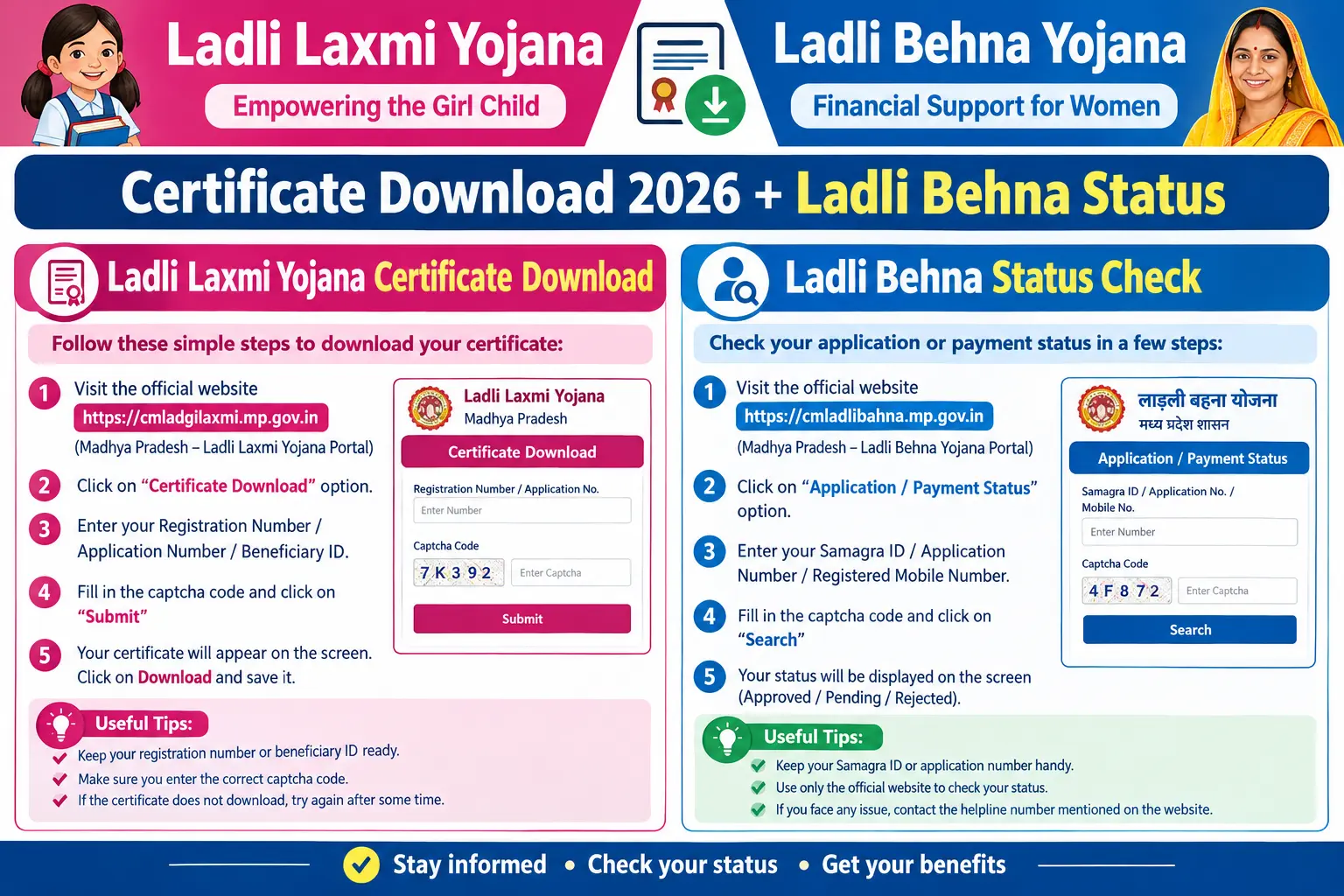
How to Download the Ladli Laxmi Yojana Certificate Online
The certificate download sits on the official state portal at ladlilaxmi.mp.gov.in, under a dedicated certificate or “प्रमाण पत्र” section. You can search by the girl’s registration number, or — if that number is lost — by name, parents’ names, date of birth, and district.
Here is the sequence that actually works:
- Open the official Ladli Laxmi portal and locate the certificate option on the homepage. If the page is slow, try a desktop browser rather than a phone — the portal’s search form often behaves better on a larger screen.
- Enter the registration number from the enrolment slip. No registration number? Use the alternate search fields: girl’s name, mother’s name, father’s name, date of birth, and district. Spelling matters here — “Sunita” and “Suneeta” will pull different results.
- Complete the captcha. If the captcha image does not load, refresh once and wait; repeated refreshes can time out the session.
- The matching record appears on screen. Read every field before downloading — the girl’s name, date of birth, parents’ names, and registration number. A single wrong digit in the date of birth is the most common reason a certificate gets rejected later at the school counter.
- Download or print the PDF. Save a copy to your phone as well; the portal does not always keep old records easily searchable.
If the download stalls or the session expires mid-way, close the browser completely and start again rather than hitting back — the portal often caches a broken session. And if you cannot manage it yourself, an anganwadi worker or a Lok Seva Kendra operator can retrieve the certificate using the registration number. MP Online kiosks handle printing. What no legitimate agent can do is “generate” a certificate without a valid registration — the certificate exists only if the girl was properly enrolled and verified.
Checking Status Under Maharashtra’s Mukhyamantri Majhi Ladki Bahin Yojana
Maharashtra’s scheme — commonly called Mukhyamantri Majhi Ladli Behna Yojana, or simply Ladki Bahin Yojana — is a different programme from Madhya Pradesh’s Ladli Laxmi Yojana. It pays monthly financial assistance to eligible women, and its portal is ladakibahin.maharashtra.gov.in.
Status checking matters because the state has run large verification drives. Names have moved to “ineligible” after data cross-checking against income records, vehicle ownership, and Aadhaar data. If your payment has stopped, the “remarks” column on the portal is the first place to look. That remark usually names the problem: a document mismatch, an income discrepancy, or an incomplete e-KYC.
To check your status:
- Visit the official Ladki Bahin portal.
- Log in with your registered mobile number and password. If the password is lost, use the reset option tied to the same mobile number — not a different one.
- Open the “Application Status” or “e-KYC” section on the dashboard.
- Enter your Aadhaar number, application number, or registered mobile number, whichever the portal asks for.
- Read the status and the remark together. If the remark points to a correctable error, the portal may let you edit submitted data — for example, re-uploading a clearer photo of your Aadhaar, ration card, or bank passbook.
For payment-specific questions, the Nari Shakti Doot app is also used in Maharashtra to check payment status and, in some cases, complete e-KYC. If the portal and the app disagree, trust the portal and confirm with your ward office.
How to Complete Ladli Behna Yojana eKYC Online
The Ladli Behna Yojana eKYC online step is an Aadhaar-based verification. e-KYC stands for electronic Know Your Customer — a digital identity check where your Aadhaar details are authenticated, usually through an OTP sent to the mobile number linked with your Aadhaar.
Here is the general flow on the Maharashtra portal:
- Go to the official portal and click the e-KYC banner or option on the homepage.
- Enter your Aadhaar number and the captcha.
- Give consent for Aadhaar authentication and request the OTP.
- Enter the OTP received on your Aadhaar-linked mobile number.
- Some applicants are asked for the Aadhaar details of a father or husband for additional verification. Complete that step if it appears.
- Select the applicable caste category and submit.
- On success, the account is generally marked e-KYC complete and becomes eligible for DBT-linked payments.
The pitfall to watch for is an OTP that never arrives. This almost always means the mobile number linked to Aadhaar is different from the one in your hand. You will need to update the mobile number in Aadhaar first — through an Aadhaar Enrolment/Update Centre or the Aadhaar Seva Kendra — before e-KYC can proceed. A second common failure is a session timeout during the caste-category step; if the page hangs, do not refresh repeatedly, just log out and start fresh.
Incomplete e-KYC is one of the most common reasons a previously approved application flips to ineligible. The portal and local ward offices handle e-KYC corrections.
Common Mistakes That Delay Certificate Download or Payments
A handful of issues account for most stuck cases:
- Missing registration number. The certificate search is built around this number. Without it, use the name-and-district route, or contact the anganwadi centre that handled the registration.
- Name or date of birth mismatch. Aadhaar records, Samagra ID records, school records, and scheme records drift apart — an extra “a”, a different birth year, a maiden name vs. married name. These mismatches trigger verification failures silently.
- Bank account not seeded with Aadhaar. DBT requires the account to be Aadhaar-linked and mapped under the NPCI system. Without that link, payment stays pending even after e-KYC clears.
- Incomplete e-KYC. Where e-KYC is required, an application can be marked ineligible if it was not finished within the notified window. The remark column usually says so.
- Unofficial websites. Certificate download and e-KYC are official processes. Third-party sites that ask for Aadhaar OTPs or charge unexplained fees are not part of the scheme.
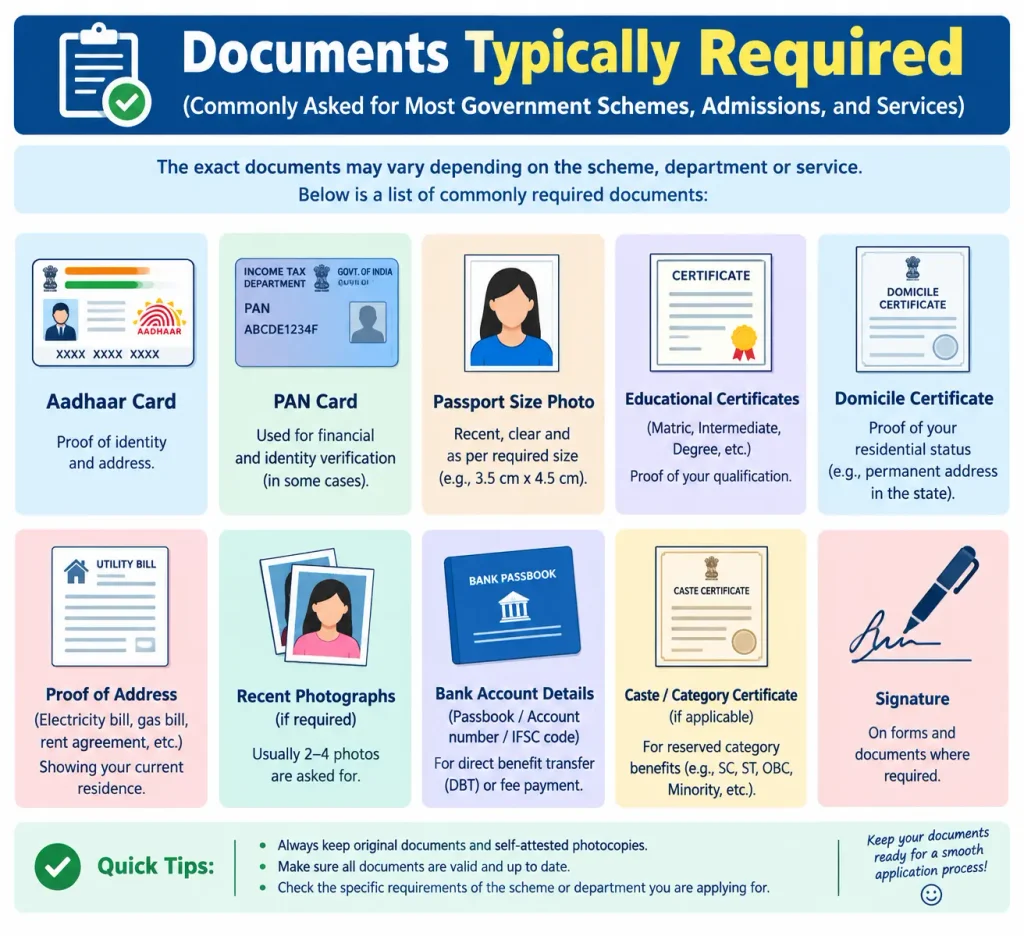
Documents Typically Required
For Ladli Laxmi Yojana registration and certificate work in Madhya Pradesh, the commonly required documents are:
- Samagra family ID and the girl child’s individual Samagra ID
- Birth certificate of the girl child
- Parents’ identity proof and Madhya Pradesh residence proof
- Bank account details
- Education certificates, where applicable, for stage benefits
For Ladli Behna Yojana in Maharashtra, the commonly required documents are:
- Aadhaar card
- An Aadhaar-linked, DBT-enabled bank account in the applicant’s own name
- An active mobile number for OTP verification
- Ration card or residence proof, depending on the current portal requirement
Document lists change. Check the current list on the official state portal before making a trip to a service centre.
A Note on Aadhaar and Fake Documents
Aadhaar serves these schemes only as an identity check and a DBT link. There is no legitimate way to create, edit, or “generate” an Aadhaar card or a scheme certificate outside proper enrolment and verification. Any website, agent, or forwarded message offering a “fake Aadhaar” or an instant certificate without registration is a fraud risk. Do not share your Aadhaar number, OTP, or bank details with such sources. Report the matter to the concerned department’s official helpline.
FAQs
Can I download the Ladli Laxmi certificate without the registration number?
Usually, yes. The portal generally allows a search by the girl’s name, mother’s name, father’s name, or date of birth along with the district. If the online search returns nothing, contact the anganwadi centre or the project office that processed the registration.
What is the difference between Ladli Laxmi Yojana and Ladli Behna Yojana?
Ladli Laxmi Yojana is Madhya Pradesh’s girl-child scheme, with education-linked stage benefits and a final payout at 21. Ladli Behna-style schemes — such as Maharashtra’s Mukhyamantri Majhi Ladki Bahin Yojana — pay monthly assistance to eligible women and are run separately by each state.
Why did my name disappear from the Ladli Behna beneficiary list?
Verification drives can move names to “ineligible” after income-limit checks, vehicle ownership data, incomplete e-KYC, or document mismatches. The remark column states the specific reason. If the issue is correctable, the portal may allow you to edit the data.
Is e-KYC mandatory for Ladli Behna Yojana?
State portals generally require e-KYC for continued eligibility and DBT payments. The exact deadline and process are notified by the state department. If unsure, check the official portal or visit your local ward office or Setu Suvidha Kendra.
What should I do if my DBT payment is pending even after e-KYC?
First, confirm your bank account is Aadhaar-seeded and NPCI-mapped. Many pending payments trace back to a missing DBT link rather than an eligibility problem. Your bank branch can confirm the seeding status on the spot.
Does Jharkhand have an online Ladli Yojana application?
Jharkhand’s Ladli-style scheme has historically followed an offline route through anganwadi centres in many districts, so ladli yojana jharkhand online apply availability can vary by district. Confirm the current process with the state’s women and child development department or the nearest anganwadi centre rather than relying on unverified third-party pages.
Closing
If your certificate download fails or your payment stays stuck, give the portal 48 hours before retrying — state servers frequently slow down during verification drives, and a failed attempt is often a server issue, not a rejection. If the problem survives two or three attempts, escalate to the ward office or anganwadi centre with your registration number and Aadhaar in hand rather than cycling through the portal again. And remember that benefit amounts, eligibility rules, and e-KYC deadlines are revised by state governments from time to time — the official state portal for your scheme, not an old WhatsApp forward, is the only reliable source for what applies to you today.
