

Your bill says 238 units. The sticker on your new AC says 1.5 kW. They look related, but they are not the same measurement—and mixing them up can make you misjudge whether your bill is fair. In India, 1 unit electricity is the term your meter and discom use for energy consumed, while kW tells you how fast an appliance draws power. This guide explains the exact link between units and kWh, how to convert kW to units, how to calculate electricity bill charges step by step, and how to use an electricity unit calculator to estimate next month’s bill before it arrives. If you have ever suspected a billing error or wondered why one appliance adds so much to your bill, start here.
What Is 1 Unit Electricity?
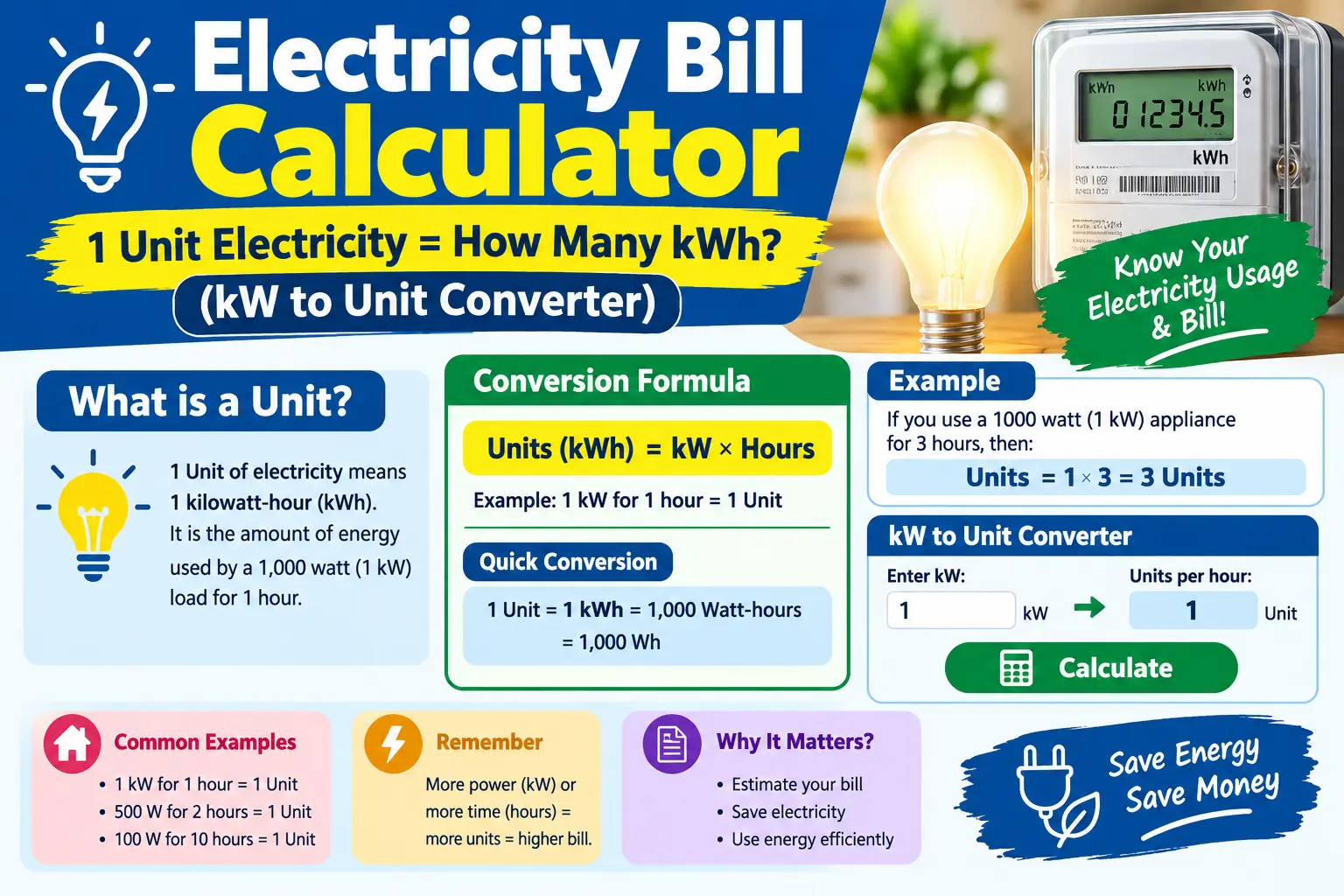
In India, 1 unit electricity = 1 kilowatt-hour (kWh). That is the standard billing meaning for domestic and most commercial connections. Put simply, 1 unit = kWh in India, and it represents the energy used when a 1,000-watt (1 kW) appliance runs for one hour.
- 1 unit = 1 kWh
- 1 kWh = 1,000 watts used for 1 hour
- 1 kW = 1,000 watts (power, not energy)
Examples make it clearer. A 100-watt fan running for 10 hours uses 1,000 watt-hours, or 1 unit. A 2,000-watt (2 kW) geyser running for 30 minutes also uses 1 unit, because 2 kW × 0.5 hours = 1 kWh. Your meter adds these units across the billing cycle, and the discom charges you per unit according to its tariff.
Discover More About:👇
TNEB Aadhaar Link Status Check – How to Check Your Electricity Connection Online
How to Check Aadhaar Linked with EB: Complete TNEB Aadhaar Link Status Guide
kW to Unit Converter: Power vs Energy
The confusion usually comes from treating kW and kWh as interchangeable. They are not. kW is power—the rate at which an appliance uses electricity. kWh, or unit, is energy—the total electricity used over time. An appliance’s label tells you power; your bill charges you for energy.
The conversion formula is:
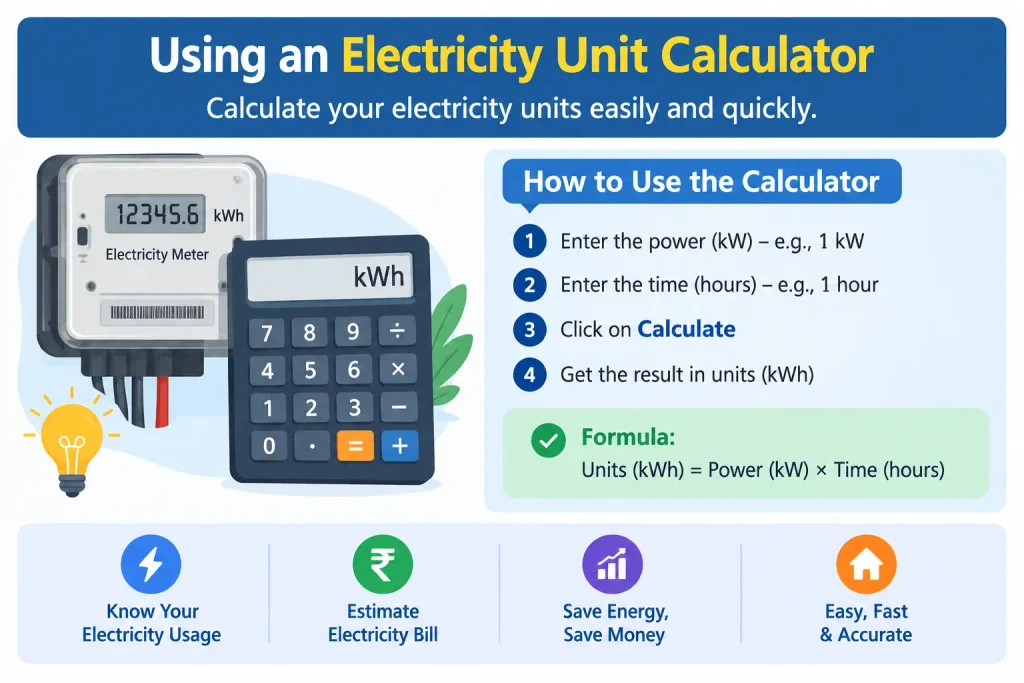
Units (kWh) = Power (kW) × Time (hours)
So a 1.5 kW heater running for 2 hours uses 3 units. A 0.5 kW refrigerator running for 8 hours uses 4 units. If the label gives watts, divide by 1,000 first: a 750-watt appliance is 0.75 kW. This same logic covers any kilowatt to unit, kilo watt to unit, kW to units, or kilowatts to units calculation. To go the other way—unit to kilowatt, unit to kW, or unit to kw—divide units by hours. Many online kW to unit converter tools do this instantly, but doing it once by hand helps you spot which appliance is driving your bill.
How to Calculate Your Electricity Bill Step by Step
Calculating a bill is not just multiplying total units by one rate. Tariff slabs, fixed charges, and taxes all matter. Here is a practical method for most Indian discoms.
Step 1: Read Your Meter
Note the current meter reading and the previous reading printed on your last bill. Subtract the previous from the current.
Units consumed = Current reading − Previous reading
If the previous reading was 1,250 and the current is 1,380, you consumed 130 units. Watch for two pitfalls: some bills show an estimated reading rather than an actual one, and some meters have a multiplication factor (common for higher loads). If your reading is lower than the previous one, the meter may have rolled over or been replaced—do not assume negative usage.
Step 2: Apply the Tariff Slab
Most states use slab-based tariffs. The first 50 or 100 units are charged at a lower rate, the next block at a higher rate, and so on. Apply each slab rate to the units that fall in that slab. Multiplying all 130 units by the highest rate is a common error and usually overstates the bill.
Step 3: Add Fixed Charges and Taxes
Energy charges are only part of the bill. You will also typically see fixed charges based on sanctioned load (in kW), electricity duty, regulatory or fuel surcharge, and sometimes meter rent. These are listed separately. Add them to the energy charge.
Step 4: Cross-Check With Your Bill
Compare your calculated total with the billed amount. If it is very different, check whether the billing period is shorter or longer than a month, whether arrears are included, or whether a tariff revision has taken effect. On discom apps, an OTP may expire while you are checking details—keep your consumer number handy and retry rather than assuming the portal is wrong.
Tariff Slabs and Per-Unit Costs in India
Tariff rates are set by State Electricity Regulatory Commissions, so there is no single national rate. In Jaipur, the Rajasthan Electricity Regulatory Commission (https://berc.org.bd/) decides the per unit electricity charges in Jaipur and the Rajasthan 1 unit price. That price is not one flat number—it depends on your slab, and surcharges may apply. Recent tariff orders have generally kept the first slab cheapest, with higher slabs costing more, but exact rates change. Check your latest bill or the current RERC tariff order before relying on any figure.
The same principle applies internationally. Per unit electricity cost in Bangladesh is regulated by the Bangladesh Energy Regulatory Commission (BERC) and has been adjusted periodically with fuel prices and subsidies. If you are comparing countries or states, use the latest official tariff order, not an old news number. The unit to kWh and electricity unit to kWh conversion stays one-to-one everywhere; only the price per unit changes.
Using an Electricity Unit Calculator
An electricity unit calculator estimates your bill before it arrives. You usually enter appliance power (kW or watts), daily usage hours, and your discom or state so the tool can apply the right slab. It then converts kilowatts to units and multiplies by the tariff.
For a manual estimate, use:
Estimated energy charge = Power (kW) × Hours used × Days × Tariff rate per unit
Then add fixed charges and taxes separately. This is useful before buying an AC, geyser, or motor pump, because it shows the monthly running cost, not just the purchase price. Many discoms also offer bill estimation tools on their official customer portals.
Common Mistakes to Avoid
- Using total units × highest slab rate. This ignores slab pricing and overestimates the bill.
- Confusing kW and kWh. An inverter AC rated 1.5 kW does not always draw 1.5 kW; compressor cycling changes actual units.
- Forgetting fixed charges. These apply even if you consume zero units, because they are tied to sanctioned load.
- Ignoring the meter multiplication factor. Higher-load meters may need the reading difference multiplied by a factor printed on the bill.
- Not checking billing period length. Slab limits can be prorated when the cycle is shorter or longer than a month.
FAQs About Electricity Units and Bills
Q1: Is 1 unit always equal to 1 kWh in India?
Yes. For domestic and commercial billing, 1 unit is the standard term for 1 kWh. The conversion is consistent; the tariff rate per unit is what differs by state and slab.
Q2: How do I convert kW to units for my appliances?
Multiply power in kW by hours used. A 2 kW appliance running 3 hours uses 6 units. If the label shows watts, divide by 1,000 first.
Q3: What is the current per unit electricity cost in Jaipur?
It depends on your slab. The Rajasthan Electricity Regulatory Commission sets the rates, and the first slab is generally cheaper than higher slabs, with surcharges added where applicable. Check your latest bill or the current RERC order for exact figures.
Q4: Can I convert unit to kilowatt or unit to kW?
Yes, if you know the time. Use kW = units ÷ hours. A load that consumes 10 units in 5 hours is drawing about 2 kW on average.
Q5: How does an electricity unit calculator help me save money?
It shows which appliances cost the most to run. You can then shift heavy usage to off-peak hours where time-of-day tariffs apply, or replace old appliances with efficient models.
Q6: Are per unit electricity charges the same across India?
No. Each state commission sets its own tariff, and rates can differ for domestic, commercial, and industrial users. Always use your own discom’s tariff schedule.
One practical habit: photograph your meter on the day of the reading and save the bill PDF. If the next bill still looks wrong, raise a complaint with your consumer number and the meter photo instead of waiting for it to correct itself. That paper trail usually speeds up the discom’s verification.
