
Your college fee is due, the semester is halfway through, and the reimbursement you were counting on still hasn’t arrived. When you check the Jnanabhumi portal, it says “Pending” — and nobody at the college office can tell you why. This is the situation thousands of Andhra Pradesh students and their families face every academic year, largely because a single document wasn’t uploaded correctly or the mother’s bank account wasn’t Aadhaar-seeded. Jagananna Vidya Deevena is the state’s full fee reimbursement scheme for SC, ST, BC, EBC, Kapu, Minority, and Differently Abled students, and the 2026–27 cycle is already underway. This article walks through the current eligibility rules, the amounts, a working status-check process, the documents that actually matter, and the mistakes that cause most rejections.
What Is Jagananna Vidya Deevena?
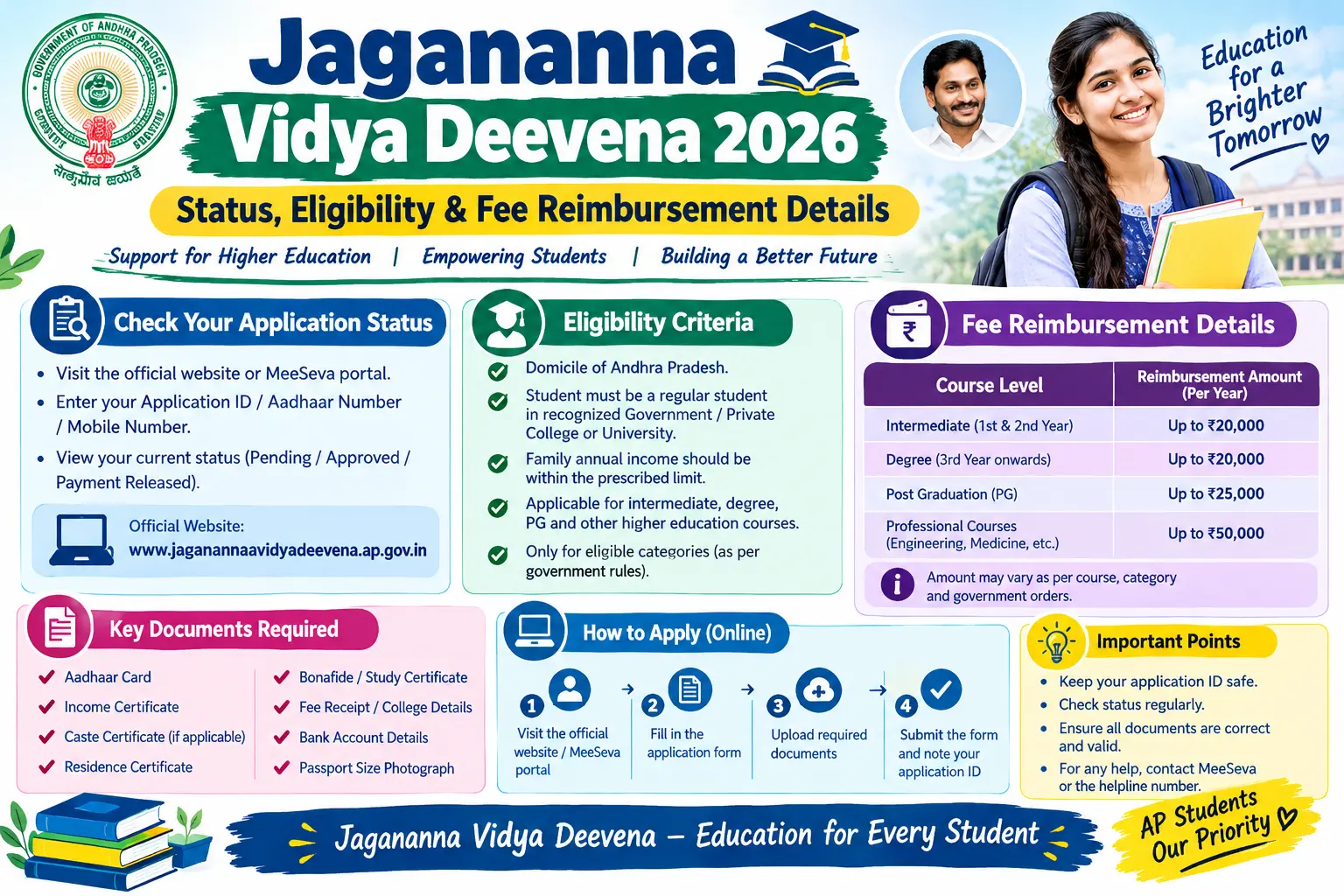
Vidya Deevena is the fee reimbursement arm of Andhra Pradesh’s Post-Matric Scholarship. It pays the full tuition fee — including special fees, other fees, and examination fees as fixed by the competent authority — for eligible students. It runs alongside Jagananna Vasathi Deevena, which covers food and hostel costs separately.
Both components are administered through the Jnanabhumi portal (jnanabhumi.ap.gov.in). On the portal and in official correspondence, the fee reimbursement is labelled RTF (Reimbursement of Tuition Fee) and the maintenance allowance is labelled MTF (Maintenance/Boarding Allowance). This distinction matters: when you check your application, RTF and MTF show up as two separate payment statuses, and one can be cleared while the other is stuck.
The money is a grant, not a loan. There is nothing to repay. Fee reimbursement goes directly to the college on the student’s behalf; the maintenance allowance is credited by DBT to the mother’s bank account (or the natural guardian’s, if the mother is deceased or absent).
Who Qualifies: Eligibility Criteria for 2026–27
Two sets of conditions apply — category/course criteria and income/asset criteria. Missing either one disqualifies the application, regardless of how strong the other is.
Eligible Categories and Courses
The scheme covers students from SC, ST, BC, EBC (other than Kapu), Kapu, Minority, and Differently Abled categories. Eligible courses include ITI, Polytechnic diplomas, and Degree-level and above programmes (engineering, medicine, postgraduate). Study must be at a Government, Aided, or Private college affiliated to a State University or Board. Day scholars and hostel residents (CAH/DAH) both qualify.
Discover More About:👇
Aadhaar Status Check – How to Check Enrolment & Update Status Online
DBT Status Check with Mobile Number (2026 Guide)
Income and Asset Criteria
- Annual family income must not exceed ₹2.5 lakh.
- Land holding must be under 10 acres wet or 25 acres dry (or a combined total not exceeding 25 acres).
- No family member may be a government employee or pensioner — sanitary workers are exempt regardless of salary or recruitment type.
- No family member may own a four-wheeler; taxis, tractors, and autos are excluded from this condition.
- Urban property must be under 1,500 sq ft of built-up area.
- No family member may be an income tax payee.
Attendance
A minimum of 75% aggregate attendance is required before the college will forward your details for payment. This is checked each semester, so a strong start followed by a slack stretch can still cost you the disbursement.
Who Is Excluded
Students in Private Universities or Deemed Universities, those pursuing distance or correspondence courses, and anyone admitted under Management or Spot Quota do not qualify.
How Much Students Receive
The vidya deevena amount is not a flat figure. It equals the approved tuition fee for your specific course and institution, which is why two students in the same district can receive different amounts. For B.Tech students in some autonomous colleges, reimbursement has been around ₹10,300 per year, but treat that as an observation, not a rule — the sanctioned fee for your programme is what gets credited.
The Jagananna Vasathi Deevena maintenance component, by contrast, is fixed:
| Course Level | Annual Maintenance Amount |
|---|---|
| ITI | ₹10,000 |
| Polytechnic | ₹15,000 |
| Degree and above | ₹20,000 |
This amount goes to the mother’s account and is meant for food and hostel expenses. A student can receive both RTF and MTF, and each appears as a separate line when you check status.
How to Check Your Status on Jnanabhumi
The status check itself takes two minutes. What takes longer is figuring out why a payment is stuck — so read the pitfalls below before you start.
Step-by-Step
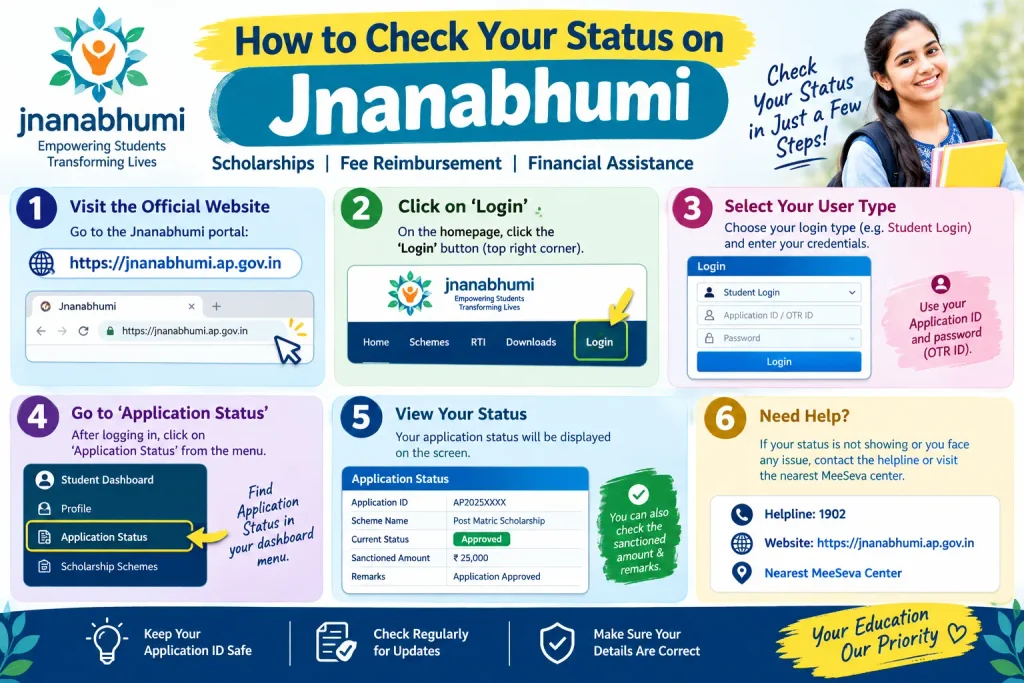
- Open jnanabhumi.ap.gov.in in a desktop browser if possible. The portal behaves better on Chrome or Edge than on mobile browsers, especially during result or admission season.
- Click “Scholarship Status” or “Know Your Status” on the homepage.
- Enter your Aadhaar number or Application ID. If you use Aadhaar, the mobile number linked to it must be active — that’s where the OTP goes.
- Select the academic year (2026–27) from the dropdown.
- Enter the captcha and submit. Your status will show as Approved, Pending, or Rejected.
- If you qualify for both components, check RTF and MTF separately. It is common for one to be cleared while the other still shows pending.
Pitfalls That Catch People
- OTP never arrives. This almost always means the mobile number linked to your Aadhaar is outdated. You’ll need to update it at an Aadhaar Seva Kendra before you can log in.
- Wrong Application ID format. The ID is case-sensitive and often mistyped from a screenshot. Copy-paste it rather than retyping.
- Portal timeout during peak hours. The site slows down noticeably around admission and result declaration periods. Try early morning or late evening.
- Status stuck at “Pending” for weeks. In most cases, this means the college hasn’t verified your attendance or documents yet. The portal will not move until the college acts.
If your status reads Rejected, contact your college’s scholarship section before doing anything else. Most rejections trace back to a correctable document error, not a permanent disqualification.
Documents You’ll Need
Keep high-quality scans ready before you start the application or renewal:
- Aadhaar card linked to an active mobile number and to the bank account receiving the funds.
- Income certificate from the competent authority — current year, not a leftover from a previous cycle.
- Caste certificate for SC, ST, BC, Kapu, and Minority categories.
- Bonafide certificate from the college confirming active enrolment.
- Bank passbook details of the Aadhaar-mapped account — for MTF, this should be the mother’s account.
- Previous marks memo (last semester or intermediate/SSC) for the merit review.
Fresh applicants must download the Jnanabhumi Scholarship Application Form (J-SAF), fill it in, and submit it to the College Principal, who verifies and uploads it. Handing the form directly to a government office skips the verification step and stalls the application.
Common Mistakes That Delay Payment
- Aadhaar not seeded with the bank account. DBT payments fail silently when the account isn’t Aadhaar-linked. This is the single most common cause of “approved but not credited.”
- Expired income certificate. A certificate from the previous academic year is usually rejected outright.
- Attendance dropping below 75%. No document error can override this. Track your attendance through the semester, not at the end.
- Mother’s account inactive or unlinked. For MTF, the mother’s account must be active and Aadhaar-seeded. A dormant account delays the credit.
- Assuming the college has submitted your form. Verification is the college’s responsibility, but following up is yours. Check the portal status two weeks after submitting.
Frequently Asked Questions
Is the scheme still running in 2026?
Yes. It continues under the current government, administered through Jnanabhumi. Fee reimbursement is labelled RTF and the maintenance allowance MTF on the portal.
What is the vidya deevena amount per student?
Fee reimbursement covers the full sanctioned tuition fee, so it varies by course and college. The maintenance allowance is fixed at ₹10,000 (ITI), ₹15,000 (Polytechnic), and ₹20,000 (Degree and above) per year.
How do I check my ysr vidya deevena status online?
Go to jnanabhumi.ap.gov.in, click “Scholarship Status,” and enter your Aadhaar number or Application ID. Both RTF and MTF statuses appear on the same page.
When is the next vidya deevena release date?
Installments are notified by the government and communicated through colleges. There is no fixed public calendar. Watch for SMS from the portal or your college, and check the portal periodically.
Can private college students apply?
Yes, if the college is affiliated to a State University or Board and you meet the category, income, asset, and attendance criteria. Private Universities and Deemed Universities are excluded.
What if my application is rejected?
Start with your college’s scholarship section — most rejections are documentation errors that can be fixed. If the college can’t resolve it, raise a complaint on the Jnanabhumi portal or visit the District Welfare Office.
If your status still shows “Pending” two weeks after the college claims to have submitted your details, don’t wait for it to resolve on its own. Take a screenshot of the status page, note the date, and follow up in person with the scholarship section — portal issues often clear faster when there’s a paper trail. And before the next academic year begins, verify that your Aadhaar is seeded with the correct bank account, because that one step prevents more payment failures than any other.
