
If your child studies in an Andhra Pradesh government, aided, or recognised private school and you are still waiting for the Thalliki Vandanam amount to reach your bank account, the delay usually traces back to one of three things — your name missing from the beneficiary list, an Aadhaar-seeding mismatch at the bank, or an attendance shortfall that triggered automatic exclusion. This guide covers what the scheme pays for 2026–27, who qualifies, when the money was scheduled to arrive, which documents you will actually be asked for, and how to check the talliki vandanam (https://thallikivandanam.com/) list 2025–26 and 2026–27 at your local secretariat.
What Is the Thalliki Vandanam Scheme?
Thalliki Vandanam is a Direct Benefit Transfer (DBT) scheme run by the School Education Department of Andhra Pradesh. It was launched on 12 June 2025 and continues into the 2026–27 academic year. The payment is not a merit scholarship — it is a flat annual amount paid to the mother or recognised guardian of every eligible school-going child.
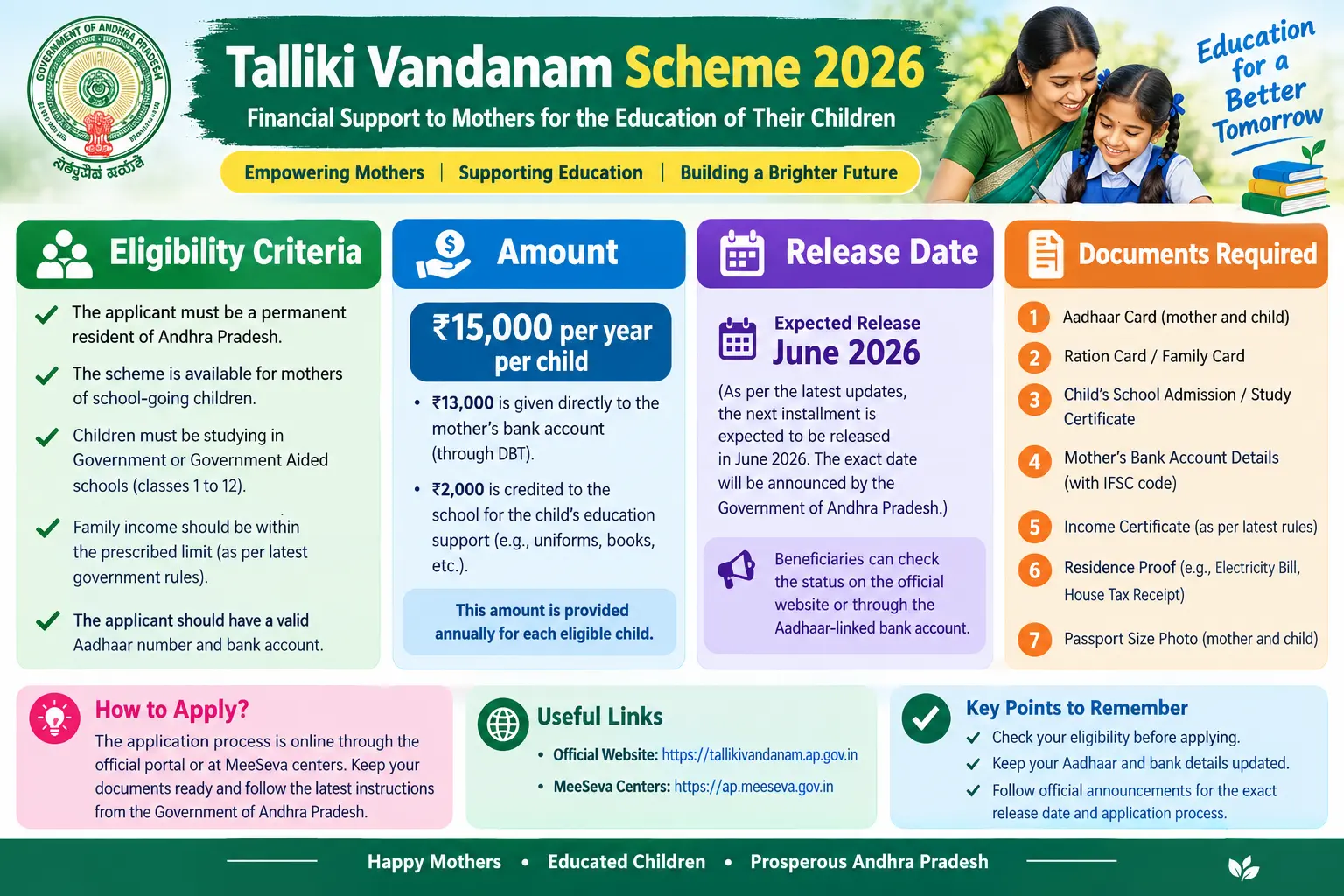
The headline figure is ₹15,000 per child per year. Of this, ₹2,000 per student is retained at source and routed into school and junior college maintenance — sanitation, hygiene, minor infrastructure. The remaining ₹13,000 is credited directly to the mother’s or guardian’s bank account. There is no cap on the number of children per family: a mother with three eligible children receives ₹39,000 in a single disbursement cycle.
The scheme covers Class I to Class XII, including Intermediate, across government, aided, private unaided, and residential institutions in the state.
Discover More About:👇
Talliki Vandanam Status Check 2026: Payment & Eligibility Status
Amma Vodi Status Check with Aadhaar Card 2026 (Mobile Number Se)
Thalliki Vandanam Eligibility Criteria
Eligibility is checked at two levels — the student and the household. Both must clear.
Student-Level Requirements
- Enrolment in Class I to XII (including Intermediate) at a recognised institution in Andhra Pradesh.
- Minimum 75% attendance for the academic year, verified from school records — not self-declared.
- Orphans and children in recognised voluntary organisations may qualify under special provisions.
- Students in ITI, Polytechnic, or RGUKT (IIIT) are excluded, since those courses already fall under separate fee reimbursement schemes.
Household-Level Requirements
- Income: Monthly household income below ₹10,000 in rural areas and ₹12,000 in urban areas.
- Rice card: At least one family member must hold a government-issued rice card.
- Land: More than three acres of wetland or ten acres of dry land disqualifies the household. Combined holdings are also assessed.
- Property: Residential property above 1,000 sq ft in a municipal area is a disqualifying factor.
- Vehicle: Ownership of a non-exempt four-wheeler rules the family out.
- Electricity: Average monthly consumption above 300 units leads to exclusion.
- Employment: Income-tax payers and most government employees are excluded, though sanitation workers, Anganwadi workers, and certain low-income government staff have been exempted.
Bank Account Prerequisite
The mother’s or guardian’s account must be Aadhaar-seeded and NPCI-mapped. Without this, the DBT credit bounces back even if every other criterion is met. This is the single most common reason for non-receipt among otherwise eligible families.
Thalliki Vandanam Amount & Release Date 2026
The Andhra Pradesh government has sanctioned ₹10,120.78 crore for the scheme’s 2026–27 implementation.
Benefit Breakdown
| Component | Amount |
|---|---|
| Total annual assistance per child | ₹15,000 |
| Retained at source for school infrastructure | ₹2,000 |
| Credited to mother/guardian’s account | ₹13,000 |
Thalliki Vandanam Release Date
The first phase of disbursement for 2026–27 was scheduled for 22 July 2026, when funds were to be credited to Aadhaar-linked accounts of verified beneficiaries. The eligible and ineligible lists were published the same day. Families who tracked the Thalliki Vandanam release date in 2025 will recognise the pattern: a July first phase, an early-August grievance window, and a late-August supplementary round.
For fresh admissions — Class I and Junior Intermediate — payments were scheduled by 30 August 2026, subject to verification.
Disbursal Schedule
| Event | Date |
|---|---|
| First phase disbursement | 22 July 2026 |
| Eligible/ineligible lists published | 22 July 2026 |
| Grievance window closes | 3 August 2026 |
| Verification and supplementary list preparation | 4–10 August 2026 |
| Fresh admissions (Class I & Jr. Inter) | Up to 25 August 2026 |
| Final supplementary payments | 30 August 2026 |
Documents Required
The scheme runs largely on government data, so you will not file a fresh application. But you will need the following for verification or grievance submission:
- Aadhaar card — student and mother/guardian.
- Bank passbook — mother/guardian’s account, with correct account number and IFSC. Confirm the account is Aadhaar-seeded and NPCI-mapped before the disbursement date.
- Income certificate — for income eligibility verification.
- Rice card — proof of the ration card linked to the household.
- School ID or bonafide certificate — proof of current enrolment.
- Passport-size photographs — student and/or mother.
- MGNREGA card or Kisan passbook — where applicable, as additional income proof.
How to Check Your Name in the Talliki Vandanam List
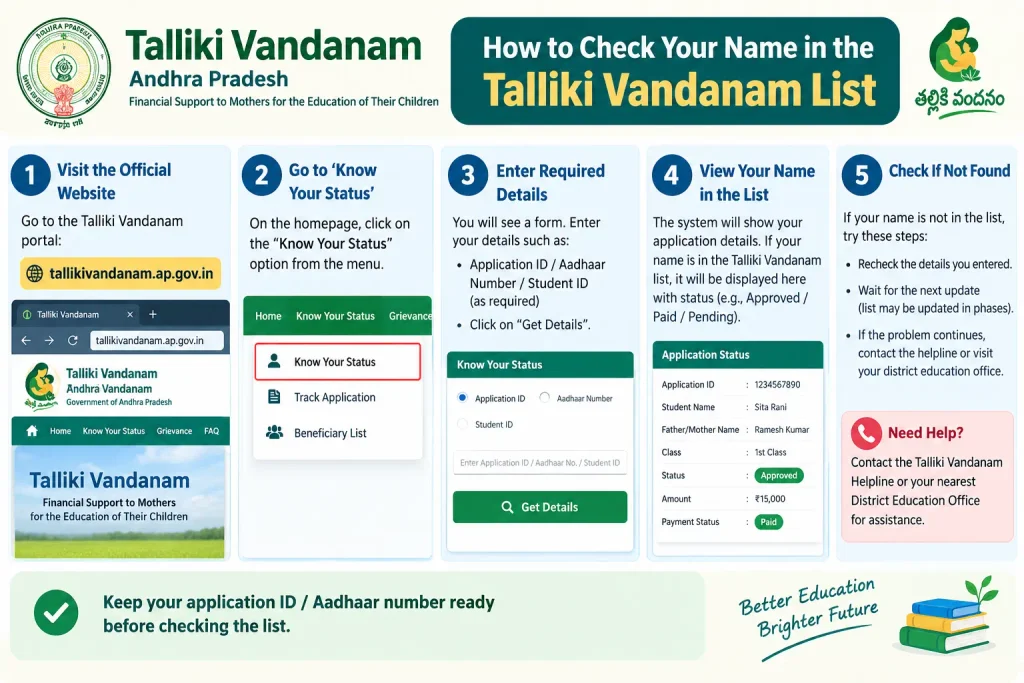
The beneficiary list is maintained at Village Secretariat (Sachivalayam) or Ward Secretariat level.
Step 1: Visit your local secretariat. Avoid the first two days after a disbursement announcement — queues are longest then, and the digital assistant is handling dozens of identical queries.
Step 2: Ask the Digital Assistant or Welfare Assistant for the Thalliki Vandanam beneficiary list.
Step 3: Provide the student’s Aadhaar number or the mother’s Aadhaar number. Have both ready — the list is indexed differently at different secretariats.
Step 4: Confirm whether the name appears under eligible or ineligible. If ineligible, ask which criterion triggered the exclusion — the reason is usually recorded against the entry.
Step 5: If eligible and the bank account is correctly seeded, the amount should arrive via DBT. If eligible but the amount has not come, the problem is almost always at the bank end, not the scheme end.
Step 6: If ineligible and you believe the exclusion is wrong, submit a grievance at the same office before the notified deadline (3 August 2026 for the first phase). Grievances filed after the window are typically carried to the next cycle.
Two pitfalls trip up most families. First, names on the beneficiary list must match Aadhaar spelling exactly — a single mismatch in initials or surname can stall verification. Second, secretariat lists are refreshed in batches, so a name added today may not appear until the next upload.
Common Mistakes to Avoid
- Unseeded bank account. Aadhaar-seeding and NPCI-mapping must be done at the bank branch, not online. Allow at least a week before the disbursement date.
- Attendance shortfall. 75% is not negotiable. If your child missed school for illness, get the school to update records before verification.
- Stale household data. Rice card details, land records, and electricity connection data must match current reality. Discrepancies are resolved only through manual verification, which delays payment.
- Applying for an excluded course. ITI, Polytechnic, and RGUKT students cannot receive this benefit alongside their existing fee reimbursement.
- Missing the grievance deadline. The window is short — usually around ten days. Missing it means waiting a full cycle.
FAQs
What is the Thalliki Vandanam scheme?
A welfare scheme by the Government of Andhra Pradesh that pays ₹15,000 per child per year to eligible mothers and guardians of school-going children from Class I to Intermediate. After a ₹2,000 deduction for school infrastructure, ₹13,000 reaches the bank account.
Who is eligible for Thalliki Vandanam?
Students in Class I–XII with 75% attendance at a recognised institution, from households with income below ₹10,000/month (rural) or ₹12,000/month (urban), holding a rice card and meeting land, property, vehicle, and electricity limits.
How much is credited under Thalliki Vandanam?
₹13,000 per child per year, after the ₹2,000 infrastructure deduction. Families with multiple eligible children receive the amount for each child.
What is the Thalliki Vandanam release date for 2026?
First phase: 22 July 2026. Fresh admissions (Class I and Junior Intermediate): by 30 August 2026.
How do I check the Talliki Vandanam list 2025 or 2026?
Visit your Village or Ward Secretariat with the student’s or mother’s Aadhaar number. The Digital Assistant or Welfare Assistant will verify your name against the eligible/ineligible list.
Is there a fee to apply?
No. The scheme is entirely government-funded. Treat any request for money for enrolment or list inclusion as fraudulent.
Final Thoughts
If your child’s name is on the eligible list and the bank account is properly seeded, the money usually arrives within the disbursement window without any follow-up. If it does not, wait until the supplementary payment date (30 August 2026) before filing a fresh grievance — many first-phase failures are corrected automatically in the supplementary round. For anything beyond that, the secretariat’s digital assistant can pull up the exact reason your payment was held, which is faster than calling the helpline during peak disbursement weeks.
