Your Thalliki Vandanam payment shows “eligible” on the portal, but the money never reached your bank account. Or worse — the Aadhaar OTP never arrived, and you are stuck at the login screen with the school fee deadline approaching. Both situations are common, and both usually trace back to the same handful of fixable issues: an unmapped bank account, a mismatched Aadhaar detail, or an out-of-date school record.
This guide walks through the Amma Vodi status check with Aadhaar card process as it works in 2026, explains what each status message actually means, and covers what to do when the payment stalls after showing as processed.
What the Scheme Is Called Now
Amma Vodi launched in 2019 and was later restructured and renamed Thalliki Vandanam. The name changed, but the purpose did not: put money in the mother’s or guardian’s hands so that school expenses do not push a child out of the classroom.
The scheme is run by the Andhra Pradesh School Education Department. One detail that catches people off guard — the benefit applies per child, not per family. A mother with three children in eligible classes receives the benefit for all three, which is why the household-level verification matters so much.
Transfers happen through Direct Benefit Transfer (DBT), meaning the government credits the bank account directly with no intermediary. That is efficient when the account details are correct. When they are not, the payment fails quietly on the banking side while the portal still shows everything as fine.
Discover More About:👇
Rythu Bharosa Status Check by Aadhaar: How to Check Farmer Payment Status in 2026
DBT Status Check with Mobile Number (2026 Guide)
Who Qualifies in 2026
A mismatch on any single criterion below typically produces a “pending” or “not eligible” result, so it is worth confirming your position before you start chasing the payment.
The student must be enrolled in a recognised Andhra Pradesh school in Classes 1 to 12 or Intermediate. Students in ITI, Polytechnic, or institutions covered by separate fee reimbursement programmes generally fall outside the scheme. Attendance of at least 75% is commonly required, and the family should hold a valid white ration card.
Household limits apply as well. Rural family income is typically expected to stay below ₹10,000 per month, and urban income below ₹12,000. Ownership of more than 3 acres of wet land or 10 acres of dry land, a private four-wheeler, or monthly electricity usage above 300 units can affect eligibility, and government or public sector employees are excluded.
The requirement that trips up the most people sits at the bank level: the mother’s or guardian’s account must be Aadhaar-seeded and NPCI-mapped. NPCI mapping lets the bank receive DBT credits through the Aadhaar Payment Bridge. Linking Aadhaar to your bank for general purposes does not automatically complete this step.

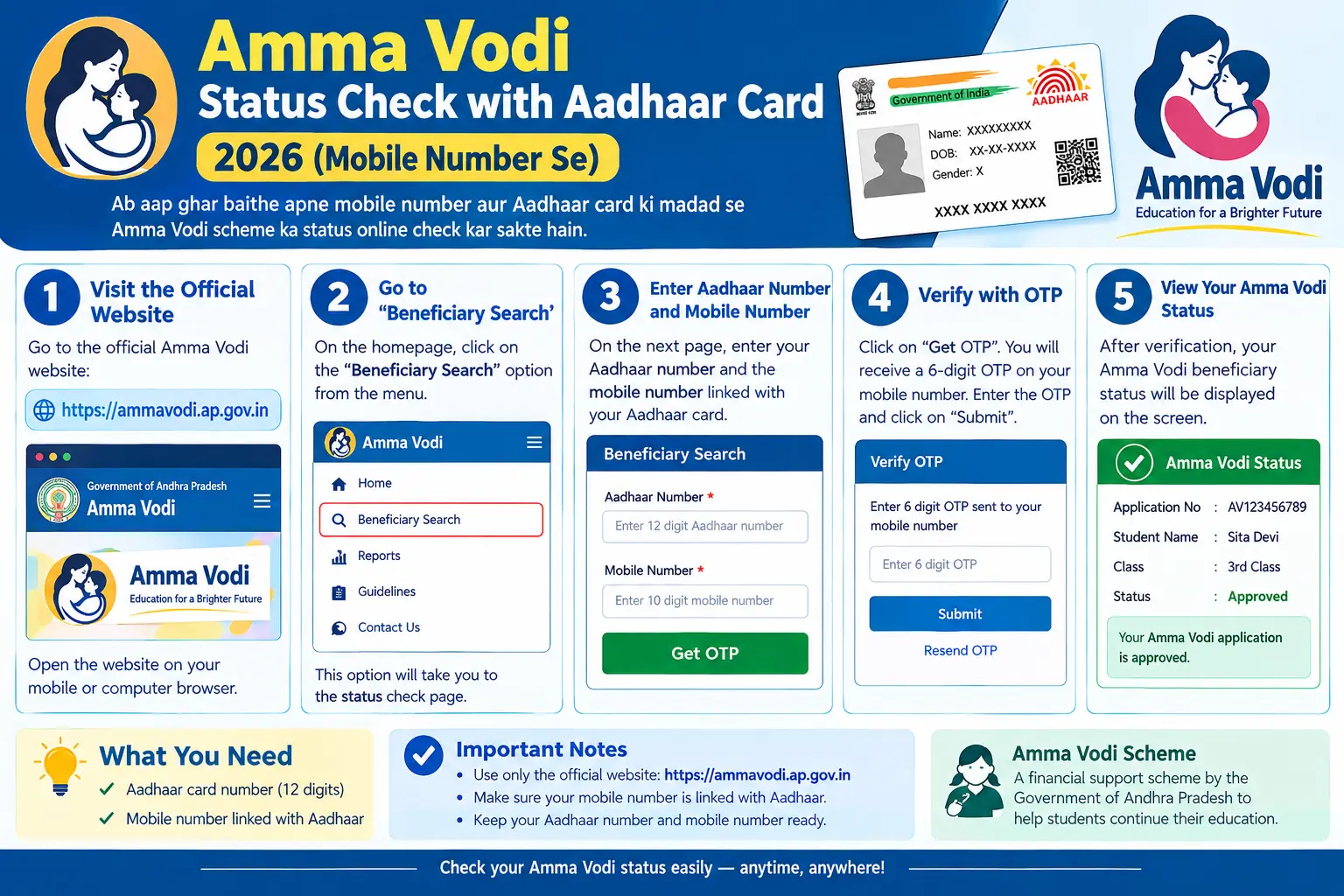
How to Check Status with Aadhaar Card Online
The old Amma Vodi portal is no longer active. The current system runs through the AP Beneficiary Management portal at bm-sgsw.ap.gov.in.
- Open bm-sgsw.ap.gov.in/BM/ on your phone or computer.
- Find the “Status Check” or “Scheme Eligibility Check” option on the homepage.
- Select “Thalliki Vandanam” from the scheme dropdown, and choose the 2026-27 academic year if that option appears.
- Enter the Aadhaar number of the mother or guardian — the primary beneficiary. Some screens also accept the student’s Aadhaar.
- Complete Aadhaar OTP verification. The OTP goes to the mobile number linked with that Aadhaar, so enter the number carefully alongside the captcha.
- Submit and read the result.
Two pitfalls cause most failed attempts here. First, the OTP only reaches the mobile number registered in the Aadhaar database — if your number changed recently and was never updated, no OTP will come no matter how many times you retry. Second, the portal times out during heavy traffic on payment release days. If the page hangs after you enter the OTP, wait a few minutes and start the login again rather than refreshing mid-session.
Checking Status Using Mobile Number Instead
If you would rather not enter a full Aadhaar number, two alternatives exist.
The LEAP app, available on the Google Play Store, accepts a registered mobile number along with the student’s date of birth. It also works with APAAR ID or PEN ID. The app displays live payment status and is generally lighter than the browser portal.
The government also runs an official WhatsApp number for beneficiary queries. Aadhaar numbers sent to that number typically return the latest status. Only use the number published officially by the government — forwarded messages circulating in WhatsApp groups often carry lookalike numbers.
For anything that needs a physical fix, the Grama or Ward Sachivalayam remains the fallback. Staff there can verify details, check status, and register a grievance in one visit.
Discover More About:👇
Ration Card Status: How to Check Rice Card Status with Aadhaar Number in AP & Telangana
What Each Status Message Means
Eligible — the beneficiary is approved and the payment is either scheduled or being released.
Payment Processed — the amount has left the government side. If your passbook shows no DBT credit, the problem is at the bank, not with the scheme.
Under Verification / Pending — records are still being reviewed. Usual causes: attendance data not updated by the school, an Aadhaar detail that does not match, or a ration card entry needing correction.
Not Eligible / Rejected — one or more criteria are unmet. Common reasons include income above the limit, attendance below the threshold, or an account not linked properly with Aadhaar.
Why the Payment Has Not Arrived
When the portal says eligible or processed but the bank balance stays unchanged, work through these in order.
The most frequent cause is inactive NPCI mapping. Your Aadhaar may be linked to the bank for everyday purposes, yet the account still cannot receive DBT credits. Only your bank branch can confirm this.
Next, check for detail mismatches. A spelling variation in the name or a different date of birth between your Aadhaar, the school register, and the household database is enough to block a transfer. Even a single letter can do it.
Bank e-KYC pending is another blocker. If the bank has not finished e-KYC on the account, DBT credits may not post.
On the school side, outdated admission data, attendance not updated in UDISE, or fresh admissions still under verification can hold things up. Class 1 and Junior Intermediate entries tend to take longer because the enrolment record is new.
If the bank confirms everything is in order, take the matter to the school headmaster or the nearest Sachivalayam.
Documents to Keep Ready
- Aadhaar of the mother or guardian, and of the student
- White ration card details
- Mother’s bank passbook showing account number and IFSC
- School admission and enrolment records
- The mobile number linked to Aadhaar, for OTP
Carry originals and photocopies when visiting the Sachivalayam or school for corrections. For anything bank-related, go to the branch where the account is held — a different branch often cannot resolve NPCI mapping issues.
Common Mistakes to Avoid
Entering Aadhaar details on unofficial websites is the most damaging mistake on this list. Restrict yourself to portals ending in .ap.gov.in or .gov.in. Lookalike sites promising instant status checks exist mainly to harvest Aadhaar numbers.
Assuming that Aadhaar linking equals DBT readiness is the second. These are separate steps, and many families discover the difference only after a payment fails.
Delaying follow-up is the third. If the portal shows processed and the money has not appeared within a few days, raise it with the bank and the Sachivalayam rather than waiting for the next disbursement cycle.
FAQs
Can I check Amma Vodi status with just my mobile number?
Yes. The LEAP app takes a registered mobile number with the student’s date of birth, and the official WhatsApp service accepts Aadhaar numbers directly. The BM-SGSW portal itself relies on Aadhaar-based OTP.
Why does the Aadhaar link matter for this scheme?
Because DBT credits move through the Aadhaar Payment Bridge. If the mother’s Aadhaar is not linked to the bank account and NPCI-mapped, the payment cannot be credited even when the beneficiary is fully eligible.
How do I check Thalliki Vandanam status without the student’s Aadhaar number?
Use the mother’s or guardian’s Aadhaar on the official portal, or ask the school headmaster to verify the record on your behalf.
Is Rythu Bharosa checked on the same portal?
No. Andhra Pradesh farmers use ysrrythubharosa.ap.gov.in, while Telangana farmers use rythubharosa.telangana.gov.in. Both accept Aadhaar with a registered mobile number.
What if my status says “not eligible” but I meet the criteria?
Visit the Village or Ward Sachivalayam with your Aadhaar, ration card, bank passbook, and school admission details. Staff can pinpoint the specific mismatch and guide the correction. A grievance can also be filed through the AP PGRS portal.
Should I check Aadhaar card status separately?
Yes, and it is worth doing. Aadhaar enrolment or update status is checked on uidai.gov.in or through the mAadhaar app. A pending Aadhaar update can hold up your scheme payment, so verify both if something is stuck.
If your status shows pending, check again after the school confirms attendance and enrolment updates — these usually reflect on the portal within a few working days, not instantly. And if the payment fails even after your bank confirms NPCI mapping is active, do not keep re-checking the portal; escalate through the Sachivalayam with your bank’s written confirmation in hand. That paper trail is what moves a stuck case forward.
2 Comments
Pingback: Thalliki Vandanam 2026: Eligibility, Amount & Date
Pingback: Thalliki Vandanam Status Check 2026