

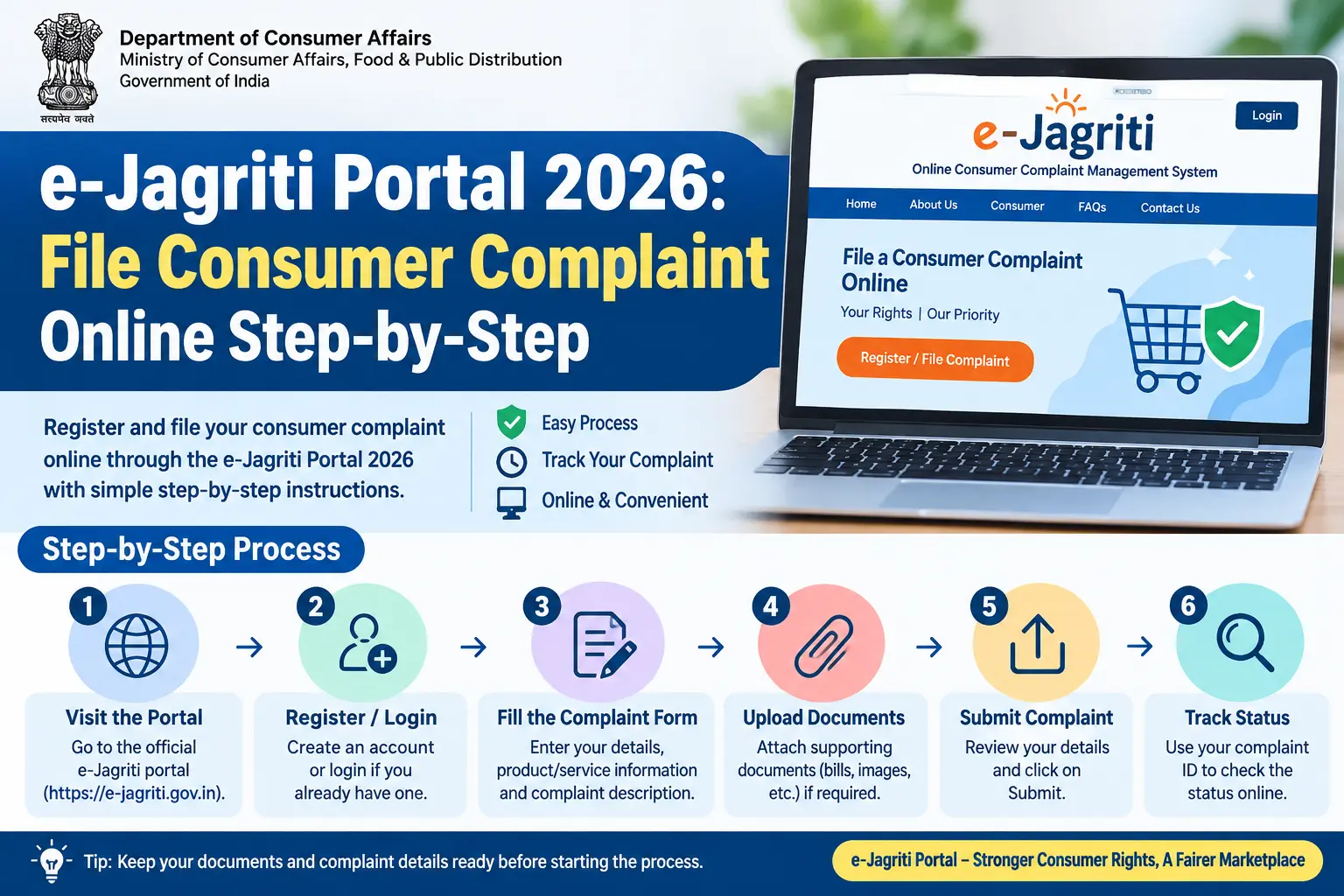
A seller goes silent after taking your money. The replacement you were promised never arrives. The warranty repair has been sitting in a service centre for six weeks with no update. You have the invoice, the chats, the emails—what you don’t have is a way to make anyone act. That is the gap the ejagriti platform exists to close. Live since 1 January 2025 under the Department of Consumer Affairs, e-Jagriti lets you file a consumer complaint, upload evidence, pay the filing fee, and appear for hearings over video, all from one account. This guide covers who can file, how the process actually works screen by screen, which documents cause the most scrutiny rejections, and what happens after submission.
What Is the e-Jagriti Portal?
The e-Jagriti portal (e-jagriti.gov.in) is a single nationwide platform for filing and tracking consumer complaints before the District, State, and National Consumer Commissions. The name expands to Justice and Grievance Redressal through Information Technology and Innovation.
Until recently this work was split across three systems: e-Daakhil for online filing, OCMS for case management, and CONFONET for backend infrastructure. e-Jagriti merges them into one paperless, AI-assisted portal with virtual courtrooms built in. The practical effect is that you no longer need to travel to a commission office to file, respond, or appear. Complaints now arrive from across India and from overseas—679 non-resident Indians had registered cases through the portal by February 2026.
Discover More About:👇
UIDAI Grievance Portal: How to File a Complaint Online (+ 1947 Helpline)
Aadhaar Complaint Status: How to Check UIDAI Grievance Status Online
Who Can File a Complaint on e-Jagriti?
Anyone who qualifies as a consumer under the Consumer Protection Act, 2019 can file. That covers:
- Individuals who bought goods or hired services for personal use.
- Legal heirs or representatives of a deceased consumer.
- Registered consumer associations.
- Central or State government authorities acting on a consumer’s behalf.
- A group of consumers with a shared interest, in certain cases.
You do not need a lawyer. The portal is built for self-representation, and advocates have separate dashboards if you choose to engage one.
Step-by-Step: How to File a Consumer Complaint on the e-Jagriti Portal
The process is manageable once you know what each screen is asking for. Here is the full sequence, along with the points where first-time filers most often get stuck.
Step 1: Register on the Portal
Go to e-jagriti.gov.in and click “Login/Sign Up” in the top-right corner. New users should select “Register” and sign up with a mobile number and email address. An OTP verifies the phone number.
Use an email you actually monitor. Every scrutiny notice, hearing link, and order lands there, and a missed notification can cost you a hearing date. If the OTP doesn’t arrive within a couple of minutes, check whether your number is on the DND list or try again on a stable connection before assuming the portal is down.
Step 2: Log In and Select “File New Case”
Log in and pick “File New Case” from the left-hand menu on your dashboard.
Step 3: Choose the Correct Commission
The portal asks which commission should hear your matter. The deciding factor is the value of the goods or services you paid for—the “consideration”—not the compensation you are claiming.
- District Commission: consideration up to ₹50 lakh.
- State Commission: ₹50 lakh to ₹2 crore.
- National Commission: above ₹2 crore.
This is where a lot of complaints get returned at scrutiny. If you paid ₹40 lakh for a flat and are claiming ₹1 crore in damages, the case still belongs before the District Commission, because the consideration falls under ₹50 lakh.
Step 4: Fill in the Case Details
The longest section, and the one worth doing slowly. Expect to provide:
- Cause Title — who is complaining against whom, e.g. “Ramesh Kumar vs. XYZ Electronics.”
- Complainant Details — your name, address, and contact information.
- Opposite Party Details — the full legal name and address of the seller, service provider, or company. Be precise. A wrong address means the notice never reaches them, and the case sits idle for months.
- Statement of Facts — a chronological account of what happened, in plain language.
- Deficiency in Service or Defect in Goods — the specific failure you are alleging.
- Relief Sought — refund, replacement, compensation, or another remedy.
Step 5: Upload the Required Documents
You will need scanned copies of your complaint bundle. The portal lists exactly what applies to your case, but in most filings this means an index, memo of parties, a notarised affidavit, a synopsis with a list of dates, and your supporting evidence. The next section covers each one.
Keep your scans within the size limit and check that text is legible before uploading. A blurry invoice can hold up scrutiny for weeks.
Step 6: Pay the Fee Online
Payment runs through the portal’s secure gateway. The fee depends on the value of the claim and is set under the Consumer Protection (Consumer Disputes Redressal Commissions) Rules, 2020. The lowest slab typically runs into a few hundred rupees, but the exact amount varies by commission and claim value. Check the official e-Jagriti portal for the fee currently applicable to your case—published figures go out of date, and an underpaid fee means a returned complaint.
Step 7: Submit and Track
Review everything, submit, and note down your case number. From that point on, scrutiny updates, hearing dates, and orders appear on your dashboard and arrive by email.
One practical warning: the portal can time out during long sessions. Save your draft at each stage, and don’t start the case-details section unless you have twenty uninterrupted minutes.
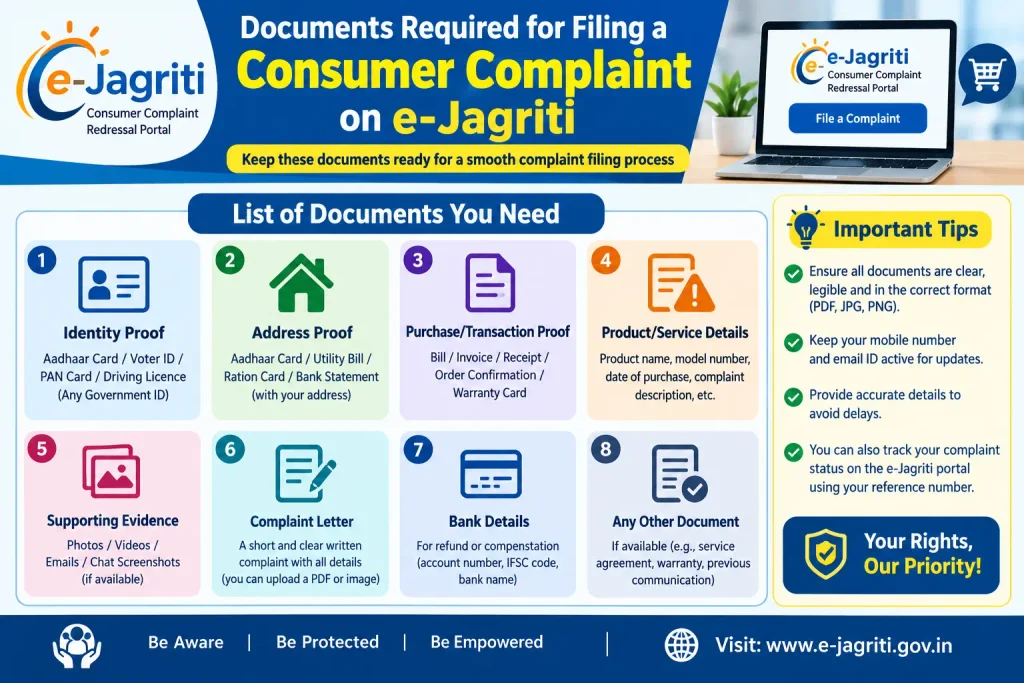
Documents Required for Filing a Consumer Complaint on e-Jagriti
Assembling the bundle before you log in saves a lot of frustration. Here is what is commonly required.
Identity Proof
A government-issued photo ID—Aadhaar, passport, or driving licence—to verify who is filing.
Index
A numbered list describing every document attached to the complaint.
Memo of Parties
A statement setting out the names and details of the complainant(s) and the opposite party(ies).
Affidavit
A sworn statement that the contents of the complaint are true. This generally needs to be notarised.
Synopsis with List of Dates and Events
A short summary of the dispute plus a timeline of the key events.
Supporting Documents
The evidence itself:
- Purchase invoices and payment receipts.
- Warranty or guarantee cards.
- Emails, chat screenshots, and letters exchanged with the seller.
- Bank or card statements showing the payment.
- Photographs of the defective product or damaged goods.
- Any other document that supports your claim.
Vakalatnama
Required only if an advocate is filing or appearing on your behalf.
Common Mistakes to Avoid
A well-prepared complaint moves through scrutiny quickly. These are the errors that hold it up.
Filing Before the Wrong Commission
The most frequent reason for a returned complaint. As noted above, the commission is fixed by the amount you paid, not the amount you are claiming.
Missing the Two-Year Deadline
Under Section 69 of the Consumer Protection Act, 2019, a complaint must be filed within two years of the date the cause of action arose—that is, when the problem occurred or when you first became aware of it. Miss that window and you will need to file a separate application for condonation of delay, explaining the reason. The commission decides whether to accept it.
Naming the Wrong Opposite Party
On an online purchase, the marketplace, the actual seller, and the payment gateway can be three different entities. Name the one you actually have a grievance against, with the correct registered address.
Skipping Notarisation
An unnotarised affidavit is often rejected at scrutiny. Get it notarised before you upload.
Illegible Scans
A phone camera shot taken at an angle rarely passes. Use a scanner or a document-scanning app that straightens and sharpens the image.
What Happens After You File?
Once the fee is paid and the complaint is submitted, the commission scrutinises it. If the paperwork is in order, a notice goes out to the opposite party. They typically have 30 days to respond, with a possible extension of up to 15 days for recorded reasons. Hearings may be scheduled over video conferencing, and every update reaches you through the dashboard and email.
If the District Commission’s order does not satisfy you, an appeal lies to the State Commission, generally within 45 days. From the State Commission, an appeal to the National Commission is generally filed within 30 days.
Frequently Asked Questions About e-Jagriti
Is e-Jagriti the same as e-Daakhil?
No. e-Daakhil was the earlier portal for online filing, launched in 2020. e-Jagriti is the newer unified platform that absorbs e-Daakhil along with OCMS, NCDRC CMS, and CONFONET. All new filings go through e-Jagriti.
Can I file a complaint on e-Jagriti without a lawyer?
Yes. The portal supports self-representation end to end—filing, document upload, fee payment, and virtual hearings. For a complex matter or a large claim, engaging an advocate is a personal choice, not a requirement.
How do I track my consumer complaint on the e-Jagriti portal?
Log in with your registered credentials and open your dashboard. Your case number will show the current status, scrutiny notes, scheduled hearings, and any orders passed.
What is the fee for filing a consumer complaint on e-Jagriti?
The fee is set under the Consumer Protection Rules, 2020, and varies with the value of the claim and the commission. Check the official e-Jagriti portal for the current fee structure, since the slabs are revised from time to time.
Can NRIs file consumer complaints on e-Jagriti?
Yes. Filing is possible from anywhere in the world. As of February 2026, 679 non-resident Indians had registered complaints through the portal.
What if I miss the two-year deadline?
File an application for condonation of delay along with your complaint, setting out the reason for the delay. The commission will decide whether the explanation is sufficient. Filing as soon as the cause of action arises remains the safest course.
Final Thoughts
The step that decides most cases is not the hearing—it is the scrutiny stage. A complaint with the right commission, a correctly named opposite party, and a notarised affidavit clears it in days; one with a ₹40 lakh property dispute filed before the State Commission comes straight back. Before you submit, read your own Statement of Facts once as if you were a stranger to the dispute: if the timeline, the amount paid, and the relief sought are not obvious by the end of it, tighten it. For anything specific to your case—current fees, filing timelines, or procedural queries—confirm on the official e-Jagriti portal or call the National Consumer Helpline on 1915 before you file, not after.
