

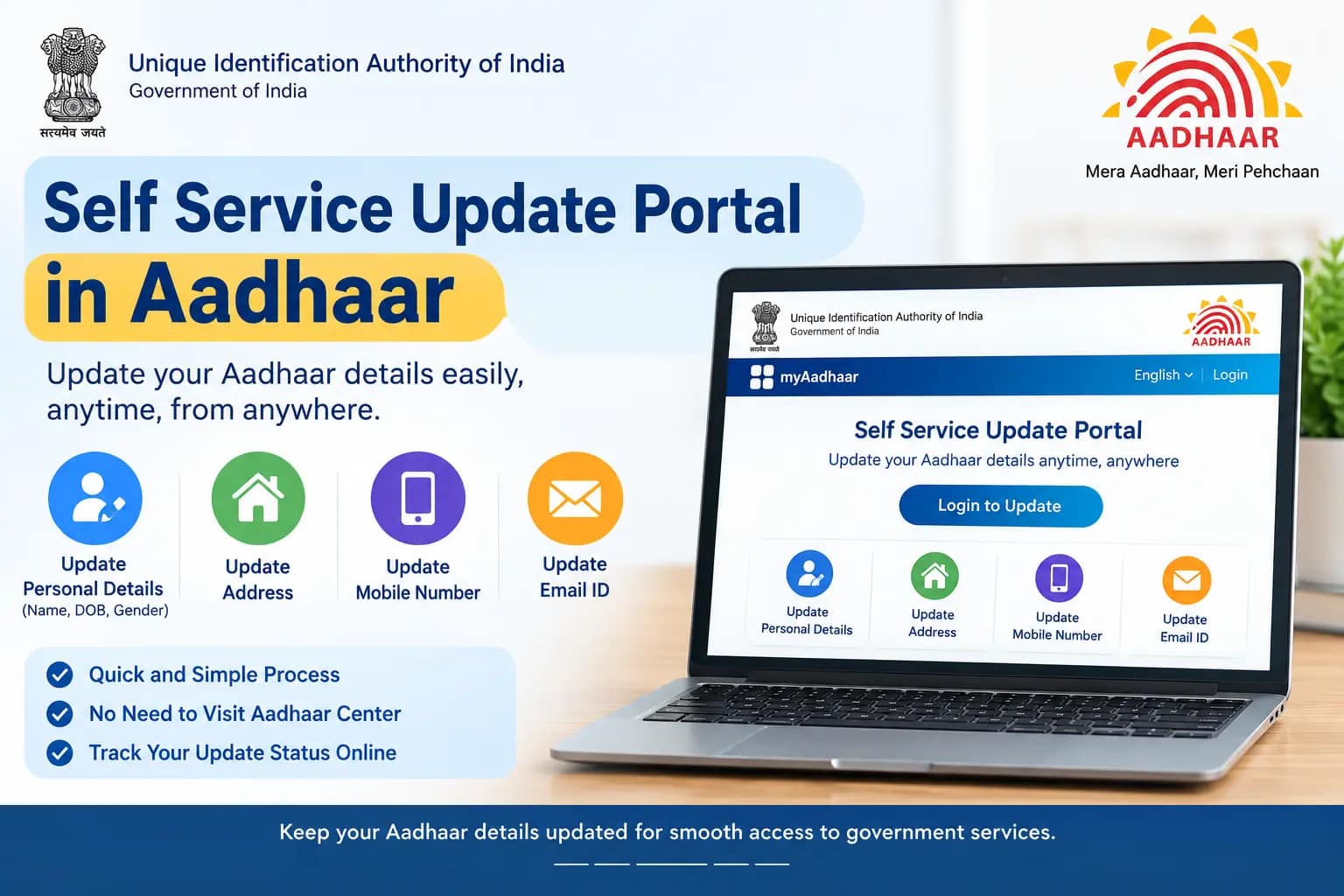
You searched for “SSUP full form” because you probably want to do something with Aadhaar—not just learn an abbreviation. Maybe you saw SSUP in an old Aadhaar guide, need to update your details, or are trying to understand a URN, SRN or Aadhaar update status.
There is another common source of confusion: people sometimes connect SSUP with PM-KISAN beneficiary or payment status simply because Aadhaar is used in both government services. They are not the same system.
SSUP stands for Self Service Update Portal, a UIDAI term associated with Aadhaar update services. However, the way users access Aadhaar services has evolved, and current users should follow the latest UIDAI and myAadhaar process rather than relying on old SSUP links or instructions.
This guide explains what SSUP means today, how it relates to myAadhaar, what “updation” means, and which portal to use when you actually need an Aadhaar or PM-KISAN status.
Note: CheckAadharStatus.com is an independent informational website. It is not affiliated with UIDAI or the Government of India. Complete Aadhaar transactions only through official UIDAI channels.
Quick Facts
| Detail | Information |
|---|---|
| SSUP full form | Self Service Update Portal |
| Governing body | UIDAI |
| Main purpose | Aadhaar self-service update facilities |
| Current user-facing ecosystem | myAadhaar / UIDAI |
| Online updates | Certain supported Aadhaar services |
| Update processing | Normally 90% of update requests are completed within 30 days |
| PM-KISAN payment status | Not an SSUP service |
| PM-KISAN status | Use the official PM-KISAN system |
UIDAI’s current material continues to use SSUP terminology, including references to SSUP (myAadhaar).
What Is the SSUP Full Form?
SSUP means Self Service Update Portal.
UIDAI introduced the SSUP terminology for online self-service Aadhaar updating. The service was designed to allow Aadhaar holders to submit eligible update requests without visiting an Aadhaar centre for every change.
The important word is eligible. SSUP should not be understood as a portal where every Aadhaar detail can always be changed online.
UIDAI’s current online services have a more specific scope. Address and document update facilities are available through the online Aadhaar service, while some other changes require an Aadhaar Enrolment/Update Centre or another currently supported UIDAI route.
Is SSUP an official UIDAI term?
Yes. UIDAI’s official documentation identifies SSUP as Self Service Update Portal. The term also continues to appear in current UIDAI material.
That is why you may still see “SSUP” in government documents and Aadhaar-related searches even when the current user experience is centred around myAadhaar.
Is SSUP Still the Aadhaar Update Portal?
This is where older online guides can become confusing.
Historically, SSUP was commonly presented as the online Aadhaar update portal. Today, users generally access online Aadhaar services through the myAadhaar ecosystem.
UIDAI itself currently refers to online document update through SSUP (myAadhaar), showing that SSUP remains relevant terminology even though the interface and available services have evolved.
So, if an old webpage gives you a historical SSUP URL, don’t assume that it is the correct place to complete an Aadhaar transaction today.
For current services, start from the official UIDAI website or myAadhaar portal.
Official UIDAI: uidai.gov.in
Official myAadhaar: myaadhaar.uidai.gov.in
What Can You Update Through Current Aadhaar Online Services?
The services available online depend on UIDAI’s current rules.
At present, UIDAI provides online facilities for supported address and document updates through myAadhaar. Other types of demographic or biometric changes may require an Aadhaar centre.
This matters because many older articles simply say:
“Update your Aadhaar online through SSUP.”
That statement is too broad for today’s process.
Before starting an update, check the current UIDAI instructions for the exact information you want to change.
How Aadhaar Updation Works
The word updation is commonly used in Indian Aadhaar searches and UIDAI material to describe updating information in an Aadhaar record.
For an eligible online update, the process generally involves:
- Accessing the appropriate official UIDAI/myAadhaar service.
- Authenticating with the registered mobile number where required.
- Entering the information that needs to be updated.
- Providing the required supporting document, where applicable.
- Submitting the request.
- Saving the reference or service-request details for future tracking.
UIDAI’s current handbook states that online demographic updating through SSUP requires a registered mobile number and OTP authentication.
The exact screens and available options can change, so users should follow the instructions displayed on the current official portal rather than an old screenshot.
How long does Aadhaar updation take?
There is no universal guaranteed completion time for every request.
UIDAI says that normally 90% of Aadhaar update requests are completed within 30 days. Requests still go through verification and validation, so an individual case can take longer.
URN, SRN and EID: Which Number Is Which?
Aadhaar users often get confused because several different reference numbers appear across enrolment and update services.
| Number | Meaning / Use |
|---|---|
| Aadhaar Number | The 12-digit Aadhaar identifier |
| EID | Enrolment ID associated with an Aadhaar enrolment acknowledgement |
| URN | Update Request Number; used in historical online update workflows |
| SRN | Service Request Number used in current service-request workflows |
Older SSUP instructions frequently refer to a URN, or Update Request Number. Current UIDAI services may provide an SRN, or Service Request Number, depending on the service.
This is why copying an old status-check tutorial can be confusing. The reference number you need depends on the service and the request you submitted.
Don’t assume that your Aadhaar number, EID, URN and SRN are interchangeable.
What Does Aadhaar Update Status Mean?
If you have submitted an update request, the status tells you what is happening with that particular request.
A request can remain under processing while UIDAI verifies the submitted information. It can also be rejected if the request does not satisfy the applicable requirements.
An update request is not automatically approved simply because it was submitted. UIDAI states that update information and documents are subject to verification and validation.
If your request is still pending:
- Keep your relevant EID, URN or SRN available
- Use the official UIDAI status/support channels
- Allow reasonable processing time (normally 90% within 30 days)
If the request is rejected:
- Review the information and supporting documents
- Ensure documents are clear, valid, and in your name
- Follow UIDAI’s current instructions
- Avoid paying anyone who promises guaranteed approval
Is SAUP the Same as SSUP?
You may encounter the search term saup when looking for Aadhaar information.
However, the official UIDAI abbreviation verified in its documentation is SSUP — Self Service Update Portal. There is no authoritative UIDAI source establishing SAUP as the standard name of the Aadhaar Self Service Update Portal.
It may be a typing variation, search variation or unofficial usage.
For that reason, it would be misleading to invent a separate “SAUP full form” simply to match a search query.
What Does SSUD Mean?
The same caution applies to ssud.
The official UIDAI terminology identified for the Aadhaar Self Service Update Portal is SSUP, not SSUD. If you find SSUD on an unofficial website, don’t automatically assume that it refers to another UIDAI portal or service.
When dealing with Aadhaar, use terminology and instructions that can be verified through official UIDAI sources.
Can SSUP Check PM-KISAN Beneficiary or Payment Status?
No. SSUP is not the PM-KISAN payment-status portal.
This distinction is especially important because Aadhaar is used in different government services, and users may search phrases such as “Aadhaar number se PM-KISAN status” or “SSUP beneficiary status.”
The two systems should be kept separate:
Aadhaar update/status → UIDAI and myAadhaar
PM-KISAN beneficiary/payment status → PM-KISAN
The current official PM-KISAN Know Your Status service asks for the PM-KISAN Registration Number and OTP. It can provide payment-related information such as payment status, bank details, UTR and credited-date information.
At the same time, the official PM-KISAN system has a separate facility for finding a PM-KISAN Registration Number, where Aadhaar Number or mobile number can be used.
That does not mean that Aadhaar SSUP itself checks PM-KISAN payments.
If your goal is a PM-KISAN beneficiary or payment check, use the official PM-KISAN service instead of trying to use an Aadhaar update portal.
Aadhaar Update vs PM-KISAN Status
A simple way to avoid confusion is to identify what you actually want to check.
| If you want to know… | Use the relevant system |
|---|---|
| Whether your Aadhaar update was processed | UIDAI/myAadhaar |
| Whether your Aadhaar address/document was updated | UIDAI/myAadhaar |
| Your Aadhaar update request details | Relevant UIDAI service |
| Your PM-KISAN registration number | Official PM-KISAN service |
| Your PM-KISAN beneficiary/payment status | Official PM-KISAN status service |
| Scheme-specific e-KYC | The relevant government scheme/service |
Aadhaar authentication and e-KYC are also not the same thing as Aadhaar updation. Authentication verifies an Aadhaar-related identity/authentication request; updating changes information in the Aadhaar record.
Common SSUP and Aadhaar Update Problems
“My update is still pending.”
A pending request does not automatically mean that it has failed. UIDAI verification can take time, and the authority says normally 90% of update requests are completed within 30 days.
“My Aadhaar update was rejected.”
Check the submitted information and supporting documentation against the current UIDAI requirements. An update request is subject to validation and is not guaranteed to be accepted.
“I don’t know whether I should use EID, URN or SRN.”
Use the identifier associated with the specific service or acknowledgement you received. Older SSUP instructions may refer to URN, while current service workflows may use SRN.
“The website I found asks me to pay for SSUP status checking.”
Be cautious. You do not need to rely on an unofficial paid “SSUP service” simply because a third-party website claims that you do. Start with UIDAI’s official website and myAadhaar.
Never share an Aadhaar OTP with an unofficial person or service.
Good to Know
UIDAI has continued updating its digital Aadhaar services rather than leaving the system exactly as it was when SSUP was first introduced.
One current example is the fee-relaxation period for online document update through SSUP (myAadhaar), which UIDAI has extended until 14 June 2027.
This is also why checking the date of an Aadhaar article matters. An instruction that was correct several years ago may no longer describe the current interface or available online services.
FAQs
What is the SSUP full form?
SSUP stands for Self Service Update Portal. It is an official UIDAI term associated with Aadhaar self-service update facilities.
Is SSUP the same as myAadhaar?
SSUP and myAadhaar are closely connected in the current UIDAI online-service ecosystem. UIDAI’s current material refers to SSUP (myAadhaar), while myAadhaar is the user-facing portal through which many online Aadhaar services are accessed.
What is Aadhaar updation?
Aadhaar updation means updating information recorded in your Aadhaar, subject to the applicable UIDAI requirements and verification process.
Is every Aadhaar update available online?
No. Current online services support certain updates, including address and document updates. Other changes may require an Aadhaar Enrolment/Update Centre or another supported UIDAI route.
What is URN in Aadhaar?
URN stands for Update Request Number and was used for tracking online Aadhaar update requests in historical SSUP workflows.
What is SRN in Aadhaar?
SRN stands for Service Request Number and is used in current UIDAI service-request workflows.
What is SAUP in Aadhaar?
SAUP is not established by the official UIDAI sources reviewed as the standard abbreviation for the Aadhaar Self Service Update Portal. The verified term is SSUP.
What is SSUD in Aadhaar?
SSUD is not established by the official UIDAI sources reviewed as the official abbreviation for the Self Service Update Portal. The verified UIDAI term is SSUP.
Can I check PM-KISAN payment status through SSUP?
No. PM-KISAN has its own status system. Its current Know Your Status process uses the PM-KISAN Registration Number and OTP.
Can I use Aadhaar to find my PM-KISAN registration number?
The official PM-KISAN service provides a separate facility where users can search for their registration number using Aadhaar Number or mobile number.
How long does an Aadhaar update take?
UIDAI says that normally 90% of Aadhaar update requests are completed within 30 days, although individual requests may take longer.
Final Takeaway
SSUP means Self Service Update Portal, and it is genuine UIDAI terminology—not a separate PM-KISAN status service.
For current Aadhaar tasks, follow the latest UIDAI/myAadhaar process rather than relying on old SSUP URLs. Keep your EID, URN or SRN safely when relevant, and remember that submitting an update request does not guarantee approval.
Most importantly, identify the status you actually need. Aadhaar update status belongs to the UIDAI ecosystem; PM-KISAN beneficiary and payment status belongs to PM-KISAN. Keeping those two processes separate can save you from outdated instructions, unnecessary confusion and unofficial paid-service scams.
Disclaimer: This is an independent informational guide and is not affiliated with UIDAI or the Government of India. Always verify current service availability and requirements on the official UIDAI/myAadhaar or PM-KISAN portal. Information is based on official sources available as of the publication date and may be subject to change.